{"title":"Spirometric Transition of at Risk Individuals and Risks for Progression to Chronic Obstructive Pulmonary Disease in General Population","authors":"","doi":"10.1016/j.arbres.2024.05.033","DOIUrl":null,"url":null,"abstract":"<div><h3>Introduction</h3><div>Chronic obstructive pulmonary disease (COPD) is a dynamic disease with a high socioeconomic burden. Using data collected prospectively from the general population, we examined factors related to the transition of at-risk individuals to COPD.</div></div><div><h3>Methods</h3><div><span>We used the Korean Genome Epidemiology Study (KoGES) database, defining pre-COPD based on respiratory symptoms and radiological abnormalities suggestive of COPD; the preserved ratio impaired spirometry (PRISm) was defined as a forced expiratory volume in 1</span> <!-->s (FEV<sub>1</sub>)/forced vital capacity ratio<!--> <!-->≥<!--> <!-->70% and FEV<sub>1</sub> <!--><<!--> <!-->80%, as predicted by spirometry. We determined group differences in the rate of lung function decline, risk of future airflow obstruction (AFO).</div></div><div><h3>Results</h3><div>The study included 4762 individuals, and longitudinal analysis revealed distinct trends in pulmonary function indicators. Compared to the normal group, the pre-COPD group showed a more rapid decline in lung function, while the PRISm group showed a slower decline. In the pre-COPD and PRISm groups, 4.4% and 3.5%, and 13.6% and 10.8%, respectively, of patients had progressed to COPD at the first and second visits. Pre-COPD and PRISm contributed to an earlier time to first AFO, but consideration of comorbid cardiovascular disease weakened this relationship in the PRISm group. Multivariate logistic regression showed that pre-COPD and PRISm are significant risk factors for future development of COPD (OR 1.80, <em>p</em> <!--><<!--> <!-->0.001; OR 4.26, <em>p</em> <!--><<!--> <!-->0.001, respectively).</div></div><div><h3>Conclusion</h3><div>Pre-COPD and PRISm patients showed different trends in lung function changes over time and both were significant risk factors for future development of COPD.</div></div>","PeriodicalId":8339,"journal":{"name":"Archivos De Bronconeumologia","volume":"60 10","pages":"Pages 634-642"},"PeriodicalIF":9.2000,"publicationDate":"2024-10-01","publicationTypes":"Journal Article","fieldsOfStudy":null,"isOpenAccess":false,"openAccessPdf":"","citationCount":"0","resultStr":null,"platform":"Semanticscholar","paperid":null,"PeriodicalName":"Archivos De Bronconeumologia","FirstCategoryId":"3","ListUrlMain":"https://www.sciencedirect.com/science/article/pii/S0300289624002151","RegionNum":3,"RegionCategory":"医学","ArticlePicture":[],"TitleCN":null,"AbstractTextCN":null,"PMCID":null,"EPubDate":"2024/6/6 0:00:00","PubModel":"Epub","JCR":"Q1","JCRName":"RESPIRATORY SYSTEM","Score":null,"Total":0}
引用次数: 0
Abstract
Introduction
Chronic obstructive pulmonary disease (COPD) is a dynamic disease with a high socioeconomic burden. Using data collected prospectively from the general population, we examined factors related to the transition of at-risk individuals to COPD.
Methods
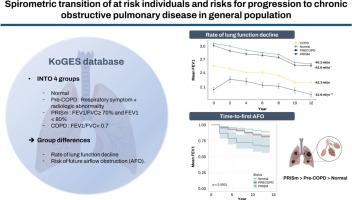
We used the Korean Genome Epidemiology Study (KoGES) database, defining pre-COPD based on respiratory symptoms and radiological abnormalities suggestive of COPD; the preserved ratio impaired spirometry (PRISm) was defined as a forced expiratory volume in 1 s (FEV1)/forced vital capacity ratio ≥ 70% and FEV1 < 80%, as predicted by spirometry. We determined group differences in the rate of lung function decline, risk of future airflow obstruction (AFO).
Results
The study included 4762 individuals, and longitudinal analysis revealed distinct trends in pulmonary function indicators. Compared to the normal group, the pre-COPD group showed a more rapid decline in lung function, while the PRISm group showed a slower decline. In the pre-COPD and PRISm groups, 4.4% and 3.5%, and 13.6% and 10.8%, respectively, of patients had progressed to COPD at the first and second visits. Pre-COPD and PRISm contributed to an earlier time to first AFO, but consideration of comorbid cardiovascular disease weakened this relationship in the PRISm group. Multivariate logistic regression showed that pre-COPD and PRISm are significant risk factors for future development of COPD (OR 1.80, p < 0.001; OR 4.26, p < 0.001, respectively).
Conclusion
Pre-COPD and PRISm patients showed different trends in lung function changes over time and both were significant risk factors for future development of COPD.
期刊介绍:
Archivos de Bronconeumologia is a scientific journal that specializes in publishing prospective original research articles focusing on various aspects of respiratory diseases, including epidemiology, pathophysiology, clinical practice, surgery, and basic investigation. Additionally, the journal features other types of articles such as reviews, editorials, special articles of interest to the society and editorial board, scientific letters, letters to the editor, and clinical images. Published monthly, the journal comprises 12 regular issues along with occasional supplements containing articles from different sections.
All manuscripts submitted to the journal undergo rigorous evaluation by the editors and are subjected to expert peer review. The editorial team, led by the Editor and/or an Associate Editor, manages the peer-review process. Archivos de Bronconeumologia is published monthly in English, facilitating broad dissemination of the latest research findings in the field.




 京公网安备 11010802042870号
京ICP备2023020795号-1
京公网安备 11010802042870号
京ICP备2023020795号-1

 分享
分享
 求助内容:
求助内容: 应助结果提醒方式:
 扫码关注我们
