Ke Zhang , Yajing Wei , Linhua Xie , Sha Kang , Fei Li , Chuanyi Wang
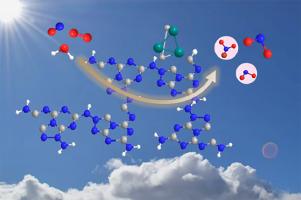
{"title":"Amorphous titanium carbide on N-defective g-C3N5 for high-efficiency photocatalytic NO removal","authors":"Ke Zhang , Yajing Wei , Linhua Xie , Sha Kang , Fei Li , Chuanyi Wang","doi":"10.1016/j.cclet.2024.110086","DOIUrl":null,"url":null,"abstract":"<div><div>Photocatalytic NO removal is regarded as an attractive strategy to reduce NO pollution in the air, but the lack of efficient and stable catalysts impedes its applications. Herein, we report on developing Ti<sub>3</sub>C<sub>2</sub> supported on N-defective g-C<sub>3</sub>N<sub>5</sub> nanosheets (CN<sub>X</sub>/TC) as an efficient photocatalyst toward NO removal. It is noteworthy that TC changed from crystal structure to amorphous structure during the photocatalytic process. Due to the existence of N vacancies and amorphous structure, the designed CN<sub>X</sub>/TC composites possess abundant unsaturated sites for adsorption and activation of O<sub>2</sub> and NO, thus facilitating the removal of NO and inhibiting the generation of NO<sub>2</sub>. The as-prepared CN<sub>X</sub>/TC-2 % shows the best activity for NO removal and inhibits toxic NO<sub>2</sub> generation. The removal rate of NO is up to 48 %, which is about 2 and 4 times higher than those of pure CN<sub>X</sub> and CN, respectively. In addition, the <em>in situ</em> diffused reflection Fourier transform infrared spectroscopy was used to investigate the NO transfer pathway during the photocatalytic process. This work might provide new insights into the catalytic role of N-defect and amorphous, inspiring the rational design of catalysts in the field of photocatalytic NO removal.</div></div>","PeriodicalId":10088,"journal":{"name":"Chinese Chemical Letters","volume":"36 3","pages":"Article 110086"},"PeriodicalIF":8.9000,"publicationDate":"2025-03-01","publicationTypes":"Journal Article","fieldsOfStudy":null,"isOpenAccess":false,"openAccessPdf":"","citationCount":"0","resultStr":null,"platform":"Semanticscholar","paperid":null,"PeriodicalName":"Chinese Chemical Letters","FirstCategoryId":"92","ListUrlMain":"https://www.sciencedirect.com/science/article/pii/S1001841724006053","RegionNum":1,"RegionCategory":"化学","ArticlePicture":[],"TitleCN":null,"AbstractTextCN":null,"PMCID":null,"EPubDate":"2024/6/4 0:00:00","PubModel":"Epub","JCR":"Q1","JCRName":"CHEMISTRY, MULTIDISCIPLINARY","Score":null,"Total":0}
引用次数: 0
Abstract
Photocatalytic NO removal is regarded as an attractive strategy to reduce NO pollution in the air, but the lack of efficient and stable catalysts impedes its applications. Herein, we report on developing Ti3C2 supported on N-defective g-C3N5 nanosheets (CNX/TC) as an efficient photocatalyst toward NO removal. It is noteworthy that TC changed from crystal structure to amorphous structure during the photocatalytic process. Due to the existence of N vacancies and amorphous structure, the designed CNX/TC composites possess abundant unsaturated sites for adsorption and activation of O2 and NO, thus facilitating the removal of NO and inhibiting the generation of NO2. The as-prepared CNX/TC-2 % shows the best activity for NO removal and inhibits toxic NO2 generation. The removal rate of NO is up to 48 %, which is about 2 and 4 times higher than those of pure CNX and CN, respectively. In addition, the in situ diffused reflection Fourier transform infrared spectroscopy was used to investigate the NO transfer pathway during the photocatalytic process. This work might provide new insights into the catalytic role of N-defect and amorphous, inspiring the rational design of catalysts in the field of photocatalytic NO removal.
期刊介绍:
Chinese Chemical Letters (CCL) (ISSN 1001-8417) was founded in July 1990. The journal publishes preliminary accounts in the whole field of chemistry, including inorganic chemistry, organic chemistry, analytical chemistry, physical chemistry, polymer chemistry, applied chemistry, etc.Chinese Chemical Letters does not accept articles previously published or scheduled to be published. To verify originality, your article may be checked by the originality detection service CrossCheck.



 京公网安备 11010802042870号
京ICP备2023020795号-1
京公网安备 11010802042870号
京ICP备2023020795号-1

 分享
分享
 求助内容:
求助内容: 应助结果提醒方式:
 扫码关注我们
