{"title":"Microglial activation-sensitive gadolinium complex as a potential MRI contrast agent for Alzheimer’s disease diagnosis","authors":"","doi":"10.1016/j.jiec.2024.06.014","DOIUrl":null,"url":null,"abstract":"<div><div><span>Numerous studies have developed gadolinium<span> (Gd)-based contrast agents (GBCAs) for </span></span><em>in-vivo</em> magnetic resonance imaging (MRI) with the aim of diagnosing Alzheimer’s disease (AD). Nevertheless, GBCAs that are capable of identifying microglial activation, a critical early indicator of AD pathology, for <em>in-vivo</em><span> diagnosis remain scarce. In response to this, we synthesized a novel GBCA, Gd-DO3A-Va, designed specifically to detect microglial activation using MRI. This innovative GBCA, which was conjugated with vanillic acid, demonstrated a high selectivity for microglial activation by targeting Toll-like receptor 4 (TLR4). The use of Gd-DO3A-Va in </span><em>in-vivo</em><span><span> imaging successfully highlighted microglial activation in a transgenic AD </span>mouse model. In particular, the use of Gd-DO3A-Va for contrast-enhanced </span><em>T</em><sub>1</sub><span>-weighted MRI enabled the detection of microglial activation within the hippocampus and cortex, regions notably affected by AD. The observed enhancements in the MR contrast correlated well with immunohistological evidence of microglial activation. Consequently, Gd-DO3A-Va represents a highly promising GBCA for the identification of microglial activation, providing a novel pathway for the molecular diagnosis of AD.</span></div></div>","PeriodicalId":363,"journal":{"name":"Journal of Industrial and Engineering Chemistry","volume":"140 ","pages":"Pages 556-566"},"PeriodicalIF":5.9000,"publicationDate":"2024-12-25","publicationTypes":"Journal Article","fieldsOfStudy":null,"isOpenAccess":false,"openAccessPdf":"","citationCount":"0","resultStr":null,"platform":"Semanticscholar","paperid":null,"PeriodicalName":"Journal of Industrial and Engineering Chemistry","FirstCategoryId":"5","ListUrlMain":"https://www.sciencedirect.com/science/article/pii/S1226086X24004027","RegionNum":3,"RegionCategory":"工程技术","ArticlePicture":[],"TitleCN":null,"AbstractTextCN":null,"PMCID":null,"EPubDate":"2024/6/11 0:00:00","PubModel":"Epub","JCR":"Q1","JCRName":"CHEMISTRY, MULTIDISCIPLINARY","Score":null,"Total":0}
引用次数: 0
Abstract
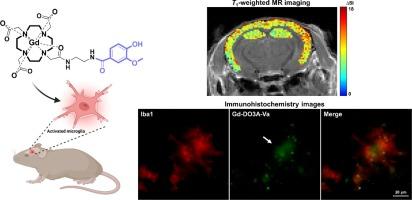
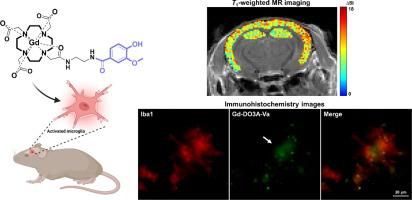
Numerous studies have developed gadolinium (Gd)-based contrast agents (GBCAs) for in-vivo magnetic resonance imaging (MRI) with the aim of diagnosing Alzheimer’s disease (AD). Nevertheless, GBCAs that are capable of identifying microglial activation, a critical early indicator of AD pathology, for in-vivo diagnosis remain scarce. In response to this, we synthesized a novel GBCA, Gd-DO3A-Va, designed specifically to detect microglial activation using MRI. This innovative GBCA, which was conjugated with vanillic acid, demonstrated a high selectivity for microglial activation by targeting Toll-like receptor 4 (TLR4). The use of Gd-DO3A-Va in in-vivo imaging successfully highlighted microglial activation in a transgenic AD mouse model. In particular, the use of Gd-DO3A-Va for contrast-enhanced T1-weighted MRI enabled the detection of microglial activation within the hippocampus and cortex, regions notably affected by AD. The observed enhancements in the MR contrast correlated well with immunohistological evidence of microglial activation. Consequently, Gd-DO3A-Va represents a highly promising GBCA for the identification of microglial activation, providing a novel pathway for the molecular diagnosis of AD.
期刊介绍:
Journal of Industrial and Engineering Chemistry is published monthly in English by the Korean Society of Industrial and Engineering Chemistry. JIEC brings together multidisciplinary interests in one journal and is to disseminate information on all aspects of research and development in industrial and engineering chemistry. Contributions in the form of research articles, short communications, notes and reviews are considered for publication. The editors welcome original contributions that have not been and are not to be published elsewhere. Instruction to authors and a manuscript submissions form are printed at the end of each issue. Bulk reprints of individual articles can be ordered. This publication is partially supported by Korea Research Foundation and the Korean Federation of Science and Technology Societies.




 京公网安备 11010802042870号
京ICP备2023020795号-1
京公网安备 11010802042870号
京ICP备2023020795号-1

 分享
分享
 求助内容:
求助内容: 应助结果提醒方式:
 扫码关注我们
