Xian-Mei Zhao , Li-Wei Tang , Yi Liu , Yu Ma , Tian Yang , Hao Rong , Lin-Jie Wei , Jun-Hua Luo , Zhi-Hua Sun
{"title":"Enhancing interlayer hydrogen bonds of 2D Ruddlesden-Popper perovskite toward stable polarization-sensitive photodetection","authors":"Xian-Mei Zhao , Li-Wei Tang , Yi Liu , Yu Ma , Tian Yang , Hao Rong , Lin-Jie Wei , Jun-Hua Luo , Zhi-Hua Sun","doi":"10.1016/j.cclet.2024.110092","DOIUrl":null,"url":null,"abstract":"<div><div>2D Ruddlesden-Popper (RP) polar perovskite, displaying the intrinsic optical anisotropy and structural polarity, has a fantastic application perspective in self-powered polarized light detection. However, the weak van der Waals interaction between the organic spacing bilayers is insufficient to preserve the stability of RP-type materials. Hence, it is of great significance to explore new stable 2D RP-phase candidates. In this work, we have successfully constructed a highly-stable polar 2D perovskite, (<em>t</em>-ACH)<sub>2</sub>PbI<sub>4</sub> (<strong>1</strong>, where <em>t</em>-ACH<sup>+</sup> is HOOC<sub>8</sub>H<sub>12</sub>NH<sub>3</sub><sup>+</sup>), by adopting a hydrophobic carboxylate <em>trans</em>-isomer of tranexamic acid as the spacing component. Strikingly, strong O-H···O hydrogen bonds between <em>t</em>-ACH<sup>+</sup>organic bilayers compose the dimer, thus decreasing van der Waals gap and enhancing structural stability. Besides, such orientational hydrogen bonds contribute to the formation of structural polarity and generate an obvious bulk photovoltaic effect in <strong>1</strong>, which facilitates its self-powered photodetection. As predicted, the combination of inherent anisotropy and polarity leads to self-powered polarized-light detection with a high ratio of around ∼5.3, superior to those of inorganic 2D counterparts. This work paves a potential way to design highly-stable 2D perovskites for high-performance optoelectronic devices.</div></div>","PeriodicalId":10088,"journal":{"name":"Chinese Chemical Letters","volume":"36 7","pages":"Article 110092"},"PeriodicalIF":8.9000,"publicationDate":"2025-07-01","publicationTypes":"Journal Article","fieldsOfStudy":null,"isOpenAccess":false,"openAccessPdf":"","citationCount":"0","resultStr":null,"platform":"Semanticscholar","paperid":null,"PeriodicalName":"Chinese Chemical Letters","FirstCategoryId":"92","ListUrlMain":"https://www.sciencedirect.com/science/article/pii/S1001841724006119","RegionNum":1,"RegionCategory":"化学","ArticlePicture":[],"TitleCN":null,"AbstractTextCN":null,"PMCID":null,"EPubDate":"2024/6/6 0:00:00","PubModel":"Epub","JCR":"Q1","JCRName":"CHEMISTRY, MULTIDISCIPLINARY","Score":null,"Total":0}
引用次数: 0
Abstract
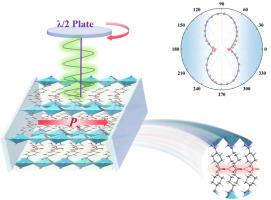
2D Ruddlesden-Popper (RP) polar perovskite, displaying the intrinsic optical anisotropy and structural polarity, has a fantastic application perspective in self-powered polarized light detection. However, the weak van der Waals interaction between the organic spacing bilayers is insufficient to preserve the stability of RP-type materials. Hence, it is of great significance to explore new stable 2D RP-phase candidates. In this work, we have successfully constructed a highly-stable polar 2D perovskite, (t-ACH)2PbI4 (1, where t-ACH+ is HOOC8H12NH3+), by adopting a hydrophobic carboxylate trans-isomer of tranexamic acid as the spacing component. Strikingly, strong O-H···O hydrogen bonds between t-ACH+organic bilayers compose the dimer, thus decreasing van der Waals gap and enhancing structural stability. Besides, such orientational hydrogen bonds contribute to the formation of structural polarity and generate an obvious bulk photovoltaic effect in 1, which facilitates its self-powered photodetection. As predicted, the combination of inherent anisotropy and polarity leads to self-powered polarized-light detection with a high ratio of around ∼5.3, superior to those of inorganic 2D counterparts. This work paves a potential way to design highly-stable 2D perovskites for high-performance optoelectronic devices.
期刊介绍:
Chinese Chemical Letters (CCL) (ISSN 1001-8417) was founded in July 1990. The journal publishes preliminary accounts in the whole field of chemistry, including inorganic chemistry, organic chemistry, analytical chemistry, physical chemistry, polymer chemistry, applied chemistry, etc.Chinese Chemical Letters does not accept articles previously published or scheduled to be published. To verify originality, your article may be checked by the originality detection service CrossCheck.





 京公网安备 11010802042870号
京ICP备2023020795号-1
京公网安备 11010802042870号
京ICP备2023020795号-1

 分享
分享
 求助内容:
求助内容: 应助结果提醒方式:
 扫码关注我们
