Tianle Li , Wei Fan , Xifeng Li , Huiping Wu , Dayong An , Qi Hu , Jun Chen
{"title":"High-cycle and low-cycle fatigue characteristics of multilayered dissimilar titanium alloys","authors":"Tianle Li , Wei Fan , Xifeng Li , Huiping Wu , Dayong An , Qi Hu , Jun Chen","doi":"10.1016/j.ijplas.2024.104033","DOIUrl":null,"url":null,"abstract":"<div><p>Multilayered structures of dissimilar titanium alloys can achieve excellent fracture ductility and strength, while their fatigue characteristics especially dislocation networks and twin formation are rarely reported. Heterogeneous microstructures are observed in the multilayered TC4/TB8 alloys, including fine acicular α grains, continuous α layer at prior β grain boundaries (α<sub>GB</sub>) and β matrix on the TB8 layer, together with equiaxed α grains on the TC4 layer. High-cycle fatigue (HCF) and low-cycle fatigue (LCF) tests show that the initial fatigue damage appears at the α<sub>GB</sub>/β matrix interfaces on the TB8 layer instead of the boned TC4/TB8 interfaces. Since the stress concentration induced by dislocation pile-up is prone to micro-void formation and crack propagation at the α<sub>GB</sub>/β interfaces. For LCF, the α<sub>GB</sub>/β interfaces can not only act as impenetrable barriers and sources of lattice dislocations, but also allow the dislocations cross boundaries during cyclic tension and compression because of the high boundary energy. The formation characteristic of deformation twins that is beneficial for the plastic deformation of α grains in TC4 layer during cyclic strain is investigated. Furthermore, the hexagonal dislocation networks are also found within the equiaxed α grains of TC4 layer after LCF, and the role between interface barrier and slip direction in the formation mechanism is analyzed.</p></div>","PeriodicalId":340,"journal":{"name":"International Journal of Plasticity","volume":"179 ","pages":"Article 104033"},"PeriodicalIF":12.8000,"publicationDate":"2024-08-01","publicationTypes":"Journal Article","fieldsOfStudy":null,"isOpenAccess":false,"openAccessPdf":"","citationCount":"0","resultStr":null,"platform":"Semanticscholar","paperid":null,"PeriodicalName":"International Journal of Plasticity","FirstCategoryId":"88","ListUrlMain":"https://www.sciencedirect.com/science/article/pii/S0749641924001608","RegionNum":1,"RegionCategory":"材料科学","ArticlePicture":[],"TitleCN":null,"AbstractTextCN":null,"PMCID":null,"EPubDate":"2024/6/13 0:00:00","PubModel":"Epub","JCR":"Q1","JCRName":"ENGINEERING, MECHANICAL","Score":null,"Total":0}
引用次数: 0
Abstract
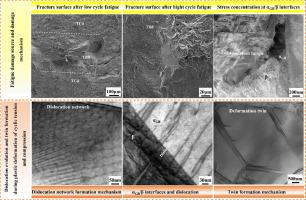
Multilayered structures of dissimilar titanium alloys can achieve excellent fracture ductility and strength, while their fatigue characteristics especially dislocation networks and twin formation are rarely reported. Heterogeneous microstructures are observed in the multilayered TC4/TB8 alloys, including fine acicular α grains, continuous α layer at prior β grain boundaries (αGB) and β matrix on the TB8 layer, together with equiaxed α grains on the TC4 layer. High-cycle fatigue (HCF) and low-cycle fatigue (LCF) tests show that the initial fatigue damage appears at the αGB/β matrix interfaces on the TB8 layer instead of the boned TC4/TB8 interfaces. Since the stress concentration induced by dislocation pile-up is prone to micro-void formation and crack propagation at the αGB/β interfaces. For LCF, the αGB/β interfaces can not only act as impenetrable barriers and sources of lattice dislocations, but also allow the dislocations cross boundaries during cyclic tension and compression because of the high boundary energy. The formation characteristic of deformation twins that is beneficial for the plastic deformation of α grains in TC4 layer during cyclic strain is investigated. Furthermore, the hexagonal dislocation networks are also found within the equiaxed α grains of TC4 layer after LCF, and the role between interface barrier and slip direction in the formation mechanism is analyzed.
期刊介绍:
International Journal of Plasticity aims to present original research encompassing all facets of plastic deformation, damage, and fracture behavior in both isotropic and anisotropic solids. This includes exploring the thermodynamics of plasticity and fracture, continuum theory, and macroscopic as well as microscopic phenomena.
Topics of interest span the plastic behavior of single crystals and polycrystalline metals, ceramics, rocks, soils, composites, nanocrystalline and microelectronics materials, shape memory alloys, ferroelectric ceramics, thin films, and polymers. Additionally, the journal covers plasticity aspects of failure and fracture mechanics. Contributions involving significant experimental, numerical, or theoretical advancements that enhance the understanding of the plastic behavior of solids are particularly valued. Papers addressing the modeling of finite nonlinear elastic deformation, bearing similarities to the modeling of plastic deformation, are also welcomed.