{"title":"Plasma-mediated F-doped activated carbon embedded with N and S atoms for the effective removal of CO2 gas","authors":"","doi":"10.1016/j.jiec.2024.06.015","DOIUrl":null,"url":null,"abstract":"<div><div>In this work, we suggest NF<sub>3</sub> plasma-treated vacuum residue oil(VR)-based activated carbon(AC) as a highly effective CO<sub>2</sub> adsorbent. The VR was pyrolyzed and activated under various conditions to determine the optimal activation conditions. The VR800AC, which have highest specific surface area of 1792.2 m<sup>2</sup>/g was selected as optimal sample and then, the VR800AC was treated with NF<sub>3</sub> plasma. Effects of NF<sub>3</sub> plasma treatment on the porosity and functionality of the VR-based AC were evaluated. Surface etching from plasma discharge induced micropores in the AC and enlarged the specific surface area. Moreover, fluorine functional groups were introduced after NF<sub>3</sub> plasma treatment. Synergistic effect of the N and S groups embedded in VR, F-groups derived from NF<sub>3</sub> plasma treatment, and micropores generated from plasma etching enhanced the CO<sub>2</sub> adsorption capacity of the NF<sub>3</sub> plasma-treated AC. After 60 s of NF<sub>3</sub> plasma treatment, the plasma-treated AC showed 14.5 % increased specific surface area, 13 % of surface fluorine groups, and revealed to have a CO<sub>2</sub> adsorption capacity of 4.55 mmol/g at 298 K and 1 bar, which is superior to that of the other heteroatom-doped ACs. Moreover, the NF<sub>3</sub> plasma-treated VR-based AC has excellent CO<sub>2</sub>/N<sub>2</sub> adsorption selectivity and high CO<sub>2</sub> adsorption cyclability.</div></div>","PeriodicalId":363,"journal":{"name":"Journal of Industrial and Engineering Chemistry","volume":"140 ","pages":"Pages 567-576"},"PeriodicalIF":5.9000,"publicationDate":"2024-12-25","publicationTypes":"Journal Article","fieldsOfStudy":null,"isOpenAccess":false,"openAccessPdf":"","citationCount":"0","resultStr":null,"platform":"Semanticscholar","paperid":null,"PeriodicalName":"Journal of Industrial and Engineering Chemistry","FirstCategoryId":"5","ListUrlMain":"https://www.sciencedirect.com/science/article/pii/S1226086X24004039","RegionNum":3,"RegionCategory":"工程技术","ArticlePicture":[],"TitleCN":null,"AbstractTextCN":null,"PMCID":null,"EPubDate":"2024/6/11 0:00:00","PubModel":"Epub","JCR":"Q1","JCRName":"CHEMISTRY, MULTIDISCIPLINARY","Score":null,"Total":0}
引用次数: 0
Abstract
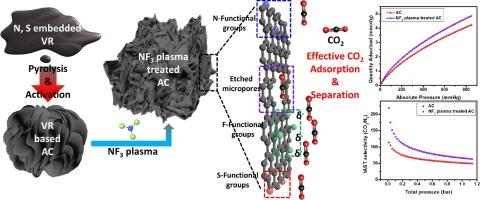
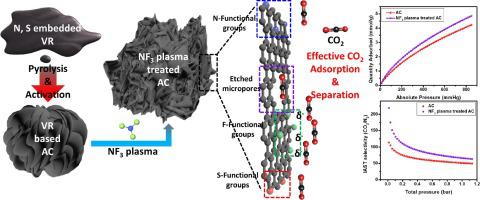
In this work, we suggest NF3 plasma-treated vacuum residue oil(VR)-based activated carbon(AC) as a highly effective CO2 adsorbent. The VR was pyrolyzed and activated under various conditions to determine the optimal activation conditions. The VR800AC, which have highest specific surface area of 1792.2 m2/g was selected as optimal sample and then, the VR800AC was treated with NF3 plasma. Effects of NF3 plasma treatment on the porosity and functionality of the VR-based AC were evaluated. Surface etching from plasma discharge induced micropores in the AC and enlarged the specific surface area. Moreover, fluorine functional groups were introduced after NF3 plasma treatment. Synergistic effect of the N and S groups embedded in VR, F-groups derived from NF3 plasma treatment, and micropores generated from plasma etching enhanced the CO2 adsorption capacity of the NF3 plasma-treated AC. After 60 s of NF3 plasma treatment, the plasma-treated AC showed 14.5 % increased specific surface area, 13 % of surface fluorine groups, and revealed to have a CO2 adsorption capacity of 4.55 mmol/g at 298 K and 1 bar, which is superior to that of the other heteroatom-doped ACs. Moreover, the NF3 plasma-treated VR-based AC has excellent CO2/N2 adsorption selectivity and high CO2 adsorption cyclability.
期刊介绍:
Journal of Industrial and Engineering Chemistry is published monthly in English by the Korean Society of Industrial and Engineering Chemistry. JIEC brings together multidisciplinary interests in one journal and is to disseminate information on all aspects of research and development in industrial and engineering chemistry. Contributions in the form of research articles, short communications, notes and reviews are considered for publication. The editors welcome original contributions that have not been and are not to be published elsewhere. Instruction to authors and a manuscript submissions form are printed at the end of each issue. Bulk reprints of individual articles can be ordered. This publication is partially supported by Korea Research Foundation and the Korean Federation of Science and Technology Societies.




 京公网安备 11010802042870号
京ICP备2023020795号-1
京公网安备 11010802042870号
京ICP备2023020795号-1

 分享
分享
 求助内容:
求助内容: 应助结果提醒方式:
 扫码关注我们
