{"title":"Catalytic decomposition of HFC-134a over metal oxide and phosphate catalysts to VDF: Reaction pathways of CH4 addition","authors":"","doi":"10.1016/j.jiec.2024.06.012","DOIUrl":null,"url":null,"abstract":"<div><div>HFC-134a refrigerants are commonly used in air-conditioners and refrigerators. HFC-134a has a GWP 1,430 times higher than that of CO<sub>2</sub> and contributes significantly to climate change. Therefore, research has been conducted to eliminate HFC-134a via catalytic decomposition. The catalytic decomposition of HFC-134a with the addition of CH<sub>4</sub> over metal oxide (CaO, MgO, and Al<sub>2</sub>O<sub>3</sub>) and phosphate catalysts (Ca<sub>2</sub>P<sub>2</sub>O<sub>7</sub>, Mg<sub>2</sub>P<sub>2</sub>O<sub>7</sub>, and AlPO<sub>4</sub>) is described herein. The prepared catalysts were characterized by NH<sub>3</sub>-TPD, TGA, and BET analysis. Metal phosphate catalysts exhibited higher HF resistance than metal oxide catalysts. XRD, XRF, and SEM-EDS confirmed the superior resistance of metal phosphates to corrosive hydrogen fluoride (HF). VDF (C<sub>2</sub>H<sub>2</sub>F<sub>2</sub>) is a valuable feed product that can be polymerized into polyvinylidene fluoride (PVDF). In addition, the VDF yield increased with CH<sub>4</sub> addition during the HFC-134a decomposition reaction. The CaP-calcium phosphate-catalysts exhibited an efficiency of more than 80 % and the highest VDF yield of 28.8 % after 10 h at 900 °C, 1 bar, and HFC-134a:CH<sub>4</sub>:N<sub>2</sub> = 1:2:17 and RT = 1.0. The introduced CH<sub>4</sub> feed acts as a CH<sub>3</sub> donor during the decomposition of HFC-134a. Consequently, a comprehensive mechanism of VDF synthesis was proposed by comparing the presence of CH<sub>4</sub> feed.</div></div>","PeriodicalId":363,"journal":{"name":"Journal of Industrial and Engineering Chemistry","volume":"140 ","pages":"Pages 530-544"},"PeriodicalIF":5.9000,"publicationDate":"2024-12-25","publicationTypes":"Journal Article","fieldsOfStudy":null,"isOpenAccess":false,"openAccessPdf":"","citationCount":"0","resultStr":null,"platform":"Semanticscholar","paperid":null,"PeriodicalName":"Journal of Industrial and Engineering Chemistry","FirstCategoryId":"5","ListUrlMain":"https://www.sciencedirect.com/science/article/pii/S1226086X24003964","RegionNum":3,"RegionCategory":"工程技术","ArticlePicture":[],"TitleCN":null,"AbstractTextCN":null,"PMCID":null,"EPubDate":"2024/6/8 0:00:00","PubModel":"Epub","JCR":"Q1","JCRName":"CHEMISTRY, MULTIDISCIPLINARY","Score":null,"Total":0}
引用次数: 0
Abstract
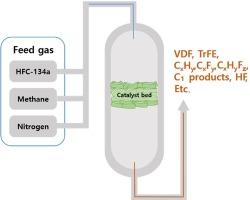
HFC-134a refrigerants are commonly used in air-conditioners and refrigerators. HFC-134a has a GWP 1,430 times higher than that of CO2 and contributes significantly to climate change. Therefore, research has been conducted to eliminate HFC-134a via catalytic decomposition. The catalytic decomposition of HFC-134a with the addition of CH4 over metal oxide (CaO, MgO, and Al2O3) and phosphate catalysts (Ca2P2O7, Mg2P2O7, and AlPO4) is described herein. The prepared catalysts were characterized by NH3-TPD, TGA, and BET analysis. Metal phosphate catalysts exhibited higher HF resistance than metal oxide catalysts. XRD, XRF, and SEM-EDS confirmed the superior resistance of metal phosphates to corrosive hydrogen fluoride (HF). VDF (C2H2F2) is a valuable feed product that can be polymerized into polyvinylidene fluoride (PVDF). In addition, the VDF yield increased with CH4 addition during the HFC-134a decomposition reaction. The CaP-calcium phosphate-catalysts exhibited an efficiency of more than 80 % and the highest VDF yield of 28.8 % after 10 h at 900 °C, 1 bar, and HFC-134a:CH4:N2 = 1:2:17 and RT = 1.0. The introduced CH4 feed acts as a CH3 donor during the decomposition of HFC-134a. Consequently, a comprehensive mechanism of VDF synthesis was proposed by comparing the presence of CH4 feed.
期刊介绍:
Journal of Industrial and Engineering Chemistry is published monthly in English by the Korean Society of Industrial and Engineering Chemistry. JIEC brings together multidisciplinary interests in one journal and is to disseminate information on all aspects of research and development in industrial and engineering chemistry. Contributions in the form of research articles, short communications, notes and reviews are considered for publication. The editors welcome original contributions that have not been and are not to be published elsewhere. Instruction to authors and a manuscript submissions form are printed at the end of each issue. Bulk reprints of individual articles can be ordered. This publication is partially supported by Korea Research Foundation and the Korean Federation of Science and Technology Societies.



 京公网安备 11010802042870号
京ICP备2023020795号-1
京公网安备 11010802042870号
京ICP备2023020795号-1

 分享
分享
 求助内容:
求助内容: 应助结果提醒方式:
 扫码关注我们
