Youngjae Yu , Erika E. Rios-Valenciana , Robert A. Root , Reyes Sierra-Alvarez , Jon Chorover , Jim A. Field
{"title":"Continuous-flow columns packed with zero-valent iron and iron sulfide as a feasible strategy to remediate the persistent contaminant nitroguanidine","authors":"Youngjae Yu , Erika E. Rios-Valenciana , Robert A. Root , Reyes Sierra-Alvarez , Jon Chorover , Jim A. Field","doi":"10.1016/j.dt.2024.06.001","DOIUrl":null,"url":null,"abstract":"<div><div>The insensitive munitions compound nitroguanidine (NQ) is used by the U.S. Army to avoid unintended explosions. However, NQ also represents an emerging contaminant whose environmental emissions can cause toxicity toward aquatic organisms, indicating the need for effective remediation strategies. Thus, we investigated the feasibility of treating water contaminated with NQ in continuous-flow columns packed with zero-valent iron (ZVI) or iron sulfide (FeS). Initially, the impact of pH on NQ transformation by ZVI or FeS was evaluated in batch experiments. The pseudo first-order rate constant for NQ transformation (<em>k</em><sub>1, NQ</sub>) by ZVI was 8–10 times higher at pH 3.0 compared to pH 5.5 and 7.0, whereas similar <em>k</em><sub>1, NQ</sub> values were obtained for FeS at pH 5.5–10.0. Based on these findings, the influent pH fed to the ZVI- and FeS-packed columns was adjusted to 3.0 and 5.5, respectively. Both reactors transformed NQ into nitrosoguanidine (NsoQ). Further transformation of NsoQ by ZVI produced aminoguanidine, guanidine, and cyanamide, whereas NsoQ transformation by FeS produced guanidine, ammonium, and traces of urea. ZVI outperformed FeS as a reactive material to remove NQ. The ZVI-packed column effectively removed NQ below detection even after 45 d of operation (490 pore volumes, PV). In contrast, NQ breakthrough (removal efficiency <85%) was observed after 18 d (180 PV) in the FeS-packed column. The high NQ removal efficiency and long service life of the ZVI-packed column (>490 PV) suggest that the technology is a promising approach for NQ treatment in packed-bed reactors and <em>in situ</em> remediation.</div></div>","PeriodicalId":58209,"journal":{"name":"Defence Technology(防务技术)","volume":"43 ","pages":"Pages 26-34"},"PeriodicalIF":5.9000,"publicationDate":"2025-01-01","publicationTypes":"Journal Article","fieldsOfStudy":null,"isOpenAccess":false,"openAccessPdf":"","citationCount":"0","resultStr":null,"platform":"Semanticscholar","paperid":null,"PeriodicalName":"Defence Technology(防务技术)","FirstCategoryId":"1087","ListUrlMain":"https://www.sciencedirect.com/science/article/pii/S221491472400134X","RegionNum":0,"RegionCategory":null,"ArticlePicture":[],"TitleCN":null,"AbstractTextCN":null,"PMCID":null,"EPubDate":"2024/6/8 0:00:00","PubModel":"Epub","JCR":"Q1","JCRName":"ENGINEERING, MULTIDISCIPLINARY","Score":null,"Total":0}
引用次数: 0
Abstract
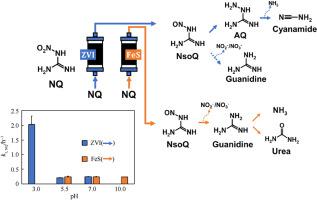
The insensitive munitions compound nitroguanidine (NQ) is used by the U.S. Army to avoid unintended explosions. However, NQ also represents an emerging contaminant whose environmental emissions can cause toxicity toward aquatic organisms, indicating the need for effective remediation strategies. Thus, we investigated the feasibility of treating water contaminated with NQ in continuous-flow columns packed with zero-valent iron (ZVI) or iron sulfide (FeS). Initially, the impact of pH on NQ transformation by ZVI or FeS was evaluated in batch experiments. The pseudo first-order rate constant for NQ transformation (k1, NQ) by ZVI was 8–10 times higher at pH 3.0 compared to pH 5.5 and 7.0, whereas similar k1, NQ values were obtained for FeS at pH 5.5–10.0. Based on these findings, the influent pH fed to the ZVI- and FeS-packed columns was adjusted to 3.0 and 5.5, respectively. Both reactors transformed NQ into nitrosoguanidine (NsoQ). Further transformation of NsoQ by ZVI produced aminoguanidine, guanidine, and cyanamide, whereas NsoQ transformation by FeS produced guanidine, ammonium, and traces of urea. ZVI outperformed FeS as a reactive material to remove NQ. The ZVI-packed column effectively removed NQ below detection even after 45 d of operation (490 pore volumes, PV). In contrast, NQ breakthrough (removal efficiency <85%) was observed after 18 d (180 PV) in the FeS-packed column. The high NQ removal efficiency and long service life of the ZVI-packed column (>490 PV) suggest that the technology is a promising approach for NQ treatment in packed-bed reactors and in situ remediation.
Defence Technology(防务技术)Mechanical Engineering, Control and Systems Engineering, Industrial and Manufacturing Engineering
CiteScore
8.70
自引率
0.00%
发文量
728
审稿时长
25 days
期刊介绍:
Defence Technology, a peer reviewed journal, is published monthly and aims to become the best international academic exchange platform for the research related to defence technology. It publishes original research papers having direct bearing on defence, with a balanced coverage on analytical, experimental, numerical simulation and applied investigations. It covers various disciplines of science, technology and engineering.




 京公网安备 11010802042870号
京ICP备2023020795号-1
京公网安备 11010802042870号
京ICP备2023020795号-1

 分享
分享
 求助内容:
求助内容: 应助结果提醒方式:
 扫码关注我们
