Optimized the SiO2 thickness in Ag@SiO2 core–shell nanoparticles for surface-enhanced Raman scattering and fluorescence

IF 2.6 4区 材料科学 Q3 CHEMISTRY, MULTIDISCIPLINARY Journal of Nanoparticle Research Pub Date : 2024-06-07 DOI:10.1007/s11051-024-06039-7
Jun Ma, Weizhou Yan, Bin Liu, Jianhui Yang
{"title":"Optimized the SiO2 thickness in Ag@SiO2 core–shell nanoparticles for surface-enhanced Raman scattering and fluorescence","authors":"Jun Ma,&nbsp;Weizhou Yan,&nbsp;Bin Liu,&nbsp;Jianhui Yang","doi":"10.1007/s11051-024-06039-7","DOIUrl":null,"url":null,"abstract":"<div><p>Ag@SiO<sub>2</sub> core–shell nanoparticles (NPs) have attracted extensive attention for their excellent surface-enhanced Raman scattering (SERS)-fluorescence (SEF) and their potential applications in sensing, biomedicine, and imaging. The thickness of silica shell plays a crucial role in determining the SERS-SEF properties. However, a few studies have been made to synthesize Ag@SiO<sub>2</sub> core–shell NPs with controllable thickness of silica shell and systematic research about the optimized SERS-SEF enhancement. Here, Ag@SiO<sub>2</sub> core–shell NPs were prepared by a modified one-pot synthetic method via reducing AgNO<sub>3</sub> using formaldehyde in the presence of cetyltrimethylammonium chloride and sequentially hydrolyzing tetraethyl orthosilicate (TEOS). The effects of the type of surfactant and the concentrations of NaOH and AgNO<sub>3</sub> on the size and morphology of the resulting Ag@SiO<sub>2</sub> core–shell NPs were systematically investigated. The thickness of the silica shell could be finely tuned from 9.3 to 38.9 nm by easily adjusting the amount of TEOS. The crystal violet molecule was used for examining SERS and SEF properties of Ag@SiO<sub>2</sub> core–shell NPs with different SiO<sub>2</sub> thicknesses. The current work will provide guidance for further understanding the growth mechanism of Ag@SiO<sub>2</sub> core–shell NPs and how the thickness of silica shell affects the SERS-SEF properties.</p><h3>Graphical Abstract</h3>\n<div><figure><div><div><picture><source><img></source></picture></div></div></figure></div></div>","PeriodicalId":653,"journal":{"name":"Journal of Nanoparticle Research","volume":"26 6","pages":""},"PeriodicalIF":2.6000,"publicationDate":"2024-06-07","publicationTypes":"Journal Article","fieldsOfStudy":null,"isOpenAccess":false,"openAccessPdf":"","citationCount":"0","resultStr":null,"platform":"Semanticscholar","paperid":null,"PeriodicalName":"Journal of Nanoparticle Research","FirstCategoryId":"88","ListUrlMain":"https://link.springer.com/article/10.1007/s11051-024-06039-7","RegionNum":4,"RegionCategory":"材料科学","ArticlePicture":[],"TitleCN":null,"AbstractTextCN":null,"PMCID":null,"EPubDate":"","PubModel":"","JCR":"Q3","JCRName":"CHEMISTRY, MULTIDISCIPLINARY","Score":null,"Total":0}
引用次数: 0

Abstract

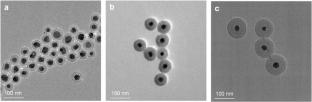
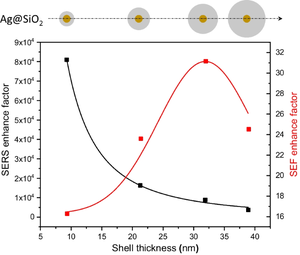
Ag@SiO2 core–shell nanoparticles (NPs) have attracted extensive attention for their excellent surface-enhanced Raman scattering (SERS)-fluorescence (SEF) and their potential applications in sensing, biomedicine, and imaging. The thickness of silica shell plays a crucial role in determining the SERS-SEF properties. However, a few studies have been made to synthesize Ag@SiO2 core–shell NPs with controllable thickness of silica shell and systematic research about the optimized SERS-SEF enhancement. Here, Ag@SiO2 core–shell NPs were prepared by a modified one-pot synthetic method via reducing AgNO3 using formaldehyde in the presence of cetyltrimethylammonium chloride and sequentially hydrolyzing tetraethyl orthosilicate (TEOS). The effects of the type of surfactant and the concentrations of NaOH and AgNO3 on the size and morphology of the resulting Ag@SiO2 core–shell NPs were systematically investigated. The thickness of the silica shell could be finely tuned from 9.3 to 38.9 nm by easily adjusting the amount of TEOS. The crystal violet molecule was used for examining SERS and SEF properties of Ag@SiO2 core–shell NPs with different SiO2 thicknesses. The current work will provide guidance for further understanding the growth mechanism of Ag@SiO2 core–shell NPs and how the thickness of silica shell affects the SERS-SEF properties.
Graphical Abstract

Abstract Image

Abstract Image

查看原文
分享 分享
微信好友 朋友圈 QQ好友 复制链接
本刊更多论文
优化 Ag@SiO2 核壳纳米粒子中的 SiO2 厚度,实现表面增强拉曼散射和荧光效果
Ag@SiO2核壳纳米粒子(NPs)因其优异的表面增强拉曼散射(SERS)-荧光(SEF)特性及其在传感、生物医学和成像领域的潜在应用而受到广泛关注。二氧化硅外壳的厚度在决定 SERS-SEF 性能方面起着至关重要的作用。然而,合成二氧化硅核壳厚度可控的 Ag@SiO2 核壳 NPs 并系统地研究优化的 SERS-SEF 增强效果的研究为数不多。本文采用改进的一锅合成法,在十六烷基三甲基氯化铵存在下用甲醛还原 AgNO3,并依次水解原硅酸四乙酯(TEOS),制备了 Ag@SiO2 核壳 NPs。系统研究了表面活性剂的类型、NaOH 和 AgNO3 的浓度对 Ag@SiO2 核壳 NPs 尺寸和形貌的影响。通过轻松调节 TEOS 的用量,二氧化硅壳的厚度可在 9.3 至 38.9 nm 之间微调。利用水晶紫分子检测了不同 SiO2 厚度的 Ag@SiO2 核壳 NPs 的 SERS 和 SEF 特性。目前的工作将为进一步理解Ag@SiO2核壳NPs的生长机制以及二氧化硅壳厚度如何影响SERS-SEF特性提供指导。
本文章由计算机程序翻译,如有差异,请以英文原文为准。
求助全文
约1分钟内获得全文 去求助
来源期刊
Journal of Nanoparticle Research
Journal of Nanoparticle Research 工程技术-材料科学:综合
CiteScore
4.40
自引率
4.00%
发文量
198
审稿时长
3.9 months
期刊介绍: The objective of the Journal of Nanoparticle Research is to disseminate knowledge of the physical, chemical and biological phenomena and processes in structures that have at least one lengthscale ranging from molecular to approximately 100 nm (or submicron in some situations), and exhibit improved and novel properties that are a direct result of their small size. Nanoparticle research is a key component of nanoscience, nanoengineering and nanotechnology. The focus of the Journal is on the specific concepts, properties, phenomena, and processes related to particles, tubes, layers, macromolecules, clusters and other finite structures of the nanoscale size range. Synthesis, assembly, transport, reactivity, and stability of such structures are considered. Development of in-situ and ex-situ instrumentation for characterization of nanoparticles and their interfaces should be based on new principles for probing properties and phenomena not well understood at the nanometer scale. Modeling and simulation may include atom-based quantum mechanics; molecular dynamics; single-particle, multi-body and continuum based models; fractals; other methods suitable for modeling particle synthesis, assembling and interaction processes. Realization and application of systems, structures and devices with novel functions obtained via precursor nanoparticles is emphasized. Approaches may include gas-, liquid-, solid-, and vacuum-based processes, size reduction, chemical- and bio-self assembly. Contributions include utilization of nanoparticle systems for enhancing a phenomenon or process and particle assembling into hierarchical structures, as well as formulation and the administration of drugs. Synergistic approaches originating from different disciplines and technologies, and interaction between the research providers and users in this field, are encouraged.
期刊最新文献
Construction of ternary BiOBr/NH2-MIL-101(Fe)/g-C3N4 nanocomposite as an efficient photocatalyst for degradation of tetracycline Co3O4/TiO2 p–n junction-decorated CNT for enhanced photocatalytic degradation of tetracycline Development of ruthenium(0) nanoparticles supported on natural clinoptilolite zeolite for hydrogen production from methanolysis of ammonia borane An imine bond-based fluorescent covalent organic framework for efficient detection of mercury (II) ions in Camellia oleifera A sustainable nanotechnology approach for finerenone detection using green-synthesized silver nanoparticles
×
引用
GB/T 7714-2015
复制
MLA
复制
APA
复制
导出至
BibTeX EndNote RefMan NoteFirst NoteExpress
×
×
提示
您的信息不完整,为了账户安全,请先补充。
现在去补充
×
提示
您因"违规操作"
具体请查看互助需知
我知道了
×
提示
现在去查看 取消
×
提示
确定
0
微信
客服QQ
Book学术公众号 扫码关注我们
反馈
×
意见反馈
请填写您的意见或建议
请填写您的手机或邮箱
已复制链接
已复制链接
快去分享给好友吧!
我知道了
×
扫码分享
扫码分享
Book学术官方微信
Book学术文献互助
Book学术文献互助群
群 号:604180095
Book学术
文献互助 智能选刊 最新文献 互助须知 联系我们:info@booksci.cn
Book学术提供免费学术资源搜索服务,方便国内外学者检索中英文文献。致力于提供最便捷和优质的服务体验。
Copyright © 2023 Book学术 All rights reserved.
ghs 京公网安备 11010802042870号 京ICP备2023020795号-1