Ji’en Zhang, Hongrui Fan, W. Xiao, Xingwang Xu, John Wakabayashi, Lili Zhang, Yonggang Zhao, Qiwei Wang, Yulong Zhao, Kaiyi Wang
{"title":"Configuration of Carbonatite Constrained in Preintrusion Transpositional Foliation in the Bayan Obo Giant Rare Earth Element Deposit, China","authors":"Ji’en Zhang, Hongrui Fan, W. Xiao, Xingwang Xu, John Wakabayashi, Lili Zhang, Yonggang Zhao, Qiwei Wang, Yulong Zhao, Kaiyi Wang","doi":"10.5382/econgeo.5076","DOIUrl":null,"url":null,"abstract":"\n The Bayan Obo ore deposit is the largest rare earth element (REE) deposit in the world and has been assumed to be hosted in dolomite that was folded in a syncline. This has been challenged by results from drill holes and low-resistivity, controlled-source audio-frequency magnetotellurics (CSAMT) survey. In this paper, we present structural analysis of clastic sedimentary rocks from around the deposit, their relationship with carbonatite, and the orientations of the carbonatite bodies and dikes to constrain the possible configuration of carbonatite. Clastic sedimentary rocks underwent mylonitic deformation to slate, metasandstone, and metaconglomerate, displaying dramatic changes of thickness along strike. Slates locally preserve intrafolial folds and hook folds bounded by foliations; metasandstones have parallel layers of recrystallized and preferred-orientated quartz aggregations; metaconglomerates contain flattened pebbles with Flinn k values of 0.01 to 0.05 and 0. The above structures and foliations were crosscut and intruded by carbonatite and associated fenite, demonstrating preintrusion transposition of original bedding to steep foliation. Preintrusion foliation provides zones of weakness that were exploited by upwelling of carbonatite magma. Northeast-SW–striking left-stepping en echelon carbonatite dikes and E-W–striking carbonatite bodies indicate that the carbonatite was emplaced in a sinistral transtensional zone. The northern and southern segments of the carbonatite bodies are parallel to the steep foliation at shallow depths and merge together at depth, constraining a Y-shaped configuration, consistent with the low resistivity result of the CSAMT survey. The newly recognized Y-shaped morphology indicates that the carbonatite extends deeper than 1,775.4 m, more than twice the previously inferred maximum depth of the syncline model, and contributes to a significant >1.78 times increase in global potential RE2O3 resources than previously estimated in 2021.","PeriodicalId":5,"journal":{"name":"ACS Applied Materials & Interfaces","volume":"600 1","pages":""},"PeriodicalIF":8.2000,"publicationDate":"2024-06-01","publicationTypes":"Journal Article","fieldsOfStudy":null,"isOpenAccess":false,"openAccessPdf":"","citationCount":"0","resultStr":null,"platform":"Semanticscholar","paperid":null,"PeriodicalName":"ACS Applied Materials & Interfaces","FirstCategoryId":"89","ListUrlMain":"https://doi.org/10.5382/econgeo.5076","RegionNum":2,"RegionCategory":"材料科学","ArticlePicture":[],"TitleCN":null,"AbstractTextCN":null,"PMCID":null,"EPubDate":"","PubModel":"","JCR":"Q1","JCRName":"MATERIALS SCIENCE, MULTIDISCIPLINARY","Score":null,"Total":0}
引用次数: 0
Abstract
The Bayan Obo ore deposit is the largest rare earth element (REE) deposit in the world and has been assumed to be hosted in dolomite that was folded in a syncline. This has been challenged by results from drill holes and low-resistivity, controlled-source audio-frequency magnetotellurics (CSAMT) survey. In this paper, we present structural analysis of clastic sedimentary rocks from around the deposit, their relationship with carbonatite, and the orientations of the carbonatite bodies and dikes to constrain the possible configuration of carbonatite. Clastic sedimentary rocks underwent mylonitic deformation to slate, metasandstone, and metaconglomerate, displaying dramatic changes of thickness along strike. Slates locally preserve intrafolial folds and hook folds bounded by foliations; metasandstones have parallel layers of recrystallized and preferred-orientated quartz aggregations; metaconglomerates contain flattened pebbles with Flinn k values of 0.01 to 0.05 and 0. The above structures and foliations were crosscut and intruded by carbonatite and associated fenite, demonstrating preintrusion transposition of original bedding to steep foliation. Preintrusion foliation provides zones of weakness that were exploited by upwelling of carbonatite magma. Northeast-SW–striking left-stepping en echelon carbonatite dikes and E-W–striking carbonatite bodies indicate that the carbonatite was emplaced in a sinistral transtensional zone. The northern and southern segments of the carbonatite bodies are parallel to the steep foliation at shallow depths and merge together at depth, constraining a Y-shaped configuration, consistent with the low resistivity result of the CSAMT survey. The newly recognized Y-shaped morphology indicates that the carbonatite extends deeper than 1,775.4 m, more than twice the previously inferred maximum depth of the syncline model, and contributes to a significant >1.78 times increase in global potential RE2O3 resources than previously estimated in 2021.
期刊介绍:
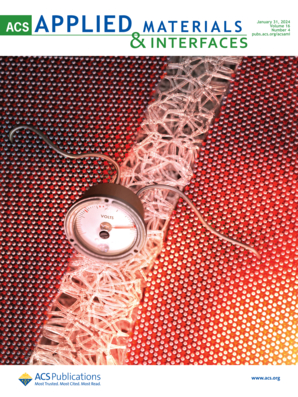
ACS Applied Materials & Interfaces is a leading interdisciplinary journal that brings together chemists, engineers, physicists, and biologists to explore the development and utilization of newly-discovered materials and interfacial processes for specific applications. Our journal has experienced remarkable growth since its establishment in 2009, both in terms of the number of articles published and the impact of the research showcased. We are proud to foster a truly global community, with the majority of published articles originating from outside the United States, reflecting the rapid growth of applied research worldwide.



 京公网安备 11010802042870号
京ICP备2023020795号-1
京公网安备 11010802042870号
京ICP备2023020795号-1

 分享
分享
 求助内容:
求助内容: 应助结果提醒方式:
 扫码关注我们
