Gen Zhang , Ying Gu , Lin Li , Fuli Ma , Dan Yue , Xiaoguang Zhou , Chungui Tian
{"title":"Anion-modulated HER and OER activity of 1D Co-Mo based interstitial compound heterojunctions for the effective overall water splitting","authors":"Gen Zhang , Ying Gu , Lin Li , Fuli Ma , Dan Yue , Xiaoguang Zhou , Chungui Tian","doi":"10.1016/j.cclet.2024.110110","DOIUrl":null,"url":null,"abstract":"<div><div>The development of highly active and easily coupled non-noble metal electrocatalysts for oxygen evolution reaction (OER) and hydrogen evolution reaction (HER) is of great significance for the H<sub>2</sub> production by water electrolysis. Here, we have shown an anion-modulated HER and OER activity of 1D Co-Mo based interstitial compound heterojunctions for effective overall water splitting. The Co-Mo based complex nanowires from a one-pot route with high yields can be converted into MoC<img>Co heterojunction nanowires under N<sub>2</sub> atmosphere, while a pyrolysis under NH<sub>3</sub> can give CoMoN<img>CoN heterostructures. The work function revealed Mott-Schottky effect between interfaces of two heterostructures, which can introduce electron redistribution and thus promote the HER/OER process. The MoC<img>Co heterojunction nanowires delivers good HER activity at a low overpotential of 39 mV to afford a current density of 10 mA/cm<sup>2</sup>. Density functional theory calculations show that the heterogeneous interface formed between the Co and MoC optimizes the hydrogen adsorption free energy. Concurrently, CoMoN<img>CoN heterojunction nanowires exhibits good OER performance with a low overpotential of 260 mV to reach 10 mA/cm<sup>2</sup>, being superior to RuO<sub>2</sub>. The two catalysts can be coupled to assemble a two-electrode cell with a solar-to-hydrogen efficiency of 12.3 % at 1.54 V. This work provides an effective means to design easily coupled HER and OER catalysts for H<sub>2</sub> production by water electrolysis.</div></div>","PeriodicalId":10088,"journal":{"name":"Chinese Chemical Letters","volume":"36 7","pages":"Article 110110"},"PeriodicalIF":8.9000,"publicationDate":"2025-07-01","publicationTypes":"Journal Article","fieldsOfStudy":null,"isOpenAccess":false,"openAccessPdf":"","citationCount":"0","resultStr":null,"platform":"Semanticscholar","paperid":null,"PeriodicalName":"Chinese Chemical Letters","FirstCategoryId":"92","ListUrlMain":"https://www.sciencedirect.com/science/article/pii/S1001841724006296","RegionNum":1,"RegionCategory":"化学","ArticlePicture":[],"TitleCN":null,"AbstractTextCN":null,"PMCID":null,"EPubDate":"2024/6/12 0:00:00","PubModel":"Epub","JCR":"Q1","JCRName":"CHEMISTRY, MULTIDISCIPLINARY","Score":null,"Total":0}
引用次数: 0
Abstract
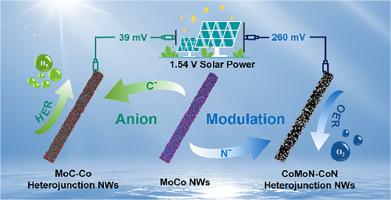
The development of highly active and easily coupled non-noble metal electrocatalysts for oxygen evolution reaction (OER) and hydrogen evolution reaction (HER) is of great significance for the H2 production by water electrolysis. Here, we have shown an anion-modulated HER and OER activity of 1D Co-Mo based interstitial compound heterojunctions for effective overall water splitting. The Co-Mo based complex nanowires from a one-pot route with high yields can be converted into MoCCo heterojunction nanowires under N2 atmosphere, while a pyrolysis under NH3 can give CoMoNCoN heterostructures. The work function revealed Mott-Schottky effect between interfaces of two heterostructures, which can introduce electron redistribution and thus promote the HER/OER process. The MoCCo heterojunction nanowires delivers good HER activity at a low overpotential of 39 mV to afford a current density of 10 mA/cm2. Density functional theory calculations show that the heterogeneous interface formed between the Co and MoC optimizes the hydrogen adsorption free energy. Concurrently, CoMoNCoN heterojunction nanowires exhibits good OER performance with a low overpotential of 260 mV to reach 10 mA/cm2, being superior to RuO2. The two catalysts can be coupled to assemble a two-electrode cell with a solar-to-hydrogen efficiency of 12.3 % at 1.54 V. This work provides an effective means to design easily coupled HER and OER catalysts for H2 production by water electrolysis.
期刊介绍:
Chinese Chemical Letters (CCL) (ISSN 1001-8417) was founded in July 1990. The journal publishes preliminary accounts in the whole field of chemistry, including inorganic chemistry, organic chemistry, analytical chemistry, physical chemistry, polymer chemistry, applied chemistry, etc.Chinese Chemical Letters does not accept articles previously published or scheduled to be published. To verify originality, your article may be checked by the originality detection service CrossCheck.




 京公网安备 11010802042870号
京ICP备2023020795号-1
京公网安备 11010802042870号
京ICP备2023020795号-1

 分享
分享
 求助内容:
求助内容: 应助结果提醒方式:
 扫码关注我们
