Prussian blue/reduced graphene oxide composites cathode material via one-pot precipitation synthesis for enhancing capacity sodium metal pouch cell batteries
{"title":"Prussian blue/reduced graphene oxide composites cathode material via one-pot precipitation synthesis for enhancing capacity sodium metal pouch cell batteries","authors":"","doi":"10.1016/j.jiec.2024.05.066","DOIUrl":null,"url":null,"abstract":"<div><div><span>The popularity of sodium<span> metal-ion batteries (SMBs) is increasingly displacing lithium-ion batteries (LIBs). Iron-based Prussian blue (Fe</span></span><sub>4</sub>[Fe(CN)<sub>6</sub>]<sub>3</sub><span>) analogs promise low-cost and easily prepared cathode materials for sodium<span> metal-ion batteries. However, the effectiveness of these materials has consistently been attributed to their inadequate electrical conductivity. In this study, we employed a one-pot synthesis technique to prepare composites of Prussian blue (PB) and reduced graphene oxide<span> (PB/rGO) with varying rGO concentrations. Ascorbic acid was utilized as a reducing agent to convert graphene oxide (GO) into reduced graphene oxide (rGO). Following optimization, the SMB coin cell with PB/rGO(5 %) electrode exhibited an initial specific discharge capacity of 91 mAh/g at a current density of 0.3C. This electrode had exceptional rate performance and remarkable capacity retention, with 75.3 % remaining after 2000 cycles. Furthermore, the pouch cell SMB using PB/rGO(5 %) showed a high capacity of 87 mAh/g at 0.05C with an energy density of 34 Wh kg</span></span></span><sup>−1</sup> and good cycle ability over 500 cycles. Notably, the performance of the SMBs surpasses that of the PB cathode, making it highly advantageous for efficient sodium ion storage in SMBs.</div></div>","PeriodicalId":363,"journal":{"name":"Journal of Industrial and Engineering Chemistry","volume":"140 ","pages":"Pages 422-433"},"PeriodicalIF":5.9000,"publicationDate":"2024-12-25","publicationTypes":"Journal Article","fieldsOfStudy":null,"isOpenAccess":false,"openAccessPdf":"","citationCount":"0","resultStr":null,"platform":"Semanticscholar","paperid":null,"PeriodicalName":"Journal of Industrial and Engineering Chemistry","FirstCategoryId":"5","ListUrlMain":"https://www.sciencedirect.com/science/article/pii/S1226086X24003721","RegionNum":3,"RegionCategory":"工程技术","ArticlePicture":[],"TitleCN":null,"AbstractTextCN":null,"PMCID":null,"EPubDate":"2024/6/7 0:00:00","PubModel":"Epub","JCR":"Q1","JCRName":"CHEMISTRY, MULTIDISCIPLINARY","Score":null,"Total":0}
引用次数: 0
Abstract
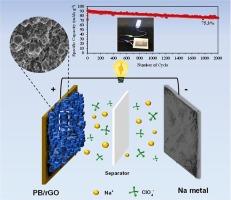
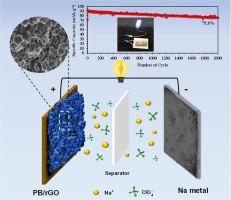
The popularity of sodium metal-ion batteries (SMBs) is increasingly displacing lithium-ion batteries (LIBs). Iron-based Prussian blue (Fe4[Fe(CN)6]3) analogs promise low-cost and easily prepared cathode materials for sodium metal-ion batteries. However, the effectiveness of these materials has consistently been attributed to their inadequate electrical conductivity. In this study, we employed a one-pot synthesis technique to prepare composites of Prussian blue (PB) and reduced graphene oxide (PB/rGO) with varying rGO concentrations. Ascorbic acid was utilized as a reducing agent to convert graphene oxide (GO) into reduced graphene oxide (rGO). Following optimization, the SMB coin cell with PB/rGO(5 %) electrode exhibited an initial specific discharge capacity of 91 mAh/g at a current density of 0.3C. This electrode had exceptional rate performance and remarkable capacity retention, with 75.3 % remaining after 2000 cycles. Furthermore, the pouch cell SMB using PB/rGO(5 %) showed a high capacity of 87 mAh/g at 0.05C with an energy density of 34 Wh kg−1 and good cycle ability over 500 cycles. Notably, the performance of the SMBs surpasses that of the PB cathode, making it highly advantageous for efficient sodium ion storage in SMBs.
期刊介绍:
Journal of Industrial and Engineering Chemistry is published monthly in English by the Korean Society of Industrial and Engineering Chemistry. JIEC brings together multidisciplinary interests in one journal and is to disseminate information on all aspects of research and development in industrial and engineering chemistry. Contributions in the form of research articles, short communications, notes and reviews are considered for publication. The editors welcome original contributions that have not been and are not to be published elsewhere. Instruction to authors and a manuscript submissions form are printed at the end of each issue. Bulk reprints of individual articles can be ordered. This publication is partially supported by Korea Research Foundation and the Korean Federation of Science and Technology Societies.



 京公网安备 11010802042870号
京ICP备2023020795号-1
京公网安备 11010802042870号
京ICP备2023020795号-1

 分享
分享
 求助内容:
求助内容: 应助结果提醒方式:
 扫码关注我们
