Md. Golam Kibria , Utpol K. Paul , Md. Shahriar Mohtasim , Barun K. Das , N.N. Mustafi
{"title":"Characterization, optimization, and performance evaluation of PCM with Al2O3 and ZnO hybrid nanoparticles for photovoltaic thermal energy storage","authors":"Md. Golam Kibria , Utpol K. Paul , Md. Shahriar Mohtasim , Barun K. Das , N.N. Mustafi","doi":"10.1016/j.enbenv.2024.06.001","DOIUrl":null,"url":null,"abstract":"<div><div>The electrical efficiency of the photovoltaic (PV) panel is affected significantly with increased cell temperature. Among various approaches, the use of Phase Change Materials (PCMs) with nanoparticles is currently one of the most effective for reducing and managing the temperature of PV panels. In this study, paraffin wax as PCM with different loading levels (0.5 %, 1 %, and 2 %) of hybrid nanoparticles Al<sub>2</sub>O<sub>3</sub> and ZnO were successfully synthesized and their effects on the performance of the Photovoltaic-Thermal (PVT) system were investigated experimentally. Additionally, a prediction model was developed to analyze the interaction between the operating factors (independent variable) and response factors (dependent variable) of the PVT/PCM and PVT with Hybrid nano-PCM (PVT/HNPCM) systems based on response surface methodology (RSM). Experimental results showed that compared to only PCM, the thermal conductivity of HNPCM increased by 24.68 %, 28.57 %, and 41.56 % for the inclusion of 0.5 %, 1 %, and 2 % hybrid nanomaterial respectively. The electrical efficiency of the PVT/HNPCM, and PVT/PCM system enhanced by 31.46 % and 28.70 % respectively compared to the conventional PV system in this study. With a cooling-water mass flow rate of 0.0021 kg/s, the highest thermal efficiency of 47 % was achieved for the PVT/PCM system, whereas 51.28 % was achieved for the PVT/HNPCM system. The analysis of the variance test yielded a P value <0.0001 which is less than 0.05 for the model of overall efficiency for PVT/PCM and PVT/HNPCM system, indicating the suggested model's appropriateness and statistical significance. These optimal conditions are observed when the solar intensity ranges from 774 W/m<sup>2</sup> to 809 W/m<sup>2</sup> and the mass flow rate is 0.002 kg/s for both the PVT/PCM and PVT/HNPCM systems. However, these systems advance sustainable urban development and climate goals by combining PV panels' electrical generation with thermal energy harvesting, boosting overall energy efficiency in the built environment.</div></div>","PeriodicalId":33659,"journal":{"name":"Energy and Built Environment","volume":"6 6","pages":"Pages 1118-1141"},"PeriodicalIF":0.0000,"publicationDate":"2025-12-01","publicationTypes":"Journal Article","fieldsOfStudy":null,"isOpenAccess":false,"openAccessPdf":"","citationCount":"0","resultStr":null,"platform":"Semanticscholar","paperid":null,"PeriodicalName":"Energy and Built Environment","FirstCategoryId":"1085","ListUrlMain":"https://www.sciencedirect.com/science/article/pii/S2666123324000667","RegionNum":0,"RegionCategory":null,"ArticlePicture":[],"TitleCN":null,"AbstractTextCN":null,"PMCID":null,"EPubDate":"2024/6/5 0:00:00","PubModel":"Epub","JCR":"Q1","JCRName":"Engineering","Score":null,"Total":0}
引用次数: 0
Abstract
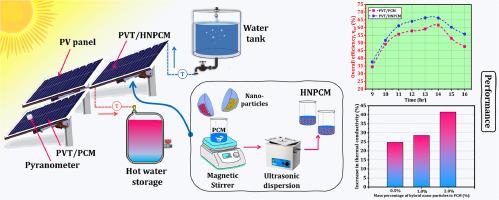
The electrical efficiency of the photovoltaic (PV) panel is affected significantly with increased cell temperature. Among various approaches, the use of Phase Change Materials (PCMs) with nanoparticles is currently one of the most effective for reducing and managing the temperature of PV panels. In this study, paraffin wax as PCM with different loading levels (0.5 %, 1 %, and 2 %) of hybrid nanoparticles Al2O3 and ZnO were successfully synthesized and their effects on the performance of the Photovoltaic-Thermal (PVT) system were investigated experimentally. Additionally, a prediction model was developed to analyze the interaction between the operating factors (independent variable) and response factors (dependent variable) of the PVT/PCM and PVT with Hybrid nano-PCM (PVT/HNPCM) systems based on response surface methodology (RSM). Experimental results showed that compared to only PCM, the thermal conductivity of HNPCM increased by 24.68 %, 28.57 %, and 41.56 % for the inclusion of 0.5 %, 1 %, and 2 % hybrid nanomaterial respectively. The electrical efficiency of the PVT/HNPCM, and PVT/PCM system enhanced by 31.46 % and 28.70 % respectively compared to the conventional PV system in this study. With a cooling-water mass flow rate of 0.0021 kg/s, the highest thermal efficiency of 47 % was achieved for the PVT/PCM system, whereas 51.28 % was achieved for the PVT/HNPCM system. The analysis of the variance test yielded a P value <0.0001 which is less than 0.05 for the model of overall efficiency for PVT/PCM and PVT/HNPCM system, indicating the suggested model's appropriateness and statistical significance. These optimal conditions are observed when the solar intensity ranges from 774 W/m2 to 809 W/m2 and the mass flow rate is 0.002 kg/s for both the PVT/PCM and PVT/HNPCM systems. However, these systems advance sustainable urban development and climate goals by combining PV panels' electrical generation with thermal energy harvesting, boosting overall energy efficiency in the built environment.




 京公网安备 11010802042870号
京ICP备2023020795号-1
京公网安备 11010802042870号
京ICP备2023020795号-1

 分享
分享
 求助内容:
求助内容: 应助结果提醒方式:
 扫码关注我们
