{"title":"Lithium-conducting phosphates as artificial solid-electrolyte interphase on silicon anode for supreme lithium storage","authors":"","doi":"10.1016/j.jiec.2024.06.009","DOIUrl":null,"url":null,"abstract":"<div><div>Silicon (Si) anode is an ideal material for next-generation lithium-ion batteries due to its high specific capacity. Unfortunately, the fragmentation and reconstruction of solid electrolyte interface (SEI) film caused by volume expansion during the (de)lithiation is still a problem to be overcome. Constructing a stable SEI film on Si surface through interface engineering is a very effective strategy to improve the electrochemical performance. In this work, we construct lithium-conducting phosphates (Li<sub>3</sub>PO<sub>4</sub>, denoted as LPO) as SEI film and SiO<em><sub>x</sub></em> buffer layer on Si surface. The obtained Si@SiO<em><sub>x</sub></em>@LPO anode retains 2015 mAh g<sup>−1</sup> after 100 cycles at 0.2 A g<sup>−1</sup> with a capacity retention of 73.6%, and 1636 mAh g<sup>−1</sup> after 500 cycles at 1 A g<sup>−1</sup> with a capacity retention of 81.7%, which is significantly higher than the Si anode under the same conditions, respectively. In addition, in/ex-situ tests demonstrate that Si@SiO<em><sub>x</sub></em>@LPO anode has faster lithium-ion diffusion and structural reversibility. The analysis shows that LPO has higher mechanical strength and provides better ionic conductivity. On the other hand, SiO<em><sub>x</sub></em> buffer layer can not only reduce the volume expansion of Si, but also reduce the energy barrier between Si and LPO interface and increase the electrical conductivity. Therefore, this work provides a novel strategy for boosting electrochemical performance by artificial SEI and surface modification.</div></div>","PeriodicalId":363,"journal":{"name":"Journal of Industrial and Engineering Chemistry","volume":"140 ","pages":"Pages 513-520"},"PeriodicalIF":5.9000,"publicationDate":"2024-12-25","publicationTypes":"Journal Article","fieldsOfStudy":null,"isOpenAccess":false,"openAccessPdf":"","citationCount":"0","resultStr":null,"platform":"Semanticscholar","paperid":null,"PeriodicalName":"Journal of Industrial and Engineering Chemistry","FirstCategoryId":"5","ListUrlMain":"https://www.sciencedirect.com/science/article/pii/S1226086X24003939","RegionNum":3,"RegionCategory":"工程技术","ArticlePicture":[],"TitleCN":null,"AbstractTextCN":null,"PMCID":null,"EPubDate":"2024/6/13 0:00:00","PubModel":"Epub","JCR":"Q1","JCRName":"CHEMISTRY, MULTIDISCIPLINARY","Score":null,"Total":0}
引用次数: 0
Abstract
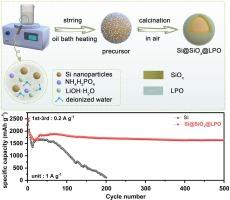
Silicon (Si) anode is an ideal material for next-generation lithium-ion batteries due to its high specific capacity. Unfortunately, the fragmentation and reconstruction of solid electrolyte interface (SEI) film caused by volume expansion during the (de)lithiation is still a problem to be overcome. Constructing a stable SEI film on Si surface through interface engineering is a very effective strategy to improve the electrochemical performance. In this work, we construct lithium-conducting phosphates (Li3PO4, denoted as LPO) as SEI film and SiOx buffer layer on Si surface. The obtained Si@SiOx@LPO anode retains 2015 mAh g−1 after 100 cycles at 0.2 A g−1 with a capacity retention of 73.6%, and 1636 mAh g−1 after 500 cycles at 1 A g−1 with a capacity retention of 81.7%, which is significantly higher than the Si anode under the same conditions, respectively. In addition, in/ex-situ tests demonstrate that Si@SiOx@LPO anode has faster lithium-ion diffusion and structural reversibility. The analysis shows that LPO has higher mechanical strength and provides better ionic conductivity. On the other hand, SiOx buffer layer can not only reduce the volume expansion of Si, but also reduce the energy barrier between Si and LPO interface and increase the electrical conductivity. Therefore, this work provides a novel strategy for boosting electrochemical performance by artificial SEI and surface modification.
硅(Si)负极具有高比容量,是下一代锂离子电池的理想材料。遗憾的是,在(脱)锂过程中,由于体积膨胀而导致的固体电解质界面(SEI)膜的破碎和重建仍是一个有待克服的问题。通过界面工程在硅表面构建稳定的 SEI 膜是提高电化学性能的有效策略。在这项工作中,我们在硅表面构建了锂导电磷酸盐(Li3PO4,简称 LPO)作为 SEI 膜和 SiOx 缓冲层。得到的 Si@SiOx@LPO 阳极在 0.2 A g-1 条件下循环 100 次后,容量保持率为 2015 mAh g-1,容量保持率为 73.6%;在 1 A g-1 条件下循环 500 次后,容量保持率为 1636 mAh g-1,容量保持率为 81.7%,分别显著高于相同条件下的硅阳极。此外,原位/离位测试表明,Si@SiOx@LPO 负极具有更快的锂离子扩散速度和结构可逆性。分析表明,LPO 具有更高的机械强度和更好的离子传导性。另一方面,SiOx 缓冲层不仅能减少 Si 的体积膨胀,还能降低 Si 与 LPO 界面之间的能障,提高导电性。因此,这项工作提供了一种通过人工 SEI 和表面改性提高电化学性能的新策略。
期刊介绍:
Journal of Industrial and Engineering Chemistry is published monthly in English by the Korean Society of Industrial and Engineering Chemistry. JIEC brings together multidisciplinary interests in one journal and is to disseminate information on all aspects of research and development in industrial and engineering chemistry. Contributions in the form of research articles, short communications, notes and reviews are considered for publication. The editors welcome original contributions that have not been and are not to be published elsewhere. Instruction to authors and a manuscript submissions form are printed at the end of each issue. Bulk reprints of individual articles can be ordered. This publication is partially supported by Korea Research Foundation and the Korean Federation of Science and Technology Societies.



 京公网安备 11010802042870号
京ICP备2023020795号-1
京公网安备 11010802042870号
京ICP备2023020795号-1

 分享
分享
 求助内容:
求助内容: 应助结果提醒方式:
 扫码关注我们
