{"title":"Lubrication mechanism of C@Ag core–shell materials as grease additive","authors":"","doi":"10.1016/j.jiec.2024.06.005","DOIUrl":null,"url":null,"abstract":"<div><div>The preparation of a low shearing shell on the surface of carbon spheres (CS) is an attractive strategy to improve the lubrication properties of CS. In this study, core–shell structural C@Ag particles were prepared using CS as the hard core and Ag nanoparticles as the soft shell. Then, the additives were mixed with Polyalphaolefin 20 to prepare the C@Ag core–shell-enhanced lithium complex grease (C@Ag-LCG). The physicochemical properties, corrosion resistance, and tribological behaviors of LCGs were investigated. C@Ag-LCG exhibited the best high-temperature resistance and colloidal stability compared with the CS-enhanced lithium complex grease (LCG) and pure LCG. The dropping point and oil separation rate of 0.05 wt% C@Ag-LCG were 255 °C and 2.36 %, respectively. The tribological behavior of greases was tested using a four-ball friction tester, and the main damage mechanism was abrasive wear. The C@Ag additive reduced the average friction coefficient and wear spot diameter by 27.17 % and 26.12 %, respectively. The improved properties were attributed to the synergistic lubrication of hard CS core and soft Ag shell with the rolling, filling, and self-repairing effects, C@Ag deposit films and the self-lubricating oil film, as well as the thickener film and the tribochemical film at the frictional interfaces.</div></div>","PeriodicalId":363,"journal":{"name":"Journal of Industrial and Engineering Chemistry","volume":"140 ","pages":"Pages 478-489"},"PeriodicalIF":5.9000,"publicationDate":"2024-12-25","publicationTypes":"Journal Article","fieldsOfStudy":null,"isOpenAccess":false,"openAccessPdf":"","citationCount":"0","resultStr":null,"platform":"Semanticscholar","paperid":null,"PeriodicalName":"Journal of Industrial and Engineering Chemistry","FirstCategoryId":"5","ListUrlMain":"https://www.sciencedirect.com/science/article/pii/S1226086X24003770","RegionNum":3,"RegionCategory":"工程技术","ArticlePicture":[],"TitleCN":null,"AbstractTextCN":null,"PMCID":null,"EPubDate":"2024/6/6 0:00:00","PubModel":"Epub","JCR":"Q1","JCRName":"CHEMISTRY, MULTIDISCIPLINARY","Score":null,"Total":0}
引用次数: 0
Abstract
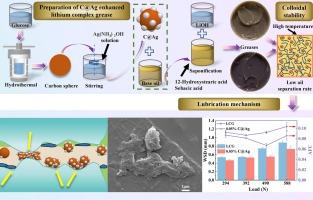
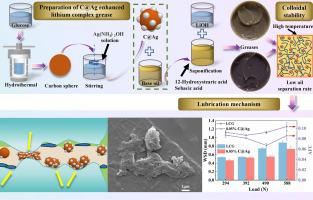
The preparation of a low shearing shell on the surface of carbon spheres (CS) is an attractive strategy to improve the lubrication properties of CS. In this study, core–shell structural C@Ag particles were prepared using CS as the hard core and Ag nanoparticles as the soft shell. Then, the additives were mixed with Polyalphaolefin 20 to prepare the C@Ag core–shell-enhanced lithium complex grease (C@Ag-LCG). The physicochemical properties, corrosion resistance, and tribological behaviors of LCGs were investigated. C@Ag-LCG exhibited the best high-temperature resistance and colloidal stability compared with the CS-enhanced lithium complex grease (LCG) and pure LCG. The dropping point and oil separation rate of 0.05 wt% C@Ag-LCG were 255 °C and 2.36 %, respectively. The tribological behavior of greases was tested using a four-ball friction tester, and the main damage mechanism was abrasive wear. The C@Ag additive reduced the average friction coefficient and wear spot diameter by 27.17 % and 26.12 %, respectively. The improved properties were attributed to the synergistic lubrication of hard CS core and soft Ag shell with the rolling, filling, and self-repairing effects, C@Ag deposit films and the self-lubricating oil film, as well as the thickener film and the tribochemical film at the frictional interfaces.
期刊介绍:
Journal of Industrial and Engineering Chemistry is published monthly in English by the Korean Society of Industrial and Engineering Chemistry. JIEC brings together multidisciplinary interests in one journal and is to disseminate information on all aspects of research and development in industrial and engineering chemistry. Contributions in the form of research articles, short communications, notes and reviews are considered for publication. The editors welcome original contributions that have not been and are not to be published elsewhere. Instruction to authors and a manuscript submissions form are printed at the end of each issue. Bulk reprints of individual articles can be ordered. This publication is partially supported by Korea Research Foundation and the Korean Federation of Science and Technology Societies.




 京公网安备 11010802042870号
京ICP备2023020795号-1
京公网安备 11010802042870号
京ICP备2023020795号-1

 分享
分享
 求助内容:
求助内容: 应助结果提醒方式:
 扫码关注我们
