{"title":"Water as a probe for the temperature-induced self-assembly transition of an amphiphilic copolymer","authors":"Changlin Su , Wensheng Cai , Xueguang Shao","doi":"10.1016/j.cclet.2024.110095","DOIUrl":null,"url":null,"abstract":"<div><div>The hydration state of amphiphilic block copolymers during the self-assembly transition is closely related to the structure and properties of copolymers. In this study, the temperature-induced self-assembly of copolymer poly(<em>N,N</em>-dimethylacrylamide)-poly(diacetone acrylamide) (PDMAA<sub>30</sub>-PDAAM<sub>60</sub>)<sub>2</sub> in aqueous solution was monitored by near-infrared spectroscopy with water as a probe. The wavelet packet transform was employed to improve the spectral resolution. The spectral information of hydrated water surrounding the hydrophilic PDMAA and hydrophobic PDAAM blocks was then extracted, revealing the significant roles of water in morphological transition of the copolymer from spherical to worm-like micelles. Specifically, water molecules interacting with N atoms and C=O groups of the hydrophilic block gradually decrease during the morphological transition, while hydrogen-bond structures NH<img>CO of the hydrophobic block gradually break, bringing more water molecules into contact with the hydrophobic block. This work provides a foundation for exploring the role of water molecules during the self-assembly transition of complex block copolymers.</div></div>","PeriodicalId":10088,"journal":{"name":"Chinese Chemical Letters","volume":"36 4","pages":"Article 110095"},"PeriodicalIF":8.9000,"publicationDate":"2025-04-01","publicationTypes":"Journal Article","fieldsOfStudy":null,"isOpenAccess":false,"openAccessPdf":"","citationCount":"0","resultStr":null,"platform":"Semanticscholar","paperid":null,"PeriodicalName":"Chinese Chemical Letters","FirstCategoryId":"92","ListUrlMain":"https://www.sciencedirect.com/science/article/pii/S1001841724006144","RegionNum":1,"RegionCategory":"化学","ArticlePicture":[],"TitleCN":null,"AbstractTextCN":null,"PMCID":null,"EPubDate":"2024/6/6 0:00:00","PubModel":"Epub","JCR":"Q1","JCRName":"CHEMISTRY, MULTIDISCIPLINARY","Score":null,"Total":0}
引用次数: 0
Abstract
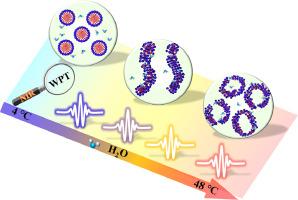
The hydration state of amphiphilic block copolymers during the self-assembly transition is closely related to the structure and properties of copolymers. In this study, the temperature-induced self-assembly of copolymer poly(N,N-dimethylacrylamide)-poly(diacetone acrylamide) (PDMAA30-PDAAM60)2 in aqueous solution was monitored by near-infrared spectroscopy with water as a probe. The wavelet packet transform was employed to improve the spectral resolution. The spectral information of hydrated water surrounding the hydrophilic PDMAA and hydrophobic PDAAM blocks was then extracted, revealing the significant roles of water in morphological transition of the copolymer from spherical to worm-like micelles. Specifically, water molecules interacting with N atoms and C=O groups of the hydrophilic block gradually decrease during the morphological transition, while hydrogen-bond structures NHCO of the hydrophobic block gradually break, bringing more water molecules into contact with the hydrophobic block. This work provides a foundation for exploring the role of water molecules during the self-assembly transition of complex block copolymers.
期刊介绍:
Chinese Chemical Letters (CCL) (ISSN 1001-8417) was founded in July 1990. The journal publishes preliminary accounts in the whole field of chemistry, including inorganic chemistry, organic chemistry, analytical chemistry, physical chemistry, polymer chemistry, applied chemistry, etc.Chinese Chemical Letters does not accept articles previously published or scheduled to be published. To verify originality, your article may be checked by the originality detection service CrossCheck.




 京公网安备 11010802042870号
京ICP备2023020795号-1
京公网安备 11010802042870号
京ICP备2023020795号-1

 分享
分享
 求助内容:
求助内容: 应助结果提醒方式:
 扫码关注我们
