{"title":"Enhanced photocatalytic degradation of diclofenac by UiO-66/MgAl-LDH: excellent performances and mechanisms†","authors":"Jia-Hang Wang, Fanying Kong, Bing-Feng Liu, Sheng-Nan Zhuo, Nan-Qi Ren and Hong-Yu Ren","doi":"10.1039/D4EN00266K","DOIUrl":null,"url":null,"abstract":"<p >The expeditious augmentation of industry and economics has brought about an increase in the pollution of the aquatic environment, and as a result, there is a prerequisite to remit a pollution status of the process when exploiting new materials. The construction of functional Zr-MOF (UiO-66) materials with layered MgAl-LDH in a hydrothermal synthesis strategy named UL<small><sub>3</sub></small> (wt%, UiO-66 : MgAl-LDH = 1 : 3) for the highly efficient photodegradation of diclofenac (DCF) was investigated in the study reported herein. The UL<small><sub>3</sub></small>/DCF photodegradation system under premium reaction conditions of 10 mg L<small><sup>−1</sup></small> of DCF, 0.1 g L<small><sup>−1</sup></small> of UL<small><sub>3</sub></small> and 25 °C reached 100% mineralization of DCF within 5 min at pH 4. Quench testing showed that dominant species in the photocatalysis was h<small><sup>+</sup></small>, which played synergetic roles during the degradation of DCF. Low metal ion leaching (under 0.25 mg L<small><sup>−1</sup></small>) and co-existing substrates certified the high stability of UL<small><sub>3</sub></small> and its good resistance to co-existing substances. This study identifies a viable photocatalyst system for water purification and solar energy utilization.</p>","PeriodicalId":73,"journal":{"name":"Environmental Science: Nano","volume":" 8","pages":" 3286-3293"},"PeriodicalIF":5.1000,"publicationDate":"2024-06-22","publicationTypes":"Journal Article","fieldsOfStudy":null,"isOpenAccess":false,"openAccessPdf":"","citationCount":"0","resultStr":null,"platform":"Semanticscholar","paperid":null,"PeriodicalName":"Environmental Science: Nano","FirstCategoryId":"6","ListUrlMain":"https://pubs.rsc.org/en/content/articlelanding/2024/en/d4en00266k","RegionNum":2,"RegionCategory":"环境科学与生态学","ArticlePicture":[],"TitleCN":null,"AbstractTextCN":null,"PMCID":null,"EPubDate":"","PubModel":"","JCR":"Q1","JCRName":"CHEMISTRY, MULTIDISCIPLINARY","Score":null,"Total":0}
引用次数: 0
Abstract
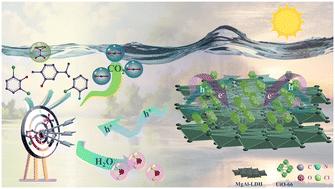
The expeditious augmentation of industry and economics has brought about an increase in the pollution of the aquatic environment, and as a result, there is a prerequisite to remit a pollution status of the process when exploiting new materials. The construction of functional Zr-MOF (UiO-66) materials with layered MgAl-LDH in a hydrothermal synthesis strategy named UL3 (wt%, UiO-66 : MgAl-LDH = 1 : 3) for the highly efficient photodegradation of diclofenac (DCF) was investigated in the study reported herein. The UL3/DCF photodegradation system under premium reaction conditions of 10 mg L−1 of DCF, 0.1 g L−1 of UL3 and 25 °C reached 100% mineralization of DCF within 5 min at pH 4. Quench testing showed that dominant species in the photocatalysis was h+, which played synergetic roles during the degradation of DCF. Low metal ion leaching (under 0.25 mg L−1) and co-existing substrates certified the high stability of UL3 and its good resistance to co-existing substances. This study identifies a viable photocatalyst system for water purification and solar energy utilization.
期刊介绍:
Environmental Science: Nano serves as a comprehensive and high-impact peer-reviewed source of information on the design and demonstration of engineered nanomaterials for environment-based applications. It also covers the interactions between engineered, natural, and incidental nanomaterials with biological and environmental systems. This scope includes, but is not limited to, the following topic areas:
Novel nanomaterial-based applications for water, air, soil, food, and energy sustainability
Nanomaterial interactions with biological systems and nanotoxicology
Environmental fate, reactivity, and transformations of nanoscale materials
Nanoscale processes in the environment
Sustainable nanotechnology including rational nanomaterial design, life cycle assessment, risk/benefit analysis




 京公网安备 11010802042870号
京ICP备2023020795号-1
京公网安备 11010802042870号
京ICP备2023020795号-1

 分享
分享
 求助内容:
求助内容: 应助结果提醒方式:
 扫码关注我们
