Meryl Thomas MBBS, Valerie Yii MBChB, Rodney Sinclair MBBS, MD
{"title":"Dissecting cellulitis of the scalp in a paediatric male","authors":"Meryl Thomas MBBS, Valerie Yii MBChB, Rodney Sinclair MBBS, MD","doi":"10.1111/ajd.14342","DOIUrl":null,"url":null,"abstract":"<p>A 13-year-old boy of Iraqi heritage presented with alopecia and scalp nodules, refractory to doxycycline, clindamycin and topical steroids. There was no significant past medical history. He has a maternal uncle with alopecia areata. Examination revealed multiple tender, erythematous nodules overlying the areas of alopecia. In addition, there were a few scattered pustules (Figure 1). While he had mild acne vulgaris on his forehead, there was no evidence of acne conglobata, hidradenitis suppurativa or pilonidal sinus. Swab from a scalp pustule did not show any bacterial or fungal growth.</p><p>The clinical diagnosis was dissecting cellulitis of the scalp. The patient was commenced on isotretinoin 10 mg daily (0.20 mg/kg), sublingual minoxidil 0.45 mg twice daily, oral prednisolone 25 mg daily for 2 weeks, then 12.5 mg daily for 4 weeks and antiseptic shampoo. On review 4 weeks later, the inflammatory scalp lesions had flattened; no new nodules or pustules had appeared and there was significant hair regrowth within some but not all the scalp patches. Further improvement was noted 10 weeks after initiation of treatment, and prednisolone was reduced to 10 mg daily (Figure 2). Apart from increased hair growth on the upper lip, there were no other side effects from the treatment regime.</p><p>Dissecting cellulitis of the scalp (DCS) is an inflammatory dermatosis of the scalp,<span><sup>1</sup></span> characterised by suppurative and often interconnected nodules that can cause cicatricial alopecia.<span><sup>2</sup></span> The condition may be associated with acne conglobata, hidradenitis suppurativa and pilonidal sinus.<span><sup>1</sup></span> Lesions are most commonly seen on the vertex of the scalp.<span><sup>3</sup></span> DCS is most common in African–American men between the ages of 20 and 40 years,<span><sup>1</sup></span> though it has also been reported in women, adolescents<span><sup>1</sup></span> and in multiple ethnic groups.<span><sup>3</sup></span> Smoking is thought to increase risk of DCS.<span><sup>4</sup></span> The condition has been reported in a 10-year-old girl.<span><sup>5</sup></span> It has also been documented in a 15-year-old boy.<span><sup>6</sup></span> To the best of our knowledge, this is the youngest reported case of DCS in a male.</p><p>Treatment of DCS is largely empirical as there have been no randomised controlled trials for this rare scalp condition. A systematic review of available treatments recommended isotretinoin first line. Dosages ranging from 0.25 mg/kg/day to 1 mg/kg/day have been documented,<span><sup>7</sup></span> though as displayed in this case, even lower doses may be sufficient. Skeletal abnormalities have been reported in children receiving prolonged treatment over several years with oral retinoids; however, short-term use does not appear to have any substantial effects on bone mineralisation.<span><sup>8</sup></span> For DCS resistant to oral retinoids, biologic agents can be considered.<span><sup>9</sup></span> Periodic nodule aspiration may be beneficial<span><sup>9</sup></span> and severe cases may require wide local excision of the affected area, resulting in permanent alopecia.<span><sup>1</sup></span></p><p>A short course of oral steroids was used in this case as an adjunct to isotretinoin to control the active inflammation, halt nodule formation and reduce the risk of scarring. Intralesional corticosteroid injection may also be used.<span><sup>1</sup></span> Minoxidil was commenced to accelerate hair regrowth. A systematic review of minoxidil in scarring alopecias found benefit in terms of disease stabilisation and hair regrowth.<span><sup>10</sup></span> The sublingual formulation theoretically provides greater bioavailability than oral.<span><sup>11</sup></span></p><p>Though uncommon in adolescents, DCS should be considered in paediatric patients with scalp nodules and patchy hair loss. The mainstay of treatment in the paediatric and adult population is isotretinoin. Minoxidil is a useful adjunct to augment regrowth.</p><p>None.</p><p>Professor Rodney Sinclair is an Editorial Board member of Australasian Journal of Dermatology and a co-author of this article. To minimise bias, they were excluded from all editorial decision-making related to the acceptance of this article for publication.</p><p>Written consent provided by next of kin.</p>","PeriodicalId":8638,"journal":{"name":"Australasian Journal of Dermatology","volume":"65 8","pages":"657-659"},"PeriodicalIF":1.8000,"publicationDate":"2024-06-24","publicationTypes":"Journal Article","fieldsOfStudy":null,"isOpenAccess":false,"openAccessPdf":"https://www.ncbi.nlm.nih.gov/pmc/articles/PMC11629137/pdf/","citationCount":"0","resultStr":null,"platform":"Semanticscholar","paperid":null,"PeriodicalName":"Australasian Journal of Dermatology","FirstCategoryId":"3","ListUrlMain":"https://onlinelibrary.wiley.com/doi/10.1111/ajd.14342","RegionNum":4,"RegionCategory":"医学","ArticlePicture":[],"TitleCN":null,"AbstractTextCN":null,"PMCID":null,"EPubDate":"","PubModel":"","JCR":"Q2","JCRName":"DERMATOLOGY","Score":null,"Total":0}
引用次数: 0
Abstract
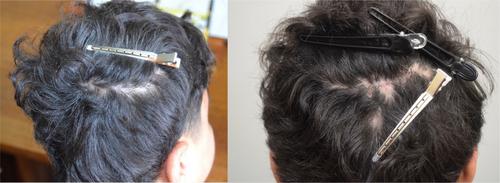
A 13-year-old boy of Iraqi heritage presented with alopecia and scalp nodules, refractory to doxycycline, clindamycin and topical steroids. There was no significant past medical history. He has a maternal uncle with alopecia areata. Examination revealed multiple tender, erythematous nodules overlying the areas of alopecia. In addition, there were a few scattered pustules (Figure 1). While he had mild acne vulgaris on his forehead, there was no evidence of acne conglobata, hidradenitis suppurativa or pilonidal sinus. Swab from a scalp pustule did not show any bacterial or fungal growth.
The clinical diagnosis was dissecting cellulitis of the scalp. The patient was commenced on isotretinoin 10 mg daily (0.20 mg/kg), sublingual minoxidil 0.45 mg twice daily, oral prednisolone 25 mg daily for 2 weeks, then 12.5 mg daily for 4 weeks and antiseptic shampoo. On review 4 weeks later, the inflammatory scalp lesions had flattened; no new nodules or pustules had appeared and there was significant hair regrowth within some but not all the scalp patches. Further improvement was noted 10 weeks after initiation of treatment, and prednisolone was reduced to 10 mg daily (Figure 2). Apart from increased hair growth on the upper lip, there were no other side effects from the treatment regime.
Dissecting cellulitis of the scalp (DCS) is an inflammatory dermatosis of the scalp,1 characterised by suppurative and often interconnected nodules that can cause cicatricial alopecia.2 The condition may be associated with acne conglobata, hidradenitis suppurativa and pilonidal sinus.1 Lesions are most commonly seen on the vertex of the scalp.3 DCS is most common in African–American men between the ages of 20 and 40 years,1 though it has also been reported in women, adolescents1 and in multiple ethnic groups.3 Smoking is thought to increase risk of DCS.4 The condition has been reported in a 10-year-old girl.5 It has also been documented in a 15-year-old boy.6 To the best of our knowledge, this is the youngest reported case of DCS in a male.
Treatment of DCS is largely empirical as there have been no randomised controlled trials for this rare scalp condition. A systematic review of available treatments recommended isotretinoin first line. Dosages ranging from 0.25 mg/kg/day to 1 mg/kg/day have been documented,7 though as displayed in this case, even lower doses may be sufficient. Skeletal abnormalities have been reported in children receiving prolonged treatment over several years with oral retinoids; however, short-term use does not appear to have any substantial effects on bone mineralisation.8 For DCS resistant to oral retinoids, biologic agents can be considered.9 Periodic nodule aspiration may be beneficial9 and severe cases may require wide local excision of the affected area, resulting in permanent alopecia.1
A short course of oral steroids was used in this case as an adjunct to isotretinoin to control the active inflammation, halt nodule formation and reduce the risk of scarring. Intralesional corticosteroid injection may also be used.1 Minoxidil was commenced to accelerate hair regrowth. A systematic review of minoxidil in scarring alopecias found benefit in terms of disease stabilisation and hair regrowth.10 The sublingual formulation theoretically provides greater bioavailability than oral.11
Though uncommon in adolescents, DCS should be considered in paediatric patients with scalp nodules and patchy hair loss. The mainstay of treatment in the paediatric and adult population is isotretinoin. Minoxidil is a useful adjunct to augment regrowth.
None.
Professor Rodney Sinclair is an Editorial Board member of Australasian Journal of Dermatology and a co-author of this article. To minimise bias, they were excluded from all editorial decision-making related to the acceptance of this article for publication.
期刊介绍:
Australasian Journal of Dermatology is the official journal of the Australasian College of Dermatologists and the New Zealand Dermatological Society, publishing peer-reviewed, original research articles, reviews and case reports dealing with all aspects of clinical practice and research in dermatology. Clinical presentations, medical and physical therapies and investigations, including dermatopathology and mycology, are covered. Short articles may be published under the headings ‘Signs, Syndromes and Diagnoses’, ‘Dermatopathology Presentation’, ‘Vignettes in Contact Dermatology’, ‘Surgery Corner’ or ‘Letters to the Editor’.



 京公网安备 11010802042870号
京ICP备2023020795号-1
京公网安备 11010802042870号
京ICP备2023020795号-1

 分享
分享

 求助内容:
求助内容: 应助结果提醒方式:
 扫码关注我们
