Yuqing Zhang , Yao Gong , Zhijun Liang , Wei Wu , Jiaxi Chen , Yuling Li , Rui Chen , Jun Mei , Zunnan Huang , Jing Sun
{"title":"Mitochondria- and endoplasmic reticulum-localizing iridium(III) complexes induce immunogenic cell death of 143B cells","authors":"Yuqing Zhang , Yao Gong , Zhijun Liang , Wei Wu , Jiaxi Chen , Yuling Li , Rui Chen , Jun Mei , Zunnan Huang , Jing Sun","doi":"10.1016/j.jinorgbio.2024.112655","DOIUrl":null,"url":null,"abstract":"<div><p>Recent breakthroughs in cancer immunology have propelled immunotherapy to the forefront of cancer research as a promising treatment approach that harnesses the body's immune system to effectively identify and eliminate cancer cells. In this study, three novel cyclometalated Ir(III) complexes, <strong>Ir1</strong>, <strong>Ir2</strong>, and <strong>Ir3</strong>, were designed, synthesized, and assessed <em>in vitro</em> for cytotoxic activity against several tumor-derived cell lines. Among these, <strong>Ir1</strong> exhibited the highest cytotoxic activity, with an IC<sub>50</sub> value of 0.4 ± 0.1 μM showcasing its significant anticancer potential. Detailed mechanistic analysis revealed that co-incubation of <strong>Ir1</strong> with 143B cells led to <strong>Ir1</strong> accumulation within mitochondria and the endoplasmic reticulum (ER). Furthermore, <strong>Ir1</strong> induced G0/G1 phase cell cycle arrest, while also diminishing mitochondrial membrane potential, disrupting mitochondrial function, and triggering ER stress. Intriguingly, in mice the <strong>Ir1</strong>-induced ER stress response disrupted calcium homeostasis to thereby trigger immunogenic cell death (ICD), which subsequently activated the host antitumor immune response while concurrently dampening the <em>in vivo</em> tumor-induced inflammatory response.</p></div>","PeriodicalId":364,"journal":{"name":"Journal of Inorganic Biochemistry","volume":"259 ","pages":"Article 112655"},"PeriodicalIF":3.2000,"publicationDate":"2024-10-01","publicationTypes":"Journal Article","fieldsOfStudy":null,"isOpenAccess":false,"openAccessPdf":"","citationCount":"0","resultStr":null,"platform":"Semanticscholar","paperid":null,"PeriodicalName":"Journal of Inorganic Biochemistry","FirstCategoryId":"99","ListUrlMain":"https://www.sciencedirect.com/science/article/pii/S016201342400179X","RegionNum":2,"RegionCategory":"化学","ArticlePicture":[],"TitleCN":null,"AbstractTextCN":null,"PMCID":null,"EPubDate":"2024/6/27 0:00:00","PubModel":"Epub","JCR":"Q2","JCRName":"BIOCHEMISTRY & MOLECULAR BIOLOGY","Score":null,"Total":0}
引用次数: 0
Abstract
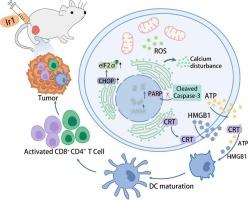
Recent breakthroughs in cancer immunology have propelled immunotherapy to the forefront of cancer research as a promising treatment approach that harnesses the body's immune system to effectively identify and eliminate cancer cells. In this study, three novel cyclometalated Ir(III) complexes, Ir1, Ir2, and Ir3, were designed, synthesized, and assessed in vitro for cytotoxic activity against several tumor-derived cell lines. Among these, Ir1 exhibited the highest cytotoxic activity, with an IC50 value of 0.4 ± 0.1 μM showcasing its significant anticancer potential. Detailed mechanistic analysis revealed that co-incubation of Ir1 with 143B cells led to Ir1 accumulation within mitochondria and the endoplasmic reticulum (ER). Furthermore, Ir1 induced G0/G1 phase cell cycle arrest, while also diminishing mitochondrial membrane potential, disrupting mitochondrial function, and triggering ER stress. Intriguingly, in mice the Ir1-induced ER stress response disrupted calcium homeostasis to thereby trigger immunogenic cell death (ICD), which subsequently activated the host antitumor immune response while concurrently dampening the in vivo tumor-induced inflammatory response.
期刊介绍:
The Journal of Inorganic Biochemistry is an established international forum for research in all aspects of Biological Inorganic Chemistry. Original papers of a high scientific level are published in the form of Articles (full length papers), Short Communications, Focused Reviews and Bioinorganic Methods. Topics include: the chemistry, structure and function of metalloenzymes; the interaction of inorganic ions and molecules with proteins and nucleic acids; the synthesis and properties of coordination complexes of biological interest including both structural and functional model systems; the function of metal- containing systems in the regulation of gene expression; the role of metals in medicine; the application of spectroscopic methods to determine the structure of metallobiomolecules; the preparation and characterization of metal-based biomaterials; and related systems. The emphasis of the Journal is on the structure and mechanism of action of metallobiomolecules.



 京公网安备 11010802042870号
京ICP备2023020795号-1
京公网安备 11010802042870号
京ICP备2023020795号-1

 分享
分享
 求助内容:
求助内容: 应助结果提醒方式:
 扫码关注我们
