Ooceraeahainingensis sp. nov.: A new Chinese Ooceraea (Hymenoptera, Formicidae, Dorylinae) species with a dealate queen, closely allied to the queenless clonal raider ant O.biroi.
Qionghua Gao, Jiliang Long, Chengyuan Liu, Haoyu Liu, Hao Ran, Kip D Lacy, Daniel J C Kronauer
{"title":"<i>Ooceraeahainingensis</i> sp. nov.: A new Chinese <i>Ooceraea</i> (Hymenoptera, Formicidae, Dorylinae) species with a dealate queen, closely allied to the queenless clonal raider ant <i>O.biroi</i>.","authors":"Qionghua Gao, Jiliang Long, Chengyuan Liu, Haoyu Liu, Hao Ran, Kip D Lacy, Daniel J C Kronauer","doi":"10.3897/zookeys.1205.118358","DOIUrl":null,"url":null,"abstract":"<p><p>The clonal raider ant, <i>Ooceraeabiroi</i>, is a queenless species that reproduces asexually, and these traits make it an attractive model system for laboratory research. However, it is unclear where on the ant phylogeny these traits evolved, partly because few closely related species have been described and studied. Here, we describe a new raider ant species, <i>Ooceraeahainingensis</i> <b>sp. nov.</b>, from Zhejiang, China. This species is closely related to <i>O.biroi</i> but can be distinguished by the following features: 1) workers of <i>O.hainingensis</i> <b>sp. nov.</b> have an obvious promesonotal suture and a metanotal groove, whereas these characters are ambiguous in <i>O.biroi</i>; and 2) the subpetiolar process of <i>O.hainingensis</i> is prominent and anteroventrally directed like a thumb with sublinear posteroventral margin, while in <i>O.biroi</i>, it is anteroventrally directed but slightly backward-bent. Molecular phylogenetic analyses confirm that <i>O.hainingensis</i> is genetically distinct from <i>O.biroi</i>. Importantly, unlike <i>O.biroi</i>, <i>O.hainingensis</i> has a queen caste with wings and well-developed eyes. This suggests that the loss of the queen caste and transition to asexual reproduction by workers is specific to <i>O.biroi</i> and occurred after that species diverged from closely related congeneric species.</p>","PeriodicalId":24051,"journal":{"name":"ZooKeys","volume":"1205 ","pages":"101-113"},"PeriodicalIF":1.5000,"publicationDate":"2024-06-20","publicationTypes":"Journal Article","fieldsOfStudy":null,"isOpenAccess":false,"openAccessPdf":"https://www.ncbi.nlm.nih.gov/pmc/articles/PMC11211655/pdf/","citationCount":"0","resultStr":null,"platform":"Semanticscholar","paperid":null,"PeriodicalName":"ZooKeys","FirstCategoryId":"99","ListUrlMain":"https://doi.org/10.3897/zookeys.1205.118358","RegionNum":3,"RegionCategory":"生物学","ArticlePicture":[],"TitleCN":null,"AbstractTextCN":null,"PMCID":null,"EPubDate":"2024/1/1 0:00:00","PubModel":"eCollection","JCR":"Q2","JCRName":"ZOOLOGY","Score":null,"Total":0}
引用次数: 0
Abstract
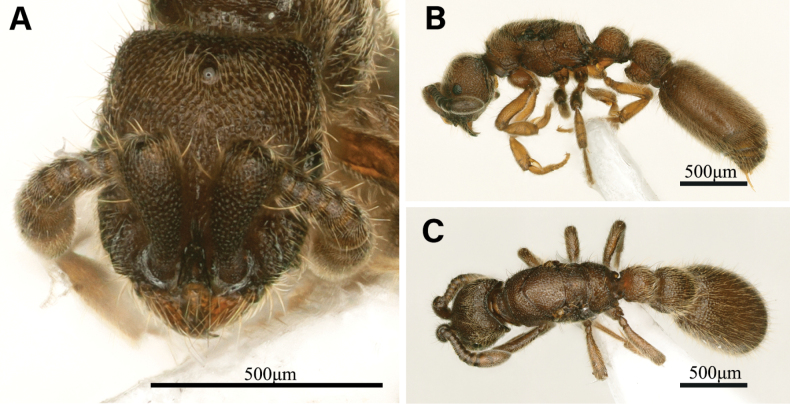
The clonal raider ant, Ooceraeabiroi, is a queenless species that reproduces asexually, and these traits make it an attractive model system for laboratory research. However, it is unclear where on the ant phylogeny these traits evolved, partly because few closely related species have been described and studied. Here, we describe a new raider ant species, Ooceraeahainingensissp. nov., from Zhejiang, China. This species is closely related to O.biroi but can be distinguished by the following features: 1) workers of O.hainingensissp. nov. have an obvious promesonotal suture and a metanotal groove, whereas these characters are ambiguous in O.biroi; and 2) the subpetiolar process of O.hainingensis is prominent and anteroventrally directed like a thumb with sublinear posteroventral margin, while in O.biroi, it is anteroventrally directed but slightly backward-bent. Molecular phylogenetic analyses confirm that O.hainingensis is genetically distinct from O.biroi. Importantly, unlike O.biroi, O.hainingensis has a queen caste with wings and well-developed eyes. This suggests that the loss of the queen caste and transition to asexual reproduction by workers is specific to O.biroi and occurred after that species diverged from closely related congeneric species.
期刊介绍:
ZooKeys is a peer-reviewed, open-access, online and print, rapidly produced journal launched to support free exchange of ideas and information in systematic zoology, phylogeny and biogeography.
All papers can be freely copied, downloaded, printed and distributed at no charge. Authors and readers are thus encouraged to post the pdf files of published papers on homepages or elsewhere to expedite distribution. There is no charge for color.






 京公网安备 11010802042870号
京ICP备2023020795号-1
京公网安备 11010802042870号
京ICP备2023020795号-1

 分享
分享
 求助内容:
求助内容: 应助结果提醒方式:
 扫码关注我们
