{"title":"The dental navigator: A necessary role in academic dental health care","authors":"Martha McComas RDH, MS, Karen Burnett LMSW, Jing Zhang BS, Elizabeth Hatfield DDS, DABOP","doi":"10.1002/jdd.13633","DOIUrl":null,"url":null,"abstract":"<p>In 2022, the American Dental Association published an article entitled Oral Health in America: Implications for Dental Practice. This publication highlighted that access to oral health care and oral care delivery had not changed in the adult population since the 2000 Surgeon General's Report on the Oral Health of America. The prevalence of dental diseases, such as dental caries and periodontal disease, has neither drastically improved nor changed; access to oral health care for many Americans is still problematic.<span><sup>1</sup></span> Many patients still seek nontraumatic dental care in hospital emergency departments (EDs).<span><sup>1</sup></span> This is especially true for individuals of low socioeconomic status, underrepresented minorities, and those without private dental insurance.<span><sup>1</sup></span> Although the US has implemented “safety net” oral healthcare facilities such as Federally Qualified Health Centers (FQHCs) and dental schools, access to comprehensive oral healthcare within these facilities is incredibly challenging and could be a key contributor to oral healthcare inequities.<span><sup>1</sup></span> The number of Americans who seek oral health care at FQHCs has steadily increased over time, but only about a quarter of patients receive any dental treatment.<span><sup>1</sup></span> This is because FQHCs are required to provide dental screening and to determine the patient's need for dental care, however, most facilities do not have on-site dental clinics.<span><sup>1</sup></span> Academic oral health centers/dental schools, are another safety net clinic for patients seeking oral health care,<span><sup>1</sup></span> though, navigating the oral health system of a large academic institution can be an additional barrier to receiving necessary oral health care.</p><p>Academic health centers (AHCs) are healthcare institutions that include a medical school, at least one or more health professions schools, and/or advanced health-related research programs, and have a relationship with at least one teaching hospital.<span><sup>2</sup></span> Many of these AHCs include schools of dentistry.<span><sup>3</sup></span> These institutions carry the burden of multiple responsibilities including balancing student graduation requirements with the needs and satisfaction of providing patient-centered care. They also provide the first introduction for dental students and faculty to participate in interprofessional and interdisciplinary education and patient care. Additionally, AHCs are charged to become the leaders in developing and implementing creative and adaptive solutions that increase accessibility to the healthcare system.<span><sup>1, 2</sup></span> AHCs are uniquely positioned to become part of an active process of reducing oral health inequities through leveraging opportunities for increased medical-dental integration.<span><sup>1-3</sup></span> However, receiving care at an AHC such as a dental school clinic can often seem inefficient and disjointed. Patients of AHCs often enter a health care system that lacks continuity of care, has lengthy and more frequent appointment times, has limited completed treatments, and has convoluted appointment processes.<span><sup>4, 5</sup></span> A 2021 study of patient satisfaction with dental treatments provided at university dental clinics indicated patients often found dental school clinics confusing. Patients stated they felt lost and didn't know what floor/clinic they needed to go to.<span><sup>5</sup></span> The same study indicated that many dental school patients were dissatisfied with how the school communicated with them, and felt they didn't fully understand why they needed to be seen, where they needed to go, and the nature of the procedure needing to be performed.<span><sup>5</sup></span> All of these barriers lead to missed and canceled appointments as well as delays in necessary treatments for both preventive and disease control measures. Studies exploring the relationship between oral health literacy and dental care documented that patients with poor oral health literacy were more likely to avoid necessary dental treatment and often miss scheduled dental appointments, leading to worsening oral health conditions, longer, larger, and more traumatic procedures, and increased dental treatment expenses.<span><sup>6</sup></span> The study entitled, “The State of Oral Health Equity in America” indicated that 46% of Americans had not seen an oral health care provider for the last two years, and yet more than half (55%) reported having an oral health problem of some kind.<span><sup>7</sup></span> When not prevented, dental disease can cause the patient significant pain and other systemic health-related problems. As reported, these patients often turn to the hospital EDs seeking dental treatment.<span><sup>1</sup></span> It is estimated that about 1% of daily ED visits end with a dental diagnosis, yet 90% of those diagnoses do not result in actual billable dental treatment but with a prescription for medication to treat the symptoms of the actual underlying problem without addressing the true etiology.<span><sup>8</sup></span> This creates a significant economic burden for hospitals and EDs. Each dental-related visit results in an average unpaid charge of $526 as most of these patients are not insured or are underinsured.<span><sup>8</sup></span> Additionally, many patients who seek dental care in the ED return when the pain reoccurs as the underlying dental diagnosis wasn't definitively treated. A prominent predictor of return ED visits for non-traumatic dental needs is the lack of a “dental home” or a place where patients can seek follow-up care after an ED visit. This results in untreated dental disease which has the potential to worsen in the future.<span><sup>9</sup></span></p><p>Similar ED burdens are represented on a smaller scale at Michigan Medicine (MM). A review of diagnoses made by the MM Emergency Services from April 2020 to April 2022 revealed that approximately 1090 patient visits were due to patients seeking urgent dental care. This included but was not limited to, dental pain, dental trauma, tooth fractures, lost crowns/restorations, and sequelae due to dental infection, such as facial swelling. An initial series of interviews conducted with MM healthcare system stakeholders, including dentists, emergency medicine physicians, and social workers, indicated several barriers that exist within the MM and UM dental care systems that serve as roadblocks for patients receiving emergent and preventive oral health care. Many of these barriers are analogous to those reported in the literature, including workflows deficient in continuity of care, lack of clarity around how to become a patient at the School of Dentistry, longer and more frequent appointment times, and confusion about how to refer, schedule, change and manage appointments.</p><p>One strategy suggested by the ADA to improve the oral health of Americans is to increase the integration of oral and medical care delivery.<span><sup>1</sup></span> To achieve this, intentional collaborative care mechanisms between dental and medical practitioners are needed and institutional-level barriers that perpetuate difficulties in getting prompt necessary care need to be addressed.<span><sup>1</sup></span> It has been suggested that ED diversion programs and formal referral systems could connect patients with dental homes, which may, over time, reduce non-traumatic dental ED visits and provide these patients with more beneficial and long-lasting oral healthcare.<span><sup>9</sup></span></p><p>Creating a collaborative patient coordination team, which we call a DN within and between AHCs could be the necessary change agent. There are numerous examples of the successes of patient navigator teams in the medical literature. An initial search of “patient navigator,” yields 244 results, though these are largely based on patient-specific diagnosis and health outcomes from implementing a patient navigator, the conclusions are quite beneficial and have applicability in other healthcare settings. Patient navigators have been useful in underserved populations to navigate through the healthcare systems. These individuals or teams provide assistance in improved communication, social and emotional support, improve screenings for preventive diseases, patient satisfaction, and help reduce access to care barriers that exist in a complex healthcare system.<span><sup>12</sup></span><sup>–17</sup> In 2001, the Institute of Medicine published a report identifying six aims needed for the improvement of healthcare equality. Those aims are treatment: timeliness, safety, effectiveness, efficiency, as well as patient-centered, and equitable patient care all of which require an individual or team trained in more than just care coordination, but in additional social services as well.<span><sup>10</sup></span> Implementing a patient navigator can address each of these aims.<span><sup>11</sup></span> A patient navigator exists to provide two main functions. One function is to provide logistical tasks that may be difficult for the patient to overcome to participate in their healthcare, such as helping to arrange transportation and enroll in insurance programs.<span><sup>16</sup></span> The second is a relationship-based role, functioning as interpersonal support that can help connect the patient with additional social services<span><sup>16</sup></span>. Currently, there does not appear to be a widely accepted or utilized patient navigation system within dentistry. Some dental providers offer select counseling services or provide information to a direct phone line for triage and referral to federally qualified or community-based clinics. However, no current literature describes the specific role of an individual or team that trains and implements a patient navigation system for dental patients.</p><p>With this aim in mind, we identified the need for an integrative interdisciplinary solution to address the gaps that currently exist including the reliance on emergency services for routine dental needs. To do this, we created and implemented a novel patient navigation system undescribed in the dental literature, the Dental Navigator (DN). The DN is a team of dental, dental hygiene, and social work faculty, and staff, that exists not only to assess patient needs, but to become the ‘‘key contact for the patient, who helps facilitate other necessary social services such as help acquiring federal, state, or private dental insurance, and interprofessional medical care communication and coordination outside of dentistry. Patients are referred to the DN from the MM Emergency Referral Services (EMRS). The EMRS team referrals the patient to the SoD DN team after they have been seen in MM ED for a nontraumatic dental condition. The DN teams consist of a dental faculty, D1–D4 dental students, D3 and D4 dental hygiene students, and the dental school social worker. These teams begin by establishing prompt communication between provider and patient as effective communication is directly proportional to patient satisfaction.<span><sup>5</sup></span> The team focuses on prioritizing the treatment of the patients' urgent dental needs to expediently address the patients' pain status, often, entailing a prompt appointment in oral surgery and/or endodontics. The team also provides tailored oral health education and prevention strategies, as well as works with the school social worker to implement strategies that address socioeconomic barriers. Finally, the team facilitates both dental and interdisciplinary care coordination which became apparent during the needs assessment appointments. Patient outcomes are monitored through the collection of pre-, mid-, and post-surveys. Thus far, we have been successful in screening, treating, and enrolling these patients into the dental school patient population as their dental home (Figure 1).</p><p>Despite many initial successes with scheduling screened patients with the DN teams, it has been a challenge to get patients to keep their initial appointments. Patient data surveys have indicated around 26% of enrolled DN patients report they have difficulty attending appointments. When asked what those difficulties are, the most commonly reported responses were difficulties concerning transportation, childcare, and general health literacy. For instance, one patient currently enrolled in the program relies solely on her daughter for transportation to her dental/medical visits. For those who present for their initial appointments, patient retention and compliance for nonurgent disease control and corrective needs have also been difficult. To date, the program has been successful in rescheduling 33% of enrolled patients into preventive care appointments. We believe a DN can help establish trust with the patient during screening and other communications by not only addressing dental concerns but by providing resources to address their specific barriers to care and to provide specific oral health and general health education helping to increase the patients’ value of scheduling and maintaining primary preventive care appointments.</p><p>Not only does the DN focus on efficient and timely dental care, but it also provides dental students with the opportunity to directly participate in interdisciplinary health teams and gain a better understanding of how large health systems work. At an individual level, students gain firsthand experience with identifying and addressing social determinants of health, which serves to advance their patient communication skills. The pilot version of the DN utilized four dental and two dental hygiene students and one social work graduate student. When asked about their experiences, all of them felt this experience added to their dental education, this was particularly evident in their understanding of barriers to care, how emergency services work, and their interest in continuing to work with this population following graduation. One student is interested in continuing this work in the future and this project has helped them consider potential future applications, “<i>I would like to continue to work with community partners in my future career. It would be great if we could help jump-start a connection between community partners and the dental field to help make referrals and interprofessional relationships easier between our fields</i>.”</p><p>We recognize the DN as a potential role to engage patients and improve communication between medical and dental professionals for effective patient management and improved patient outcomes. The establishment of this novel role has the potential for dentistry to better address patients’ dental needs, improve retention in established dental homes, reduce the burden on the EDs of dental urgencies, gather data regarding social determinants of health, and better prepare prospective graduates for their future patient care pursuits,creating a more accessible, inclusive, and equitable oral healthcare system. Though there is significant data in the medical setting, data, and outcomes are needed in the dental setting. Further work is needed to assess patient barriers in dental healthcare settings and the role a navigator may have on outcomes. With this in mind, our future goal is to assess outcomes from the pilot DN programming and to disseminate the findings in a more complete series of manuscripts that will reiterate the value of this unique role within dentistry.</p>","PeriodicalId":50216,"journal":{"name":"Journal of Dental Education","volume":"88 11","pages":"1476-1480"},"PeriodicalIF":1.6000,"publicationDate":"2024-06-28","publicationTypes":"Journal Article","fieldsOfStudy":null,"isOpenAccess":false,"openAccessPdf":"https://onlinelibrary.wiley.com/doi/epdf/10.1002/jdd.13633","citationCount":"0","resultStr":null,"platform":"Semanticscholar","paperid":null,"PeriodicalName":"Journal of Dental Education","FirstCategoryId":"3","ListUrlMain":"https://onlinelibrary.wiley.com/doi/10.1002/jdd.13633","RegionNum":4,"RegionCategory":"医学","ArticlePicture":[],"TitleCN":null,"AbstractTextCN":null,"PMCID":null,"EPubDate":"","PubModel":"","JCR":"Q3","JCRName":"DENTISTRY, ORAL SURGERY & MEDICINE","Score":null,"Total":0}
引用次数: 0
Abstract
In 2022, the American Dental Association published an article entitled Oral Health in America: Implications for Dental Practice. This publication highlighted that access to oral health care and oral care delivery had not changed in the adult population since the 2000 Surgeon General's Report on the Oral Health of America. The prevalence of dental diseases, such as dental caries and periodontal disease, has neither drastically improved nor changed; access to oral health care for many Americans is still problematic.1 Many patients still seek nontraumatic dental care in hospital emergency departments (EDs).1 This is especially true for individuals of low socioeconomic status, underrepresented minorities, and those without private dental insurance.1 Although the US has implemented “safety net” oral healthcare facilities such as Federally Qualified Health Centers (FQHCs) and dental schools, access to comprehensive oral healthcare within these facilities is incredibly challenging and could be a key contributor to oral healthcare inequities.1 The number of Americans who seek oral health care at FQHCs has steadily increased over time, but only about a quarter of patients receive any dental treatment.1 This is because FQHCs are required to provide dental screening and to determine the patient's need for dental care, however, most facilities do not have on-site dental clinics.1 Academic oral health centers/dental schools, are another safety net clinic for patients seeking oral health care,1 though, navigating the oral health system of a large academic institution can be an additional barrier to receiving necessary oral health care.
Academic health centers (AHCs) are healthcare institutions that include a medical school, at least one or more health professions schools, and/or advanced health-related research programs, and have a relationship with at least one teaching hospital.2 Many of these AHCs include schools of dentistry.3 These institutions carry the burden of multiple responsibilities including balancing student graduation requirements with the needs and satisfaction of providing patient-centered care. They also provide the first introduction for dental students and faculty to participate in interprofessional and interdisciplinary education and patient care. Additionally, AHCs are charged to become the leaders in developing and implementing creative and adaptive solutions that increase accessibility to the healthcare system.1, 2 AHCs are uniquely positioned to become part of an active process of reducing oral health inequities through leveraging opportunities for increased medical-dental integration.1-3 However, receiving care at an AHC such as a dental school clinic can often seem inefficient and disjointed. Patients of AHCs often enter a health care system that lacks continuity of care, has lengthy and more frequent appointment times, has limited completed treatments, and has convoluted appointment processes.4, 5 A 2021 study of patient satisfaction with dental treatments provided at university dental clinics indicated patients often found dental school clinics confusing. Patients stated they felt lost and didn't know what floor/clinic they needed to go to.5 The same study indicated that many dental school patients were dissatisfied with how the school communicated with them, and felt they didn't fully understand why they needed to be seen, where they needed to go, and the nature of the procedure needing to be performed.5 All of these barriers lead to missed and canceled appointments as well as delays in necessary treatments for both preventive and disease control measures. Studies exploring the relationship between oral health literacy and dental care documented that patients with poor oral health literacy were more likely to avoid necessary dental treatment and often miss scheduled dental appointments, leading to worsening oral health conditions, longer, larger, and more traumatic procedures, and increased dental treatment expenses.6 The study entitled, “The State of Oral Health Equity in America” indicated that 46% of Americans had not seen an oral health care provider for the last two years, and yet more than half (55%) reported having an oral health problem of some kind.7 When not prevented, dental disease can cause the patient significant pain and other systemic health-related problems. As reported, these patients often turn to the hospital EDs seeking dental treatment.1 It is estimated that about 1% of daily ED visits end with a dental diagnosis, yet 90% of those diagnoses do not result in actual billable dental treatment but with a prescription for medication to treat the symptoms of the actual underlying problem without addressing the true etiology.8 This creates a significant economic burden for hospitals and EDs. Each dental-related visit results in an average unpaid charge of $526 as most of these patients are not insured or are underinsured.8 Additionally, many patients who seek dental care in the ED return when the pain reoccurs as the underlying dental diagnosis wasn't definitively treated. A prominent predictor of return ED visits for non-traumatic dental needs is the lack of a “dental home” or a place where patients can seek follow-up care after an ED visit. This results in untreated dental disease which has the potential to worsen in the future.9
Similar ED burdens are represented on a smaller scale at Michigan Medicine (MM). A review of diagnoses made by the MM Emergency Services from April 2020 to April 2022 revealed that approximately 1090 patient visits were due to patients seeking urgent dental care. This included but was not limited to, dental pain, dental trauma, tooth fractures, lost crowns/restorations, and sequelae due to dental infection, such as facial swelling. An initial series of interviews conducted with MM healthcare system stakeholders, including dentists, emergency medicine physicians, and social workers, indicated several barriers that exist within the MM and UM dental care systems that serve as roadblocks for patients receiving emergent and preventive oral health care. Many of these barriers are analogous to those reported in the literature, including workflows deficient in continuity of care, lack of clarity around how to become a patient at the School of Dentistry, longer and more frequent appointment times, and confusion about how to refer, schedule, change and manage appointments.
One strategy suggested by the ADA to improve the oral health of Americans is to increase the integration of oral and medical care delivery.1 To achieve this, intentional collaborative care mechanisms between dental and medical practitioners are needed and institutional-level barriers that perpetuate difficulties in getting prompt necessary care need to be addressed.1 It has been suggested that ED diversion programs and formal referral systems could connect patients with dental homes, which may, over time, reduce non-traumatic dental ED visits and provide these patients with more beneficial and long-lasting oral healthcare.9
Creating a collaborative patient coordination team, which we call a DN within and between AHCs could be the necessary change agent. There are numerous examples of the successes of patient navigator teams in the medical literature. An initial search of “patient navigator,” yields 244 results, though these are largely based on patient-specific diagnosis and health outcomes from implementing a patient navigator, the conclusions are quite beneficial and have applicability in other healthcare settings. Patient navigators have been useful in underserved populations to navigate through the healthcare systems. These individuals or teams provide assistance in improved communication, social and emotional support, improve screenings for preventive diseases, patient satisfaction, and help reduce access to care barriers that exist in a complex healthcare system.12–17 In 2001, the Institute of Medicine published a report identifying six aims needed for the improvement of healthcare equality. Those aims are treatment: timeliness, safety, effectiveness, efficiency, as well as patient-centered, and equitable patient care all of which require an individual or team trained in more than just care coordination, but in additional social services as well.10 Implementing a patient navigator can address each of these aims.11 A patient navigator exists to provide two main functions. One function is to provide logistical tasks that may be difficult for the patient to overcome to participate in their healthcare, such as helping to arrange transportation and enroll in insurance programs.16 The second is a relationship-based role, functioning as interpersonal support that can help connect the patient with additional social services16. Currently, there does not appear to be a widely accepted or utilized patient navigation system within dentistry. Some dental providers offer select counseling services or provide information to a direct phone line for triage and referral to federally qualified or community-based clinics. However, no current literature describes the specific role of an individual or team that trains and implements a patient navigation system for dental patients.
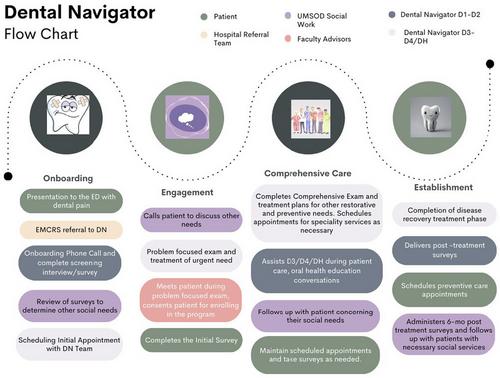
With this aim in mind, we identified the need for an integrative interdisciplinary solution to address the gaps that currently exist including the reliance on emergency services for routine dental needs. To do this, we created and implemented a novel patient navigation system undescribed in the dental literature, the Dental Navigator (DN). The DN is a team of dental, dental hygiene, and social work faculty, and staff, that exists not only to assess patient needs, but to become the ‘‘key contact for the patient, who helps facilitate other necessary social services such as help acquiring federal, state, or private dental insurance, and interprofessional medical care communication and coordination outside of dentistry. Patients are referred to the DN from the MM Emergency Referral Services (EMRS). The EMRS team referrals the patient to the SoD DN team after they have been seen in MM ED for a nontraumatic dental condition. The DN teams consist of a dental faculty, D1–D4 dental students, D3 and D4 dental hygiene students, and the dental school social worker. These teams begin by establishing prompt communication between provider and patient as effective communication is directly proportional to patient satisfaction.5 The team focuses on prioritizing the treatment of the patients' urgent dental needs to expediently address the patients' pain status, often, entailing a prompt appointment in oral surgery and/or endodontics. The team also provides tailored oral health education and prevention strategies, as well as works with the school social worker to implement strategies that address socioeconomic barriers. Finally, the team facilitates both dental and interdisciplinary care coordination which became apparent during the needs assessment appointments. Patient outcomes are monitored through the collection of pre-, mid-, and post-surveys. Thus far, we have been successful in screening, treating, and enrolling these patients into the dental school patient population as their dental home (Figure 1).
Despite many initial successes with scheduling screened patients with the DN teams, it has been a challenge to get patients to keep their initial appointments. Patient data surveys have indicated around 26% of enrolled DN patients report they have difficulty attending appointments. When asked what those difficulties are, the most commonly reported responses were difficulties concerning transportation, childcare, and general health literacy. For instance, one patient currently enrolled in the program relies solely on her daughter for transportation to her dental/medical visits. For those who present for their initial appointments, patient retention and compliance for nonurgent disease control and corrective needs have also been difficult. To date, the program has been successful in rescheduling 33% of enrolled patients into preventive care appointments. We believe a DN can help establish trust with the patient during screening and other communications by not only addressing dental concerns but by providing resources to address their specific barriers to care and to provide specific oral health and general health education helping to increase the patients’ value of scheduling and maintaining primary preventive care appointments.
Not only does the DN focus on efficient and timely dental care, but it also provides dental students with the opportunity to directly participate in interdisciplinary health teams and gain a better understanding of how large health systems work. At an individual level, students gain firsthand experience with identifying and addressing social determinants of health, which serves to advance their patient communication skills. The pilot version of the DN utilized four dental and two dental hygiene students and one social work graduate student. When asked about their experiences, all of them felt this experience added to their dental education, this was particularly evident in their understanding of barriers to care, how emergency services work, and their interest in continuing to work with this population following graduation. One student is interested in continuing this work in the future and this project has helped them consider potential future applications, “I would like to continue to work with community partners in my future career. It would be great if we could help jump-start a connection between community partners and the dental field to help make referrals and interprofessional relationships easier between our fields.”
We recognize the DN as a potential role to engage patients and improve communication between medical and dental professionals for effective patient management and improved patient outcomes. The establishment of this novel role has the potential for dentistry to better address patients’ dental needs, improve retention in established dental homes, reduce the burden on the EDs of dental urgencies, gather data regarding social determinants of health, and better prepare prospective graduates for their future patient care pursuits,creating a more accessible, inclusive, and equitable oral healthcare system. Though there is significant data in the medical setting, data, and outcomes are needed in the dental setting. Further work is needed to assess patient barriers in dental healthcare settings and the role a navigator may have on outcomes. With this in mind, our future goal is to assess outcomes from the pilot DN programming and to disseminate the findings in a more complete series of manuscripts that will reiterate the value of this unique role within dentistry.
期刊介绍:
The Journal of Dental Education (JDE) is a peer-reviewed monthly journal that publishes a wide variety of educational and scientific research in dental, allied dental and advanced dental education. Published continuously by the American Dental Education Association since 1936 and internationally recognized as the premier journal for academic dentistry, the JDE publishes articles on such topics as curriculum reform, education research methods, innovative educational and assessment methodologies, faculty development, community-based dental education, student recruitment and admissions, professional and educational ethics, dental education around the world and systematic reviews of educational interest. The JDE is one of the top scholarly journals publishing the most important work in oral health education today; it celebrated its 80th anniversary in 2016.



 京公网安备 11010802042870号
京ICP备2023020795号-1
京公网安备 11010802042870号
京ICP备2023020795号-1

 分享
分享
 求助内容:
求助内容: 应助结果提醒方式:
 扫码关注我们
