Bo Guan , Li Wang , Yunchang Xin , Peidong Wu , Jing Xu , Xiaoxu Huang , Qing Liu
{"title":"Double-peak strain hardening behavior of Mg–1.2 wt.%Y alloy","authors":"Bo Guan , Li Wang , Yunchang Xin , Peidong Wu , Jing Xu , Xiaoxu Huang , Qing Liu","doi":"10.1016/j.ijplas.2024.104041","DOIUrl":null,"url":null,"abstract":"<div><p>In this study, the mechanical behavior and deformation mechanism of an extruded Mg–1.2 wt.%Y rod under tension and compression along the extrusion direction (ED) were systematically investigated through experiments and crystal plasticity simulations. A double-peak strain hardening behavior comprising five distinct stages was observed under compression along the ED. The five stages are as follows: a fast drop in the strain hardening rate (stage I), steady increase in the strain hardening rate (stage II), gradual decrease in the hardening rate (stage III), second increase in the strain hardening rate (stage IV), and rapid decrease in the strain hardening rate (stage V). This unique strain hardening behavior led to an ultimate compressive strength of up to 539 MPa at a high strain of 0.4. Crystal plastic simulations using an elastic viscoplastic self-consistent model revealed a high activity and a long process of {10<span><math><mover><mn>1</mn><mo>¯</mo></mover></math></span>2} twinning in a strain range of 0–0.35 under compression along the ED. The twinning behavior examined via electron backscattering diffraction indicated that the {10<span><math><mover><mn>1</mn><mo>¯</mo></mover></math></span>2} twinning was activated in both grains with relatively high and very low Schmid factors. Subsequently, the mechanism for the presence of this double-peak strain hardening was established and, finally, the significance of this double-peak strain hardening for strengthening Mg alloys was discussed.</p></div>","PeriodicalId":340,"journal":{"name":"International Journal of Plasticity","volume":"179 ","pages":"Article 104041"},"PeriodicalIF":12.8000,"publicationDate":"2024-08-01","publicationTypes":"Journal Article","fieldsOfStudy":null,"isOpenAccess":false,"openAccessPdf":"","citationCount":"0","resultStr":null,"platform":"Semanticscholar","paperid":null,"PeriodicalName":"International Journal of Plasticity","FirstCategoryId":"88","ListUrlMain":"https://www.sciencedirect.com/science/article/pii/S0749641924001682","RegionNum":1,"RegionCategory":"材料科学","ArticlePicture":[],"TitleCN":null,"AbstractTextCN":null,"PMCID":null,"EPubDate":"2024/6/17 0:00:00","PubModel":"Epub","JCR":"Q1","JCRName":"ENGINEERING, MECHANICAL","Score":null,"Total":0}
引用次数: 0
Abstract
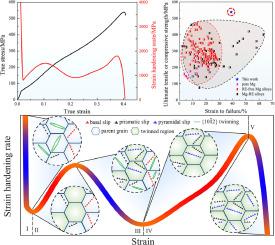
In this study, the mechanical behavior and deformation mechanism of an extruded Mg–1.2 wt.%Y rod under tension and compression along the extrusion direction (ED) were systematically investigated through experiments and crystal plasticity simulations. A double-peak strain hardening behavior comprising five distinct stages was observed under compression along the ED. The five stages are as follows: a fast drop in the strain hardening rate (stage I), steady increase in the strain hardening rate (stage II), gradual decrease in the hardening rate (stage III), second increase in the strain hardening rate (stage IV), and rapid decrease in the strain hardening rate (stage V). This unique strain hardening behavior led to an ultimate compressive strength of up to 539 MPa at a high strain of 0.4. Crystal plastic simulations using an elastic viscoplastic self-consistent model revealed a high activity and a long process of {102} twinning in a strain range of 0–0.35 under compression along the ED. The twinning behavior examined via electron backscattering diffraction indicated that the {102} twinning was activated in both grains with relatively high and very low Schmid factors. Subsequently, the mechanism for the presence of this double-peak strain hardening was established and, finally, the significance of this double-peak strain hardening for strengthening Mg alloys was discussed.
期刊介绍:
International Journal of Plasticity aims to present original research encompassing all facets of plastic deformation, damage, and fracture behavior in both isotropic and anisotropic solids. This includes exploring the thermodynamics of plasticity and fracture, continuum theory, and macroscopic as well as microscopic phenomena.
Topics of interest span the plastic behavior of single crystals and polycrystalline metals, ceramics, rocks, soils, composites, nanocrystalline and microelectronics materials, shape memory alloys, ferroelectric ceramics, thin films, and polymers. Additionally, the journal covers plasticity aspects of failure and fracture mechanics. Contributions involving significant experimental, numerical, or theoretical advancements that enhance the understanding of the plastic behavior of solids are particularly valued. Papers addressing the modeling of finite nonlinear elastic deformation, bearing similarities to the modeling of plastic deformation, are also welcomed.