{"title":"On the anisotropic coalescence of elliptic cylindrical voids considering the geometric and distributive properties","authors":"Jiawei Chen, Tsuyoshi Furushima","doi":"10.1016/j.ijplas.2024.104036","DOIUrl":null,"url":null,"abstract":"<div><p>The geometric and distributive properties of voids significantly influence anisotropic coalescence behaviour. However, this problem has received little attention owing to the complexity of considering all the properties in the current analytical framework of limit analysis. To address this issue, this study proposes an analytical framework based on an elliptic coordinate system, including the determination of the ligament zone, characterization of plastic flow, and derivation of the void coalescence criterion, for porous materials with various geometric and distributive properties, including size, shape, spacing, and orientation. This framework is motivated by our observations that the evolution of the void geometry and surrounding plastic flow can be well characterized by the grid of the elliptic coordinate system. Subsequently, an analytical function is proposed to determine the ligament zone and coalescence direction with various void properties. A hollow nonaxisymmetric cylindrical unit cell is proposed to describe this ligament zone, and the corresponding trial velocity field is derived by extending the previous Gurson-like velocity field into the elliptic cylindrical coordinate system. The rationality of the field is validated by comparing its equivalent strain rate field with numerical simulations. Finally, a coalescence criterion is derived via the limit analysis of the proposed unit cell undergoing internal necking. Two heuristic adjustments are formulated for the overflow phenomenon in the rigid zone and outer ligament zones. Numerical assessments with various void properties confirm the accuracy of the analytical model. The coalescence criterion can predict the independent and coupling effects of geometric and distributive properties on anisotropic void coalescence. This study provides possible solutions to future plasticity problems of ellipsoidal inclusions.</p></div>","PeriodicalId":340,"journal":{"name":"International Journal of Plasticity","volume":"179 ","pages":"Article 104036"},"PeriodicalIF":12.8000,"publicationDate":"2024-08-01","publicationTypes":"Journal Article","fieldsOfStudy":null,"isOpenAccess":false,"openAccessPdf":"https://www.sciencedirect.com/science/article/pii/S0749641924001633/pdfft?md5=62c81b82e160fc6ca9282ed0bd83035e&pid=1-s2.0-S0749641924001633-main.pdf","citationCount":"0","resultStr":null,"platform":"Semanticscholar","paperid":null,"PeriodicalName":"International Journal of Plasticity","FirstCategoryId":"88","ListUrlMain":"https://www.sciencedirect.com/science/article/pii/S0749641924001633","RegionNum":1,"RegionCategory":"材料科学","ArticlePicture":[],"TitleCN":null,"AbstractTextCN":null,"PMCID":null,"EPubDate":"2024/6/17 0:00:00","PubModel":"Epub","JCR":"Q1","JCRName":"ENGINEERING, MECHANICAL","Score":null,"Total":0}
引用次数: 0
Abstract
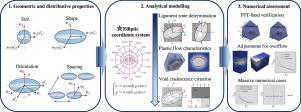
The geometric and distributive properties of voids significantly influence anisotropic coalescence behaviour. However, this problem has received little attention owing to the complexity of considering all the properties in the current analytical framework of limit analysis. To address this issue, this study proposes an analytical framework based on an elliptic coordinate system, including the determination of the ligament zone, characterization of plastic flow, and derivation of the void coalescence criterion, for porous materials with various geometric and distributive properties, including size, shape, spacing, and orientation. This framework is motivated by our observations that the evolution of the void geometry and surrounding plastic flow can be well characterized by the grid of the elliptic coordinate system. Subsequently, an analytical function is proposed to determine the ligament zone and coalescence direction with various void properties. A hollow nonaxisymmetric cylindrical unit cell is proposed to describe this ligament zone, and the corresponding trial velocity field is derived by extending the previous Gurson-like velocity field into the elliptic cylindrical coordinate system. The rationality of the field is validated by comparing its equivalent strain rate field with numerical simulations. Finally, a coalescence criterion is derived via the limit analysis of the proposed unit cell undergoing internal necking. Two heuristic adjustments are formulated for the overflow phenomenon in the rigid zone and outer ligament zones. Numerical assessments with various void properties confirm the accuracy of the analytical model. The coalescence criterion can predict the independent and coupling effects of geometric and distributive properties on anisotropic void coalescence. This study provides possible solutions to future plasticity problems of ellipsoidal inclusions.
期刊介绍:
International Journal of Plasticity aims to present original research encompassing all facets of plastic deformation, damage, and fracture behavior in both isotropic and anisotropic solids. This includes exploring the thermodynamics of plasticity and fracture, continuum theory, and macroscopic as well as microscopic phenomena.
Topics of interest span the plastic behavior of single crystals and polycrystalline metals, ceramics, rocks, soils, composites, nanocrystalline and microelectronics materials, shape memory alloys, ferroelectric ceramics, thin films, and polymers. Additionally, the journal covers plasticity aspects of failure and fracture mechanics. Contributions involving significant experimental, numerical, or theoretical advancements that enhance the understanding of the plastic behavior of solids are particularly valued. Papers addressing the modeling of finite nonlinear elastic deformation, bearing similarities to the modeling of plastic deformation, are also welcomed.



 京公网安备 11010802042870号
京ICP备2023020795号-1
京公网安备 11010802042870号
京ICP备2023020795号-1

 分享
分享
 求助内容:
求助内容: 应助结果提醒方式:
 扫码关注我们
