Mette Axelsson Bjerg , Eva-Maria Ekstrand , Ingrid Sundgren , Sepehr Shakeri Yekta , Jan Moestedt , Annika Björn
{"title":"Moderate thermal post-treatment of digestate to improve biomethane production from agricultural- and food waste","authors":"Mette Axelsson Bjerg , Eva-Maria Ekstrand , Ingrid Sundgren , Sepehr Shakeri Yekta , Jan Moestedt , Annika Björn","doi":"10.1016/j.biteb.2024.101887","DOIUrl":null,"url":null,"abstract":"<div><p>The aim of this study was to assess the feasibility of moderate thermal treatment (70 °C for one hour) of digestate in combination with post-digestion targeting residual biomethane potentials from three full-scale biogas plants digesting food waste (FW), agricultural waste (AW) and a mixture of AW and manure (AWM). Dissolved organic carbon (DOC), biomethane production, and digestate quality were investigated. For the study six laboratory-scale continuously stirred tank biogas reactors working as post-digesters, with thermally-treated and non-treated digestate were used. DOC for thermally-treated digestates increased significantly (<em>t</em>-test, <em>p</em> < 0.05); FW-digestate (110–200 %), AW-digestate (24–92 %) and for AWM-digestate (4–73 %). Indexes for corresponding DOC quality showed lower apparent organic molecular weights and decreased aromaticity (with the exception of FW-digestate). Thermal treatment of digestate improved the biomethane production during post-digestion by 21–22 % (FW-digestate) and 9 % (AW-digestate). For AMW-digestate no clear positive effect was observed, most likely due to biogas plant operational process disturbances.</p></div>","PeriodicalId":8947,"journal":{"name":"Bioresource Technology Reports","volume":"27 ","pages":"Article 101887"},"PeriodicalIF":0.0000,"publicationDate":"2024-06-19","publicationTypes":"Journal Article","fieldsOfStudy":null,"isOpenAccess":false,"openAccessPdf":"https://www.sciencedirect.com/science/article/pii/S2589014X24001282/pdfft?md5=0bb84ea9565fe33376470868adf43e49&pid=1-s2.0-S2589014X24001282-main.pdf","citationCount":"0","resultStr":null,"platform":"Semanticscholar","paperid":null,"PeriodicalName":"Bioresource Technology Reports","FirstCategoryId":"1085","ListUrlMain":"https://www.sciencedirect.com/science/article/pii/S2589014X24001282","RegionNum":0,"RegionCategory":null,"ArticlePicture":[],"TitleCN":null,"AbstractTextCN":null,"PMCID":null,"EPubDate":"","PubModel":"","JCR":"Q1","JCRName":"Environmental Science","Score":null,"Total":0}
引用次数: 0
Abstract
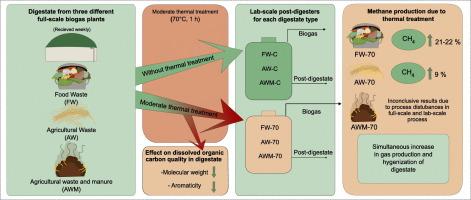
The aim of this study was to assess the feasibility of moderate thermal treatment (70 °C for one hour) of digestate in combination with post-digestion targeting residual biomethane potentials from three full-scale biogas plants digesting food waste (FW), agricultural waste (AW) and a mixture of AW and manure (AWM). Dissolved organic carbon (DOC), biomethane production, and digestate quality were investigated. For the study six laboratory-scale continuously stirred tank biogas reactors working as post-digesters, with thermally-treated and non-treated digestate were used. DOC for thermally-treated digestates increased significantly (t-test, p < 0.05); FW-digestate (110–200 %), AW-digestate (24–92 %) and for AWM-digestate (4–73 %). Indexes for corresponding DOC quality showed lower apparent organic molecular weights and decreased aromaticity (with the exception of FW-digestate). Thermal treatment of digestate improved the biomethane production during post-digestion by 21–22 % (FW-digestate) and 9 % (AW-digestate). For AMW-digestate no clear positive effect was observed, most likely due to biogas plant operational process disturbances.




 京公网安备 11010802042870号
京ICP备2023020795号-1
京公网安备 11010802042870号
京ICP备2023020795号-1

 分享
分享
 求助内容:
求助内容: 应助结果提醒方式:
 扫码关注我们
