{"title":"Quinoidal π-extension of dipyranylidene derivatives: towards efficient dopants for n-type organic semiconductors†‡","authors":"Takaya Matsuo , Kohsuke Kawabata , Kazuo Takimiya","doi":"10.1039/d4qo00961d","DOIUrl":null,"url":null,"abstract":"<div><div>Quinoidal π-extended dipyranylidene derivatives, 2,2′,6,6′-tetraphenyl-4,4′-(cyclohexa-1,4-diene-3,6-diylidene)dipyran (<strong>DP8</strong>) and its tetrakis(dimethylamino) derivative (<strong>DP9</strong>), were newly synthesized and characterized. <strong>DP8</strong>, with the HOMO energy level (<em>E</em><sub>HOMO</sub>) of −4.2 eV, was isolated as a stable compound, whereas <strong>DP9</strong>, with a very high-lying <em>E</em><sub>HOMO</sub> of −3.9 eV, was unstable under ambient air conditions. Nevertheless, they were well characterized by means of single-crystal X-ray analysis. Based on the bond lengths and theoretical calculations, it was concluded that they mainly have a quinoidal character in the crystalline state. <strong>DP9</strong>, with the highest <em>E</em><sub>HOMO</sub> among the dipyranylidene-based n-type dopants, acted as an efficient dopant to polybenzimidazobenzophenanthroline (BBL) with a low-lying LUMO energy level (<em>E</em><sub>LUMO</sub>) of −4.3 eV and to N2200 with an <em>E</em><sub>LUMO</sub> of −3.8 eV. Although the ambient stability of <strong>DP9</strong> was still an issue, the quinoidal π-extension is an efficient strategy to develop n-type dopants with “Weitz type” molecules.</div></div>","PeriodicalId":94379,"journal":{"name":"Organic chemistry frontiers : an international journal of organic chemistry","volume":"11 17","pages":"Pages 4682-4688"},"PeriodicalIF":0.0000,"publicationDate":"2024-07-16","publicationTypes":"Journal Article","fieldsOfStudy":null,"isOpenAccess":false,"openAccessPdf":"","citationCount":"0","resultStr":null,"platform":"Semanticscholar","paperid":null,"PeriodicalName":"Organic chemistry frontiers : an international journal of organic chemistry","FirstCategoryId":"1085","ListUrlMain":"https://www.sciencedirect.com/org/science/article/pii/S2052412924004649","RegionNum":0,"RegionCategory":null,"ArticlePicture":[],"TitleCN":null,"AbstractTextCN":null,"PMCID":null,"EPubDate":"2024/7/3 0:00:00","PubModel":"Epub","JCR":"","JCRName":"","Score":null,"Total":0}
引用次数: 0
Abstract
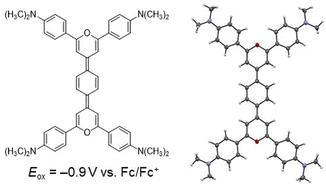
Quinoidal π-extended dipyranylidene derivatives, 2,2′,6,6′-tetraphenyl-4,4′-(cyclohexa-1,4-diene-3,6-diylidene)dipyran (DP8) and its tetrakis(dimethylamino) derivative (DP9), were newly synthesized and characterized. DP8, with the HOMO energy level (EHOMO) of −4.2 eV, was isolated as a stable compound, whereas DP9, with a very high-lying EHOMO of −3.9 eV, was unstable under ambient air conditions. Nevertheless, they were well characterized by means of single-crystal X-ray analysis. Based on the bond lengths and theoretical calculations, it was concluded that they mainly have a quinoidal character in the crystalline state. DP9, with the highest EHOMO among the dipyranylidene-based n-type dopants, acted as an efficient dopant to polybenzimidazobenzophenanthroline (BBL) with a low-lying LUMO energy level (ELUMO) of −4.3 eV and to N2200 with an ELUMO of −3.8 eV. Although the ambient stability of DP9 was still an issue, the quinoidal π-extension is an efficient strategy to develop n-type dopants with “Weitz type” molecules.



 京公网安备 11010802042870号
京ICP备2023020795号-1
京公网安备 11010802042870号
京ICP备2023020795号-1

 分享
分享

 求助内容:
求助内容: 应助结果提醒方式:
 扫码关注我们
