Piezoelectric and Triboelectric Contributions by Aromatic Hyperbranched Polyesters of Second-Generation/PVDF Nanofiber-Based Nanogenerators for Energy Harvesting and Wearable Electronics
Ramadasu Gunasekhar, Amrutha Bindhu, Mohammad Shamim Reza, Anand Prabu Arun, Kap Jin Kim, Hongdoo Kim
{"title":"Piezoelectric and Triboelectric Contributions by Aromatic Hyperbranched Polyesters of Second-Generation/PVDF Nanofiber-Based Nanogenerators for Energy Harvesting and Wearable Electronics","authors":"Ramadasu Gunasekhar, Amrutha Bindhu, Mohammad Shamim Reza, Anand Prabu Arun, Kap Jin Kim, Hongdoo Kim","doi":"10.1021/acsaelm.4c00556","DOIUrl":null,"url":null,"abstract":"Piezoelectric nanogenerators (PENGs) and triboelectric nanogenerators (TENGs) are among the emerging technologies as energy harvesters, aided by their cost-effective device architecture and ease of fabrication. The present study investigates the influence of electrospun polyvinylidene fluoride (PVDF) blended with second-generation aromatic hyperbranched polyester (Ar.HBP-G2) of varied content (0 to 40 wt % relative to PVDF content) on the electrical characteristics of PENG/TENG devices. The optimized PVDF/Ar.HBP-G2–10-based PENG device produced an open-circuit voltage of 9.54 V, and the TENG device produced an open-circuit voltage and short-circuit current of 158 V and 1.6 μA, respectively. Further, the fabricated PENG and TENG devices were tested for real-time applications to power up portable electronic devices and human healthcare monitoring from the harvested mechanical energy. Additionally, the long-term mechanical steadiness of the TENG was also studied. The above results provide great possibilities for fabricating high-performance and cost-effective energy harvesting and wearable devices.","PeriodicalId":3,"journal":{"name":"ACS Applied Electronic Materials","volume":"11 1","pages":""},"PeriodicalIF":4.7000,"publicationDate":"2024-07-02","publicationTypes":"Journal Article","fieldsOfStudy":null,"isOpenAccess":false,"openAccessPdf":"","citationCount":"0","resultStr":null,"platform":"Semanticscholar","paperid":null,"PeriodicalName":"ACS Applied Electronic Materials","FirstCategoryId":"88","ListUrlMain":"https://doi.org/10.1021/acsaelm.4c00556","RegionNum":3,"RegionCategory":"材料科学","ArticlePicture":[],"TitleCN":null,"AbstractTextCN":null,"PMCID":null,"EPubDate":"","PubModel":"","JCR":"Q1","JCRName":"ENGINEERING, ELECTRICAL & ELECTRONIC","Score":null,"Total":0}
引用次数: 0
Abstract
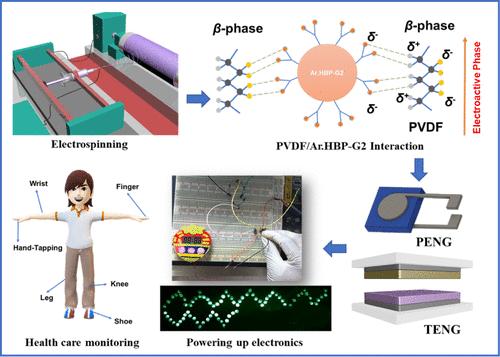
Piezoelectric nanogenerators (PENGs) and triboelectric nanogenerators (TENGs) are among the emerging technologies as energy harvesters, aided by their cost-effective device architecture and ease of fabrication. The present study investigates the influence of electrospun polyvinylidene fluoride (PVDF) blended with second-generation aromatic hyperbranched polyester (Ar.HBP-G2) of varied content (0 to 40 wt % relative to PVDF content) on the electrical characteristics of PENG/TENG devices. The optimized PVDF/Ar.HBP-G2–10-based PENG device produced an open-circuit voltage of 9.54 V, and the TENG device produced an open-circuit voltage and short-circuit current of 158 V and 1.6 μA, respectively. Further, the fabricated PENG and TENG devices were tested for real-time applications to power up portable electronic devices and human healthcare monitoring from the harvested mechanical energy. Additionally, the long-term mechanical steadiness of the TENG was also studied. The above results provide great possibilities for fabricating high-performance and cost-effective energy harvesting and wearable devices.
期刊介绍:
ACS Applied Electronic Materials is an interdisciplinary journal publishing original research covering all aspects of electronic materials. The journal is devoted to reports of new and original experimental and theoretical research of an applied nature that integrate knowledge in the areas of materials science, engineering, optics, physics, and chemistry into important applications of electronic materials. Sample research topics that span the journal's scope are inorganic, organic, ionic and polymeric materials with properties that include conducting, semiconducting, superconducting, insulating, dielectric, magnetic, optoelectronic, piezoelectric, ferroelectric and thermoelectric.
Indexed/Abstracted:
Web of Science SCIE
Scopus
CAS
INSPEC
Portico




 京公网安备 11010802042870号
京ICP备2023020795号-1
京公网安备 11010802042870号
京ICP备2023020795号-1

 分享
分享
 求助内容:
求助内容: 应助结果提醒方式:
 扫码关注我们
