{"title":"Physics-Enhanced NMF Toward Anomaly Detection in Rotating Mechanical Systems","authors":"Bingxin Yan;Xiaobing Ma;Qiuzhuang Sun;Lijuan Shen","doi":"10.1109/TR.2024.3417262","DOIUrl":null,"url":null,"abstract":"With the advancements in sensor technology, it is now possible to measure and record a multitude of features that reflect the health condition of complex systems. These measurements are stored in a sizable data matrix, enabling the detection of anomalies. Nevertheless, the presence of this large data matrix poses a significant computational burden. The dimension-reduction methods, such as non-negative matrix factorization (NMF), can efficiently reduce computational burden. However, their pure data-driven nature can lead to overfitting and biases in anomaly detection results. To address this shortcoming, we propose a physics-enhanced NMF (PNMF) method by incorporating physical knowledge into NMF with the help of graph technique. The graph technique organizes measurements and features into two graph objects, respectively, and the physical knowledge guides the formation of edges between nodes in the graph. This allows the PNMF to capture not only the data-driven patterns but also the physical structure inherent in the system. The closed-form update algorithm is developed for the PNMF model, which can guarantee the convergence of parameters estimation. The superior performance of the PNMF model in detecting anomalies is demonstrated by comparing prevailing methods in both public datasets and real-world applications.","PeriodicalId":56305,"journal":{"name":"IEEE Transactions on Reliability","volume":"74 3","pages":"3911-3925"},"PeriodicalIF":5.7000,"publicationDate":"2024-07-01","publicationTypes":"Journal Article","fieldsOfStudy":null,"isOpenAccess":false,"openAccessPdf":"","citationCount":"0","resultStr":null,"platform":"Semanticscholar","paperid":null,"PeriodicalName":"IEEE Transactions on Reliability","FirstCategoryId":"94","ListUrlMain":"https://ieeexplore.ieee.org/document/10579702/","RegionNum":2,"RegionCategory":"计算机科学","ArticlePicture":[],"TitleCN":null,"AbstractTextCN":null,"PMCID":null,"EPubDate":"","PubModel":"","JCR":"Q1","JCRName":"COMPUTER SCIENCE, HARDWARE & ARCHITECTURE","Score":null,"Total":0}
引用次数: 0
Abstract
With the advancements in sensor technology, it is now possible to measure and record a multitude of features that reflect the health condition of complex systems. These measurements are stored in a sizable data matrix, enabling the detection of anomalies. Nevertheless, the presence of this large data matrix poses a significant computational burden. The dimension-reduction methods, such as non-negative matrix factorization (NMF), can efficiently reduce computational burden. However, their pure data-driven nature can lead to overfitting and biases in anomaly detection results. To address this shortcoming, we propose a physics-enhanced NMF (PNMF) method by incorporating physical knowledge into NMF with the help of graph technique. The graph technique organizes measurements and features into two graph objects, respectively, and the physical knowledge guides the formation of edges between nodes in the graph. This allows the PNMF to capture not only the data-driven patterns but also the physical structure inherent in the system. The closed-form update algorithm is developed for the PNMF model, which can guarantee the convergence of parameters estimation. The superior performance of the PNMF model in detecting anomalies is demonstrated by comparing prevailing methods in both public datasets and real-world applications.
期刊介绍:
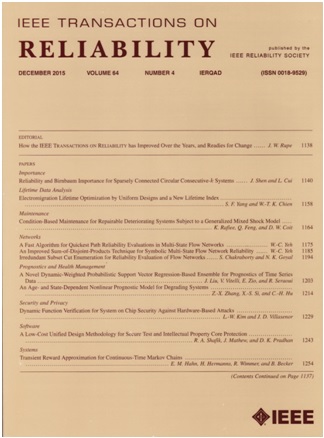
IEEE Transactions on Reliability is a refereed journal for the reliability and allied disciplines including, but not limited to, maintainability, physics of failure, life testing, prognostics, design and manufacture for reliability, reliability for systems of systems, network availability, mission success, warranty, safety, and various measures of effectiveness. Topics eligible for publication range from hardware to software, from materials to systems, from consumer and industrial devices to manufacturing plants, from individual items to networks, from techniques for making things better to ways of predicting and measuring behavior in the field. As an engineering subject that supports new and existing technologies, we constantly expand into new areas of the assurance sciences.




 京公网安备 11010802042870号
京ICP备2023020795号-1
京公网安备 11010802042870号
京ICP备2023020795号-1

 分享
分享
 求助内容:
求助内容: 应助结果提醒方式:
 扫码关注我们
