{"title":"Superhydrophilic Self-supported Perovskite Oxides for Oxygen Evolution Reactions in Oilfield Wastewater","authors":"Jianzhao Cao, Salman Riaz, Zhaoxiang Qi, Ke Zhao, Ying Qi, Peng Wei, Yahong Xie","doi":"10.1007/s10562-024-04753-4","DOIUrl":null,"url":null,"abstract":"<div><p>Developing highly efficient catalysts for oxygen evolution reactions (OER) in complex water environments is crucial for promoting the photovoltaic electrolysis of water splitting for hydrogen production in arid areas. However, traditional catalysts often exhibit limitations in terms of reaction kinetics and electrode corrosion resistance. In this work, we successfully prepared a self-supporting perovskite complex oxide La<sub>0.7</sub>Sr<sub>0.3</sub>CoO<sub>3-δ</sub>/NF (LSC/NF) catalyst by means of simple hydrothermal synthesis combined with programmed annealing, and successfully applied to OER reaction in oilfield wastewater. In alkaline oilfield wastewater, at a current density of 10 mA cm<sup>−2</sup>, LSC/NF requires only 411 mV of overpotential, which is lower than that of LSC (493 mV) and traditional catalyst RuO<sub>2</sub> (451 mV), suggesting a high OER catalytic activity. The good electrocatalytic activity can be attributed to its superhydrophilicity, increased electrochemical active surface area, faster reaction kinetics and higher oxygen vacancy concentration. This research offers valuable new insights for the development of OER electrocatalysts with high catalytic activity in complex water systems in arid areas.</p><h3>Graphical Abstract</h3><p>A self-supporting perovskite oxide catalyst La<sub>0.7</sub>Sr<sub>0.3</sub>CoO<sub>3-δ</sub>/NF was synthesized by a simple process combining hydrothermal and annealing. The growth of perovskite oxide nanosheets directly on the conductive nickel foam matrix gives the catalyst a strong hydrophilicity and significantly expands its electrochemical active surface area, thus enhancing the OER activity of LSC/NF in oilfield wastewater.</p>\n<div><figure><div><div><picture><source><img></source></picture></div></div></figure></div></div>","PeriodicalId":508,"journal":{"name":"Catalysis Letters","volume":"154 10","pages":"5350 - 5358"},"PeriodicalIF":2.3000,"publicationDate":"2024-06-20","publicationTypes":"Journal Article","fieldsOfStudy":null,"isOpenAccess":false,"openAccessPdf":"","citationCount":"0","resultStr":null,"platform":"Semanticscholar","paperid":null,"PeriodicalName":"Catalysis Letters","FirstCategoryId":"92","ListUrlMain":"https://link.springer.com/article/10.1007/s10562-024-04753-4","RegionNum":4,"RegionCategory":"化学","ArticlePicture":[],"TitleCN":null,"AbstractTextCN":null,"PMCID":null,"EPubDate":"","PubModel":"","JCR":"Q3","JCRName":"CHEMISTRY, PHYSICAL","Score":null,"Total":0}
引用次数: 0
Abstract
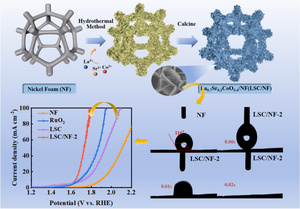
Developing highly efficient catalysts for oxygen evolution reactions (OER) in complex water environments is crucial for promoting the photovoltaic electrolysis of water splitting for hydrogen production in arid areas. However, traditional catalysts often exhibit limitations in terms of reaction kinetics and electrode corrosion resistance. In this work, we successfully prepared a self-supporting perovskite complex oxide La0.7Sr0.3CoO3-δ/NF (LSC/NF) catalyst by means of simple hydrothermal synthesis combined with programmed annealing, and successfully applied to OER reaction in oilfield wastewater. In alkaline oilfield wastewater, at a current density of 10 mA cm−2, LSC/NF requires only 411 mV of overpotential, which is lower than that of LSC (493 mV) and traditional catalyst RuO2 (451 mV), suggesting a high OER catalytic activity. The good electrocatalytic activity can be attributed to its superhydrophilicity, increased electrochemical active surface area, faster reaction kinetics and higher oxygen vacancy concentration. This research offers valuable new insights for the development of OER electrocatalysts with high catalytic activity in complex water systems in arid areas.
Graphical Abstract
A self-supporting perovskite oxide catalyst La0.7Sr0.3CoO3-δ/NF was synthesized by a simple process combining hydrothermal and annealing. The growth of perovskite oxide nanosheets directly on the conductive nickel foam matrix gives the catalyst a strong hydrophilicity and significantly expands its electrochemical active surface area, thus enhancing the OER activity of LSC/NF in oilfield wastewater.
期刊介绍:
Catalysis Letters aim is the rapid publication of outstanding and high-impact original research articles in catalysis. The scope of the journal covers a broad range of topics in all fields of both applied and theoretical catalysis, including heterogeneous, homogeneous and biocatalysis.
The high-quality original research articles published in Catalysis Letters are subject to rigorous peer review. Accepted papers are published online first and subsequently in print issues. All contributions must include a graphical abstract. Manuscripts should be written in English and the responsibility lies with the authors to ensure that they are grammatically and linguistically correct. Authors for whom English is not the working language are encouraged to consider using a professional language-editing service before submitting their manuscripts.



 京公网安备 11010802042870号
京ICP备2023020795号-1
京公网安备 11010802042870号
京ICP备2023020795号-1

 分享
分享
 求助内容:
求助内容: 应助结果提醒方式:
 扫码关注我们
