Nabi Ullah, Dariusz Guziejewski, Asim Mahmood, Sami Ullah, Sikandar Khan, Shahid Hussain, Muhammad Imran
{"title":"Three-Dimensionally Arranged NiSe2 Nanosheets as an Efficient Electrocatalyst for Methanol Electrooxidation Reaction","authors":"Nabi Ullah, Dariusz Guziejewski, Asim Mahmood, Sami Ullah, Sikandar Khan, Shahid Hussain, Muhammad Imran","doi":"10.1002/ente.202400390","DOIUrl":null,"url":null,"abstract":"<p>Methanol oxidation stands out as a pivotal solution in addressing the global energy crisis and environmental pollution, owing to its practical applicability, high current density, and the ready availability of methanol as a fuel source. To effectively catalyze methanol oxidation, an electrocatalyst is imperious to overcome the activation energy barrier. Herein, a three-dimensionally arranged NiSe<sub>2</sub> nanosheet-based electrocatalyst is synthesized through a facile solvothermal followed by an annealing method. The catalyst's porous structure enhances catalytic efficiency by providing a substantial electrochemical surface area (ECSA) equivalent to 0.121 mF cm<sup>−2</sup>. Notably, the electrocatalyst exhibits a remarkable response of 21.58 mA cm<sup>−2</sup> at an overpotential of 1.70 V vs RHE, accompanied by the lowest Tafel slope recorded at 39.14 mV dec<sup>−1</sup>. The electronic circuit, represented by <i>R</i><sub>s</sub>(<i>Q</i><sub>f</sub>(<i>R</i><sub>f</sub><i>W</i>(<i>Q</i><sub>dl</sub><i>R</i><sub>ct</sub>)), aligns well with electrochemical impedance spectroscopy data, elucidating the reaction path and intrinsic properties. Furthermore, the catalytic performance is elucidated concerning ECSA and weight, revealing current densities of 5.60 mA cm<sup>−2</sup> and 71.34 mA mg<sup>−1</sup>, respectively. Impressively, the catalyst demonstrates exceptional resistance to poisoning and sustained stability over a continuous 3600-s operation. This comprehensive study underscores the promising potential of the NiSe<sub>2</sub> nanosheet-based electrocatalyst for efficient methanol oxidation, providing valuable insights for advancing clean energy technologies.</p>","PeriodicalId":11573,"journal":{"name":"Energy technology","volume":"12 9","pages":""},"PeriodicalIF":3.6000,"publicationDate":"2024-06-26","publicationTypes":"Journal Article","fieldsOfStudy":null,"isOpenAccess":false,"openAccessPdf":"","citationCount":"0","resultStr":null,"platform":"Semanticscholar","paperid":null,"PeriodicalName":"Energy technology","FirstCategoryId":"5","ListUrlMain":"https://onlinelibrary.wiley.com/doi/10.1002/ente.202400390","RegionNum":4,"RegionCategory":"工程技术","ArticlePicture":[],"TitleCN":null,"AbstractTextCN":null,"PMCID":null,"EPubDate":"","PubModel":"","JCR":"Q3","JCRName":"ENERGY & FUELS","Score":null,"Total":0}
引用次数: 0
Abstract
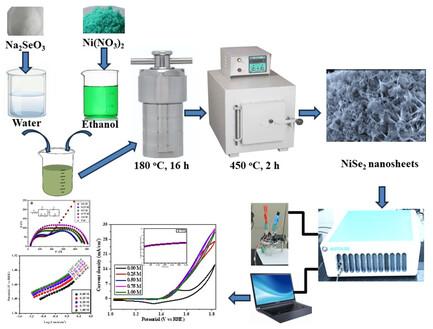
Methanol oxidation stands out as a pivotal solution in addressing the global energy crisis and environmental pollution, owing to its practical applicability, high current density, and the ready availability of methanol as a fuel source. To effectively catalyze methanol oxidation, an electrocatalyst is imperious to overcome the activation energy barrier. Herein, a three-dimensionally arranged NiSe2 nanosheet-based electrocatalyst is synthesized through a facile solvothermal followed by an annealing method. The catalyst's porous structure enhances catalytic efficiency by providing a substantial electrochemical surface area (ECSA) equivalent to 0.121 mF cm−2. Notably, the electrocatalyst exhibits a remarkable response of 21.58 mA cm−2 at an overpotential of 1.70 V vs RHE, accompanied by the lowest Tafel slope recorded at 39.14 mV dec−1. The electronic circuit, represented by Rs(Qf(RfW(QdlRct)), aligns well with electrochemical impedance spectroscopy data, elucidating the reaction path and intrinsic properties. Furthermore, the catalytic performance is elucidated concerning ECSA and weight, revealing current densities of 5.60 mA cm−2 and 71.34 mA mg−1, respectively. Impressively, the catalyst demonstrates exceptional resistance to poisoning and sustained stability over a continuous 3600-s operation. This comprehensive study underscores the promising potential of the NiSe2 nanosheet-based electrocatalyst for efficient methanol oxidation, providing valuable insights for advancing clean energy technologies.
期刊介绍:
Energy Technology provides a forum for researchers and engineers from all relevant disciplines concerned with the generation, conversion, storage, and distribution of energy.
This new journal shall publish articles covering all technical aspects of energy process engineering from different perspectives, e.g.,
new concepts of energy generation and conversion;
design, operation, control, and optimization of processes for energy generation (e.g., carbon capture) and conversion of energy carriers;
improvement of existing processes;
combination of single components to systems for energy generation;
design of systems for energy storage;
production processes of fuels, e.g., hydrogen, electricity, petroleum, biobased fuels;
concepts and design of devices for energy distribution.




 京公网安备 11010802042870号
京ICP备2023020795号-1
京公网安备 11010802042870号
京ICP备2023020795号-1

 分享
分享
 求助内容:
求助内容: 应助结果提醒方式:
 扫码关注我们
