Haipeng You, Yixiao Chen, Yue Li, Jun Chen, Xiyu Chen, Meifeng Liu, Shuai Dong, Jin Peng
{"title":"Evolution of Magnetism Induced by K+/La3+ Implantations in Double Perovskite Ba2MnTeO6","authors":"Haipeng You, Yixiao Chen, Yue Li, Jun Chen, Xiyu Chen, Meifeng Liu, Shuai Dong, Jin Peng","doi":"10.1021/acsaelm.4c00401","DOIUrl":null,"url":null,"abstract":"<i>B</i>-site rock salt type ordered double perovskites with general formula <i>A</i><sub>2</sub><i>B′B</i>″<i>X</i><sub>6</sub> have attracted a variety of attention due to remarkable magnetic properties and potential applications in spintronics. Here we report the structural, magnetic, and electronic properties of polycrystalline compounds Ba<sub>2</sub>MnTeO<sub>6</sub> and (Ba<sub>0.9</sub>X<sub>0.1</sub>)<sub>2</sub>MnTeO<sub>6</sub> (X = K/La) by powder X-ray diffraction, magnetic susceptibility measurements, specific heat measurements, and X-ray photoelectron spectroscopy. Ba<sub>2</sub>MnTeO<sub>6</sub> is antiferromagnetically ordered below 20 K. Density functional theory calculations show that Ba<sub>2</sub>MnTeO<sub>6</sub> prefers type III antiferromagnetic order with a dominant antiferromagnetic nearest-neighbor exchange and a weak ferromagnetic next-nearest-neighbor exchange. Our Monte Carlo simulations lead to a transition temperature of 28 K, consistent with the experimental results. Upon K<sup>+</sup>/La<sup>3+</sup> cations’ implantation on Ba sites, while (Ba<sub>0.9</sub>K<sub>0.1</sub>)<sub>2</sub>MnTeO<sub>6</sub> orders antiferromagnetically at 20 K, (Ba<sub>0.9</sub>La<sub>0.1</sub>)<sub>2</sub>MnTeO<sub>6</sub> exhibits superparamagnetism below room temperature, which may originate from oxygen ion adsorptions. These findings reveal the modulation of magnetism for Ba<sub>2</sub>MnTeO<sub>6</sub>, which may hint at potential applications of double perovskites in magnetic devices.","PeriodicalId":3,"journal":{"name":"ACS Applied Electronic Materials","volume":"61 1","pages":""},"PeriodicalIF":4.7000,"publicationDate":"2024-06-24","publicationTypes":"Journal Article","fieldsOfStudy":null,"isOpenAccess":false,"openAccessPdf":"","citationCount":"0","resultStr":null,"platform":"Semanticscholar","paperid":null,"PeriodicalName":"ACS Applied Electronic Materials","FirstCategoryId":"88","ListUrlMain":"https://doi.org/10.1021/acsaelm.4c00401","RegionNum":3,"RegionCategory":"材料科学","ArticlePicture":[],"TitleCN":null,"AbstractTextCN":null,"PMCID":null,"EPubDate":"","PubModel":"","JCR":"Q1","JCRName":"ENGINEERING, ELECTRICAL & ELECTRONIC","Score":null,"Total":0}
引用次数: 0
Abstract
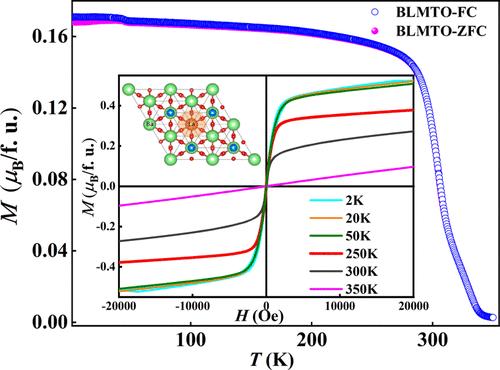
B-site rock salt type ordered double perovskites with general formula A2B′B″X6 have attracted a variety of attention due to remarkable magnetic properties and potential applications in spintronics. Here we report the structural, magnetic, and electronic properties of polycrystalline compounds Ba2MnTeO6 and (Ba0.9X0.1)2MnTeO6 (X = K/La) by powder X-ray diffraction, magnetic susceptibility measurements, specific heat measurements, and X-ray photoelectron spectroscopy. Ba2MnTeO6 is antiferromagnetically ordered below 20 K. Density functional theory calculations show that Ba2MnTeO6 prefers type III antiferromagnetic order with a dominant antiferromagnetic nearest-neighbor exchange and a weak ferromagnetic next-nearest-neighbor exchange. Our Monte Carlo simulations lead to a transition temperature of 28 K, consistent with the experimental results. Upon K+/La3+ cations’ implantation on Ba sites, while (Ba0.9K0.1)2MnTeO6 orders antiferromagnetically at 20 K, (Ba0.9La0.1)2MnTeO6 exhibits superparamagnetism below room temperature, which may originate from oxygen ion adsorptions. These findings reveal the modulation of magnetism for Ba2MnTeO6, which may hint at potential applications of double perovskites in magnetic devices.
期刊介绍:
ACS Applied Electronic Materials is an interdisciplinary journal publishing original research covering all aspects of electronic materials. The journal is devoted to reports of new and original experimental and theoretical research of an applied nature that integrate knowledge in the areas of materials science, engineering, optics, physics, and chemistry into important applications of electronic materials. Sample research topics that span the journal's scope are inorganic, organic, ionic and polymeric materials with properties that include conducting, semiconducting, superconducting, insulating, dielectric, magnetic, optoelectronic, piezoelectric, ferroelectric and thermoelectric.
Indexed/Abstracted:
Web of Science SCIE
Scopus
CAS
INSPEC
Portico




 京公网安备 11010802042870号
京ICP备2023020795号-1
京公网安备 11010802042870号
京ICP备2023020795号-1

 分享
分享
 求助内容:
求助内容: 应助结果提醒方式:
 扫码关注我们
