Effects of Interfacial Nanoengineering through an Artificial Oxidation of Epitaxial Pd/Co Ultrathin Films on Perpendicular Magnetic Anisotropy and the Dzyaloshinskii–Moriya Interaction
Aleksei G. Kozlov, Aleksandr V. Davydenko, Leonid L. Afremov, Ilia G. Iliushin, Vladimir N. Kharitonov, Pavel S. Mushtuk, Egor V. Tarasov, Aleksandr A. Turpak, Aleksandr F. Shishelov, Nikolay N. Chernousov, Mikhail E. Letushev, Alexandr V. Sadovnikov, Anna B. Khutieva, Alexey V. Ognev, Alexander S. Samardak
{"title":"Effects of Interfacial Nanoengineering through an Artificial Oxidation of Epitaxial Pd/Co Ultrathin Films on Perpendicular Magnetic Anisotropy and the Dzyaloshinskii–Moriya Interaction","authors":"Aleksei G. Kozlov, Aleksandr V. Davydenko, Leonid L. Afremov, Ilia G. Iliushin, Vladimir N. Kharitonov, Pavel S. Mushtuk, Egor V. Tarasov, Aleksandr A. Turpak, Aleksandr F. Shishelov, Nikolay N. Chernousov, Mikhail E. Letushev, Alexandr V. Sadovnikov, Anna B. Khutieva, Alexey V. Ognev, Alexander S. Samardak","doi":"10.1021/acsaelm.4c00466","DOIUrl":null,"url":null,"abstract":"Transition metal oxides are promising for future electronics because of their unique magnetoionic properties and spin–charge interconversion. Here, epitaxial Pd/Co films with an artificially oxidized magnetic layer are studied. The effect of the oxidation dose of the Co layer on the structural and magnetic properties is investigated. The opportunity of epitaxial growth of Pd layers on top of the partially disordered oxide layer with preservation of the epitaxial ratio is shown. The calculations show that the process of oxide formation occurs according to the layer-by-island growth mechanism. An increase in the anisotropy field from the residual thickness of cobalt with an increase in the oxidation dose is observed. The enhancement of the Dzyaloshinskii–Moriya interaction at the interface between the ferromagnet and the oxide layer is experimentally confirmed by analyzing the velocity curves of the asymmetric displacement of domain walls in crossed magnetic fields in the creep mode and is supported by Brillouin light scattering spectroscopy. We demonstrate that the most significant contribution to the interfacial Dzyaloshinskii–Moriya interaction in Pd/Co/CoO films is made by the Co oxide layer. Our findings can be used to develop memory and logic devices of oxide spintronics having advantages of effective control of magnetization state, nonvolatility, low power consumption, and fast data processing.","PeriodicalId":3,"journal":{"name":"ACS Applied Electronic Materials","volume":"1 1","pages":""},"PeriodicalIF":4.7000,"publicationDate":"2024-06-20","publicationTypes":"Journal Article","fieldsOfStudy":null,"isOpenAccess":false,"openAccessPdf":"","citationCount":"0","resultStr":null,"platform":"Semanticscholar","paperid":null,"PeriodicalName":"ACS Applied Electronic Materials","FirstCategoryId":"88","ListUrlMain":"https://doi.org/10.1021/acsaelm.4c00466","RegionNum":3,"RegionCategory":"材料科学","ArticlePicture":[],"TitleCN":null,"AbstractTextCN":null,"PMCID":null,"EPubDate":"","PubModel":"","JCR":"Q1","JCRName":"ENGINEERING, ELECTRICAL & ELECTRONIC","Score":null,"Total":0}
引用次数: 0
Abstract
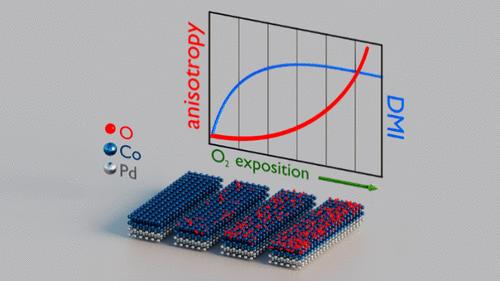
Transition metal oxides are promising for future electronics because of their unique magnetoionic properties and spin–charge interconversion. Here, epitaxial Pd/Co films with an artificially oxidized magnetic layer are studied. The effect of the oxidation dose of the Co layer on the structural and magnetic properties is investigated. The opportunity of epitaxial growth of Pd layers on top of the partially disordered oxide layer with preservation of the epitaxial ratio is shown. The calculations show that the process of oxide formation occurs according to the layer-by-island growth mechanism. An increase in the anisotropy field from the residual thickness of cobalt with an increase in the oxidation dose is observed. The enhancement of the Dzyaloshinskii–Moriya interaction at the interface between the ferromagnet and the oxide layer is experimentally confirmed by analyzing the velocity curves of the asymmetric displacement of domain walls in crossed magnetic fields in the creep mode and is supported by Brillouin light scattering spectroscopy. We demonstrate that the most significant contribution to the interfacial Dzyaloshinskii–Moriya interaction in Pd/Co/CoO films is made by the Co oxide layer. Our findings can be used to develop memory and logic devices of oxide spintronics having advantages of effective control of magnetization state, nonvolatility, low power consumption, and fast data processing.
期刊介绍:
ACS Applied Electronic Materials is an interdisciplinary journal publishing original research covering all aspects of electronic materials. The journal is devoted to reports of new and original experimental and theoretical research of an applied nature that integrate knowledge in the areas of materials science, engineering, optics, physics, and chemistry into important applications of electronic materials. Sample research topics that span the journal's scope are inorganic, organic, ionic and polymeric materials with properties that include conducting, semiconducting, superconducting, insulating, dielectric, magnetic, optoelectronic, piezoelectric, ferroelectric and thermoelectric.
Indexed/Abstracted:
Web of Science SCIE
Scopus
CAS
INSPEC
Portico




 京公网安备 11010802042870号
京ICP备2023020795号-1
京公网安备 11010802042870号
京ICP备2023020795号-1

 分享
分享
 求助内容:
求助内容: 应助结果提醒方式:
 扫码关注我们
