{"title":"CuTiO3/TiO2 MSM UV Photodetector with a Type-I Heterojunction for Rapid and Low-Power Detection","authors":"Yupeng Zhang, Zhengyu Bi, Xinyan Liu, Yan Ma, Shengping Ruan, Ruiliang Xu, Jingran Zhou","doi":"10.1021/acsaelm.4c00950","DOIUrl":null,"url":null,"abstract":"Dark current and response speed matter a lot in UV detection. TiO<sub>2</sub> MSM UV detectors offer many positive attributes, including chemical stability and excellent absorption in the UV region. However, they also have a high dark current and a poor response time. To get around these drawbacks, an MSM UV detector based on the CuTiO<sub>3</sub>/TiO<sub>2</sub> type-I heterojunction was created in this work. The introduction of high-dielectric perovskite CuTiO<sub>3</sub> reduces carriers and thus leads to a low dark current (8.06 × 10<sup>–12</sup> A). Furthermore, type-I heterojunction properties of the CuTiO<sub>3</sub>/TiO<sub>2</sub> heterojunction significantly restrict the recombination process of photogenerated carriers in TiO<sub>2</sub>, improving response and recovery times (78 and 93 ms). The findings suggested that high-performance UV photodetectors might be created by combining conventional wide-band-gap semiconductor materials with high-dielectric perovskite CuTiO<sub>3</sub>.","PeriodicalId":3,"journal":{"name":"ACS Applied Electronic Materials","volume":"150 1","pages":""},"PeriodicalIF":4.7000,"publicationDate":"2024-06-26","publicationTypes":"Journal Article","fieldsOfStudy":null,"isOpenAccess":false,"openAccessPdf":"","citationCount":"0","resultStr":null,"platform":"Semanticscholar","paperid":null,"PeriodicalName":"ACS Applied Electronic Materials","FirstCategoryId":"88","ListUrlMain":"https://doi.org/10.1021/acsaelm.4c00950","RegionNum":3,"RegionCategory":"材料科学","ArticlePicture":[],"TitleCN":null,"AbstractTextCN":null,"PMCID":null,"EPubDate":"","PubModel":"","JCR":"Q1","JCRName":"ENGINEERING, ELECTRICAL & ELECTRONIC","Score":null,"Total":0}
引用次数: 0
Abstract
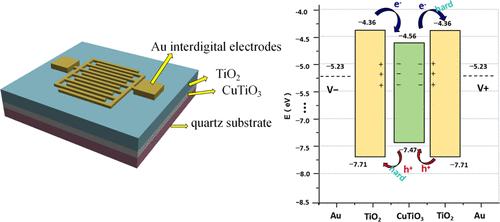
Dark current and response speed matter a lot in UV detection. TiO2 MSM UV detectors offer many positive attributes, including chemical stability and excellent absorption in the UV region. However, they also have a high dark current and a poor response time. To get around these drawbacks, an MSM UV detector based on the CuTiO3/TiO2 type-I heterojunction was created in this work. The introduction of high-dielectric perovskite CuTiO3 reduces carriers and thus leads to a low dark current (8.06 × 10⁻¹² A). Furthermore, type-I heterojunction properties of the CuTiO3/TiO2 heterojunction significantly restrict the recombination process of photogenerated carriers in TiO2, improving response and recovery times (78 and 93 ms). The findings suggested that high-performance UV photodetectors might be created by combining conventional wide-band-gap semiconductor materials with high-dielectric perovskite CuTiO3.
期刊介绍:
ACS Applied Electronic Materials is an interdisciplinary journal publishing original research covering all aspects of electronic materials. The journal is devoted to reports of new and original experimental and theoretical research of an applied nature that integrate knowledge in the areas of materials science, engineering, optics, physics, and chemistry into important applications of electronic materials. Sample research topics that span the journal's scope are inorganic, organic, ionic and polymeric materials with properties that include conducting, semiconducting, superconducting, insulating, dielectric, magnetic, optoelectronic, piezoelectric, ferroelectric and thermoelectric.
Indexed/Abstracted:
Web of Science SCIE
Scopus
CAS
INSPEC
Portico





 京公网安备 11010802042870号
京ICP备2023020795号-1
京公网安备 11010802042870号
京ICP备2023020795号-1

 分享
分享
 求助内容:
求助内容: 应助结果提醒方式:
 扫码关注我们
