Ana Yareli Flores-Ramírez , Ramsés Ramón González-Estrada , Martina Alejandra Chacón-López , María de Lourdes García-Magaña , Efigenia Montalvo-González , Alejandra Álvarez-López , Aarón Rodríguez-López , Ulises Miguel López-García
{"title":"Detection of foodborne pathogens in contaminated food using nanomaterial-based electrochemical biosensors","authors":"Ana Yareli Flores-Ramírez , Ramsés Ramón González-Estrada , Martina Alejandra Chacón-López , María de Lourdes García-Magaña , Efigenia Montalvo-González , Alejandra Álvarez-López , Aarón Rodríguez-López , Ulises Miguel López-García","doi":"10.1016/j.ab.2024.115600","DOIUrl":null,"url":null,"abstract":"<div><p>Foodborne pathogens are a grave concern for the for food, medical, environmental, and economic sectors. Their ease of transmission and resistance to treatments, such as antimicrobial agents, make them an important challenge. Food tainted with these pathogens is swiftly rejected, and if ingested, can result in severe illnesses and even fatalities. This review provides and overview of the current status of various pathogens and their metabolites transmitted through food. Despite a plethora of studies on treatments to eradicate and inhibit these pathogens, their indiscriminate use can compromise the sensory properties of food and lead to contamination. Therefore, the study of detection methods such as electrochemical biosensors has been proposed, which are devices with advantages such as simplicity, fast response, and sensitivity. However, these biosensors may also present some limitations. In this regard, it has been reported that nanomaterials with high conductivity, surface-to-volume ratio, and robustness have been observed to improve the detection of foodborne pathogens or their metabolites. Therefore, in this work, we analyze the detection of pathogens transmitted through food and their metabolites using electrochemical biosensors based on nanomaterials.</p></div>","PeriodicalId":7830,"journal":{"name":"Analytical biochemistry","volume":"693 ","pages":"Article 115600"},"PeriodicalIF":2.5000,"publicationDate":"2024-10-01","publicationTypes":"Journal Article","fieldsOfStudy":null,"isOpenAccess":false,"openAccessPdf":"","citationCount":"0","resultStr":null,"platform":"Semanticscholar","paperid":null,"PeriodicalName":"Analytical biochemistry","FirstCategoryId":"99","ListUrlMain":"https://www.sciencedirect.com/science/article/pii/S0003269724001441","RegionNum":4,"RegionCategory":"生物学","ArticlePicture":[],"TitleCN":null,"AbstractTextCN":null,"PMCID":null,"EPubDate":"2024/7/2 0:00:00","PubModel":"Epub","JCR":"Q2","JCRName":"BIOCHEMICAL RESEARCH METHODS","Score":null,"Total":0}
引用次数: 0
Abstract
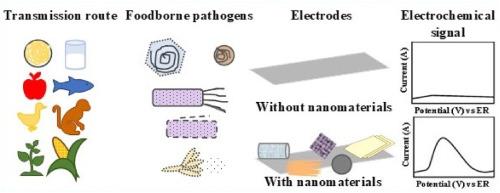
Foodborne pathogens are a grave concern for the for food, medical, environmental, and economic sectors. Their ease of transmission and resistance to treatments, such as antimicrobial agents, make them an important challenge. Food tainted with these pathogens is swiftly rejected, and if ingested, can result in severe illnesses and even fatalities. This review provides and overview of the current status of various pathogens and their metabolites transmitted through food. Despite a plethora of studies on treatments to eradicate and inhibit these pathogens, their indiscriminate use can compromise the sensory properties of food and lead to contamination. Therefore, the study of detection methods such as electrochemical biosensors has been proposed, which are devices with advantages such as simplicity, fast response, and sensitivity. However, these biosensors may also present some limitations. In this regard, it has been reported that nanomaterials with high conductivity, surface-to-volume ratio, and robustness have been observed to improve the detection of foodborne pathogens or their metabolites. Therefore, in this work, we analyze the detection of pathogens transmitted through food and their metabolites using electrochemical biosensors based on nanomaterials.
期刊介绍:
The journal''s title Analytical Biochemistry: Methods in the Biological Sciences declares its broad scope: methods for the basic biological sciences that include biochemistry, molecular genetics, cell biology, proteomics, immunology, bioinformatics and wherever the frontiers of research take the field.
The emphasis is on methods from the strictly analytical to the more preparative that would include novel approaches to protein purification as well as improvements in cell and organ culture. The actual techniques are equally inclusive ranging from aptamers to zymology.
The journal has been particularly active in:
-Analytical techniques for biological molecules-
Aptamer selection and utilization-
Biosensors-
Chromatography-
Cloning, sequencing and mutagenesis-
Electrochemical methods-
Electrophoresis-
Enzyme characterization methods-
Immunological approaches-
Mass spectrometry of proteins and nucleic acids-
Metabolomics-
Nano level techniques-
Optical spectroscopy in all its forms.
The journal is reluctant to include most drug and strictly clinical studies as there are more suitable publication platforms for these types of papers.




 京公网安备 11010802042870号
京ICP备2023020795号-1
京公网安备 11010802042870号
京ICP备2023020795号-1

 分享
分享
 求助内容:
求助内容: 应助结果提醒方式:
 扫码关注我们
