Xianyin Duan, Hanlin Xiong, Rong Liu, Xianbao Duan, Haotian Yu
{"title":"Enhanced deep leaning model for detection and grading of lumbar disc herniation from MRI.","authors":"Xianyin Duan, Hanlin Xiong, Rong Liu, Xianbao Duan, Haotian Yu","doi":"10.1007/s11517-024-03161-5","DOIUrl":null,"url":null,"abstract":"<p><p>Lumbar disc herniation is one of the most prevalent orthopedic issues in clinical practice. The lumbar spine is a crucial joint for movement and weight-bearing, so back pain can significantly impact the everyday lives of patients and is prone to recurring. The pathogenesis of lumbar disc herniation is complex and diverse, making it difficult to identify and assess after it has occurred. Magnetic resonance imaging (MRI) is the most effective method for detecting injuries, requiring continuous examination by medical experts to determine the extent of the injury. However, the continuous examination process is time-consuming and susceptible to errors. This study proposes an enhanced model, BE-YOLOv5, for hierarchical detection of lumbar disc herniation from MRI images. To tailor the training of the model to the job requirements, a specialized dataset was created. The data was cleaned and improved before the final calibration. A final training set of 2083 data points and a test set of 100 data points were obtained. The YOLOv5 model was enhanced by integrating the attention mechanism module, ECAnet, with a 3 × 3 convolutional kernel size, substituting its feature extraction network with a BiFPN, and implementing structural system pruning. The model achieved an 89.7% mean average precision (mAP) and 48.7 frames per second (FPS) on the test set. In comparison to Faster R-CNN, original YOLOv5, and the latest YOLOv8, this model performs better in terms of both accuracy and speed for the detection and grading of lumbar disc herniation from MRI, validating the effectiveness of multiple enhancement methods. The proposed model is expected to be used for diagnosing lumbar disc herniation from MRI images and to demonstrate efficient and high-precision performance.</p>","PeriodicalId":49840,"journal":{"name":"Medical & Biological Engineering & Computing","volume":" ","pages":"3709-3719"},"PeriodicalIF":2.6000,"publicationDate":"2024-12-01","publicationTypes":"Journal Article","fieldsOfStudy":null,"isOpenAccess":false,"openAccessPdf":"","citationCount":"0","resultStr":null,"platform":"Semanticscholar","paperid":null,"PeriodicalName":"Medical & Biological Engineering & Computing","FirstCategoryId":"1085","ListUrlMain":"https://doi.org/10.1007/s11517-024-03161-5","RegionNum":4,"RegionCategory":"医学","ArticlePicture":[],"TitleCN":null,"AbstractTextCN":null,"PMCID":null,"EPubDate":"2024/7/5 0:00:00","PubModel":"Epub","JCR":"Q2","JCRName":"COMPUTER SCIENCE, INTERDISCIPLINARY APPLICATIONS","Score":null,"Total":0}
引用次数: 0
Abstract
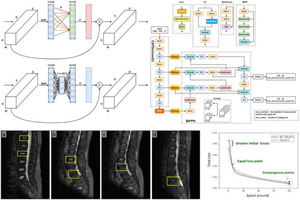
Lumbar disc herniation is one of the most prevalent orthopedic issues in clinical practice. The lumbar spine is a crucial joint for movement and weight-bearing, so back pain can significantly impact the everyday lives of patients and is prone to recurring. The pathogenesis of lumbar disc herniation is complex and diverse, making it difficult to identify and assess after it has occurred. Magnetic resonance imaging (MRI) is the most effective method for detecting injuries, requiring continuous examination by medical experts to determine the extent of the injury. However, the continuous examination process is time-consuming and susceptible to errors. This study proposes an enhanced model, BE-YOLOv5, for hierarchical detection of lumbar disc herniation from MRI images. To tailor the training of the model to the job requirements, a specialized dataset was created. The data was cleaned and improved before the final calibration. A final training set of 2083 data points and a test set of 100 data points were obtained. The YOLOv5 model was enhanced by integrating the attention mechanism module, ECAnet, with a 3 × 3 convolutional kernel size, substituting its feature extraction network with a BiFPN, and implementing structural system pruning. The model achieved an 89.7% mean average precision (mAP) and 48.7 frames per second (FPS) on the test set. In comparison to Faster R-CNN, original YOLOv5, and the latest YOLOv8, this model performs better in terms of both accuracy and speed for the detection and grading of lumbar disc herniation from MRI, validating the effectiveness of multiple enhancement methods. The proposed model is expected to be used for diagnosing lumbar disc herniation from MRI images and to demonstrate efficient and high-precision performance.
期刊介绍:
Founded in 1963, Medical & Biological Engineering & Computing (MBEC) continues to serve the biomedical engineering community, covering the entire spectrum of biomedical and clinical engineering. The journal presents exciting and vital experimental and theoretical developments in biomedical science and technology, and reports on advances in computer-based methodologies in these multidisciplinary subjects. The journal also incorporates new and evolving technologies including cellular engineering and molecular imaging.
MBEC publishes original research articles as well as reviews and technical notes. Its Rapid Communications category focuses on material of immediate value to the readership, while the Controversies section provides a forum to exchange views on selected issues, stimulating a vigorous and informed debate in this exciting and high profile field.
MBEC is an official journal of the International Federation of Medical and Biological Engineering (IFMBE).



 京公网安备 11010802042870号
京ICP备2023020795号-1
京公网安备 11010802042870号
京ICP备2023020795号-1

 分享
分享
 求助内容:
求助内容: 应助结果提醒方式:
 扫码关注我们
