Yi Liu , Qian Wang , Yuhui Zhao , Liu Liu , Jingxi Hu , Yao Qiao , Jinyi Chen , Chao Qin
{"title":"Identification of novel drug targets for multiple sclerosis by integrating plasma genetics and proteomes","authors":"Yi Liu , Qian Wang , Yuhui Zhao , Liu Liu , Jingxi Hu , Yao Qiao , Jinyi Chen , Chao Qin","doi":"10.1016/j.exger.2024.112505","DOIUrl":null,"url":null,"abstract":"<div><h3>Background</h3><p>Genome-wide association studies (GWAS) have revealed numerous loci associated with multiple sclerosis (MS). However, the challenge lies in deciphering the mechanisms by which these loci influence the target traits. Here, we employed an integrative analytical pipeline to efficiently transform genetic associations to identify novel proteins for MS.</p></div><div><h3>Methods</h3><p>We systematically integrated MS GWAS data (N = 115,803) with human plasma proteome data (N = 7213) and conducted proteome-wide association studies (PWAS) to identify MS-associated pathogenic proteins. Following this, we employed Mendelian randomization and Bayesian colocalization analyses to verify the causal relationship between these significant plasma proteins and MS. Lastly, we utilized the Drug-Gene Interaction Database (DGIdb) to identify potential drug targets for MS.</p></div><div><h3>Results</h3><p>The PWAS identified 25 statistically significant cis-regulated plasma proteins associated with MS at a false discovery rate of <em>P</em> < 0.05. Further analysis revealed that the abundance of 7 of these proteins (PLEK, TNXB, CASP3, CD59, CR1, TAPBPL, ATXN3) was causally related to the incidence of MS. Our findings indicated that genetically predicted higher levels of TNXB and CD59 were associated with a lower risk of MS, whereas higher levels of PLEK, CASP3, CR1, TAPBPL, and ATXN3 were associated with an increased risk of MS. Three plasma proteins (PLEK, CR1, CD59) were validated by colocalization analysis. Among these, CR1 was prioritized as a target for Eculizumab due to its significant association with MS risk. Additionally, PLEK, CR1, and CD59 were identified as druggable target genes.</p></div><div><h3>Conclusions</h3><p>Our proteomic analysis has identified PLEK, CR1, and CD59 as potential drug targets for MS treatment. Developing pharmacological inducers or inhibitors for these proteins could pave the way for new therapeutic approaches, potentially improving outcomes for MS patients.</p></div>","PeriodicalId":94003,"journal":{"name":"Experimental gerontology","volume":"194 ","pages":"Article 112505"},"PeriodicalIF":4.3000,"publicationDate":"2024-09-01","publicationTypes":"Journal Article","fieldsOfStudy":null,"isOpenAccess":false,"openAccessPdf":"https://www.sciencedirect.com/science/article/pii/S0531556524001475/pdfft?md5=a786f464c549e3fcdbc219ea6f8647fe&pid=1-s2.0-S0531556524001475-main.pdf","citationCount":"0","resultStr":null,"platform":"Semanticscholar","paperid":null,"PeriodicalName":"Experimental gerontology","FirstCategoryId":"1085","ListUrlMain":"https://www.sciencedirect.com/science/article/pii/S0531556524001475","RegionNum":0,"RegionCategory":null,"ArticlePicture":[],"TitleCN":null,"AbstractTextCN":null,"PMCID":null,"EPubDate":"2024/7/10 0:00:00","PubModel":"Epub","JCR":"","JCRName":"","Score":null,"Total":0}
引用次数: 0
Abstract
Background
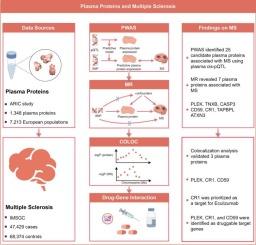
Genome-wide association studies (GWAS) have revealed numerous loci associated with multiple sclerosis (MS). However, the challenge lies in deciphering the mechanisms by which these loci influence the target traits. Here, we employed an integrative analytical pipeline to efficiently transform genetic associations to identify novel proteins for MS.
Methods
We systematically integrated MS GWAS data (N = 115,803) with human plasma proteome data (N = 7213) and conducted proteome-wide association studies (PWAS) to identify MS-associated pathogenic proteins. Following this, we employed Mendelian randomization and Bayesian colocalization analyses to verify the causal relationship between these significant plasma proteins and MS. Lastly, we utilized the Drug-Gene Interaction Database (DGIdb) to identify potential drug targets for MS.
Results
The PWAS identified 25 statistically significant cis-regulated plasma proteins associated with MS at a false discovery rate of P < 0.05. Further analysis revealed that the abundance of 7 of these proteins (PLEK, TNXB, CASP3, CD59, CR1, TAPBPL, ATXN3) was causally related to the incidence of MS. Our findings indicated that genetically predicted higher levels of TNXB and CD59 were associated with a lower risk of MS, whereas higher levels of PLEK, CASP3, CR1, TAPBPL, and ATXN3 were associated with an increased risk of MS. Three plasma proteins (PLEK, CR1, CD59) were validated by colocalization analysis. Among these, CR1 was prioritized as a target for Eculizumab due to its significant association with MS risk. Additionally, PLEK, CR1, and CD59 were identified as druggable target genes.
Conclusions
Our proteomic analysis has identified PLEK, CR1, and CD59 as potential drug targets for MS treatment. Developing pharmacological inducers or inhibitors for these proteins could pave the way for new therapeutic approaches, potentially improving outcomes for MS patients.




 京公网安备 11010802042870号
京ICP备2023020795号-1
京公网安备 11010802042870号
京ICP备2023020795号-1

 分享
分享
 求助内容:
求助内容: 应助结果提醒方式:
 扫码关注我们
