{"title":"Reversion induced LIM domain protein (RIL) is a Daam1-interacting protein and regulator of the actin cytoskeleton during non-canonical Wnt signaling","authors":"Courtney Mezzacappa, Yuko Komiya, Raymond Habas","doi":"10.1016/j.ydbio.2024.06.022","DOIUrl":null,"url":null,"abstract":"<div><p>The Daam1 protein regulates Wnt-induced cytoskeletal changes during vertebrate gastrulation though its full mode of action and binding partners remain unresolved. Here we identify Reversion Induced LIM domain protein (RIL) as a new interacting protein of Daam1. Interaction studies uncover binding of RIL to the C-terminal actin-nucleating portion of Daam1 in a Wnt-responsive manner. Immunofluorescence studies showed subcellular localization of RIL to actin fibers and co-localization with Daam1 at the plasma membrane. RIL gain- and loss-of-function approaches in <em>Xenopus</em> produced severe gastrulation defects in injected embryos. Additionally, a simultaneous loss of Daam1 and RIL synergized to produce severe gastrulation defects indicating RIL and Daam1 may function in the same signaling pathway. RIL further synergizes with another novel Daam1-interacting protein, Formin Binding Protein 1 (FNBP1), to regulate gastrulation. Our studies altogether show RIL mediates Daam1-regulated non-canonical Wnt signaling that is required for vertebrate gastrulation.</p></div>","PeriodicalId":11070,"journal":{"name":"Developmental biology","volume":"515 ","pages":""},"PeriodicalIF":2.1000,"publicationDate":"2024-07-03","publicationTypes":"Journal Article","fieldsOfStudy":null,"isOpenAccess":false,"openAccessPdf":"","citationCount":"0","resultStr":null,"platform":"Semanticscholar","paperid":null,"PeriodicalName":"Developmental biology","FirstCategoryId":"99","ListUrlMain":"https://www.sciencedirect.com/science/article/pii/S0012160624001726","RegionNum":3,"RegionCategory":"生物学","ArticlePicture":[],"TitleCN":null,"AbstractTextCN":null,"PMCID":null,"EPubDate":"","PubModel":"","JCR":"Q2","JCRName":"DEVELOPMENTAL BIOLOGY","Score":null,"Total":0}
引用次数: 0
Abstract
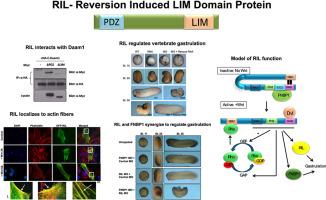
The Daam1 protein regulates Wnt-induced cytoskeletal changes during vertebrate gastrulation though its full mode of action and binding partners remain unresolved. Here we identify Reversion Induced LIM domain protein (RIL) as a new interacting protein of Daam1. Interaction studies uncover binding of RIL to the C-terminal actin-nucleating portion of Daam1 in a Wnt-responsive manner. Immunofluorescence studies showed subcellular localization of RIL to actin fibers and co-localization with Daam1 at the plasma membrane. RIL gain- and loss-of-function approaches in Xenopus produced severe gastrulation defects in injected embryos. Additionally, a simultaneous loss of Daam1 and RIL synergized to produce severe gastrulation defects indicating RIL and Daam1 may function in the same signaling pathway. RIL further synergizes with another novel Daam1-interacting protein, Formin Binding Protein 1 (FNBP1), to regulate gastrulation. Our studies altogether show RIL mediates Daam1-regulated non-canonical Wnt signaling that is required for vertebrate gastrulation.
期刊介绍:
Developmental Biology (DB) publishes original research on mechanisms of development, differentiation, and growth in animals and plants at the molecular, cellular, genetic and evolutionary levels. Areas of particular emphasis include transcriptional control mechanisms, embryonic patterning, cell-cell interactions, growth factors and signal transduction, and regulatory hierarchies in developing plants and animals.



 京公网安备 11010802042870号
京ICP备2023020795号-1
京公网安备 11010802042870号
京ICP备2023020795号-1

 分享
分享
 求助内容:
求助内容: 应助结果提醒方式:
 扫码关注我们
