Cesar Quintela , Antonio Grimalt-Alemany , Oskar Modin , Yvonne Nygård , Lisbeth Olsson , Ioannis V. Skiadas , Hariklia N. Gavala
{"title":"Effect of pH in syngas conversion to C4 & C6 acids in mixed-culture trickle bed reactors","authors":"Cesar Quintela , Antonio Grimalt-Alemany , Oskar Modin , Yvonne Nygård , Lisbeth Olsson , Ioannis V. Skiadas , Hariklia N. Gavala","doi":"10.1016/j.biombioe.2024.107292","DOIUrl":null,"url":null,"abstract":"<div><p>Syngas fermentation allows for the conversion of wastes into useful commodity chemicals. To target higher value products, the conditions can be tuned to be favourable for both acetogenic and reverse beta-oxidation pathways and produce, in one stage, butyric and caproic acid. Studies in CSTR have shown the crucial role of pH, which must be low enough to allow for ethanol generation in the acetogenic step while avoiding the inhibition of reverse β-oxidation in acidic conditions. However, no studies have investigated the effect of pH in reactor configurations suitable for syngas fermentation (i.e., allowing for cell retention and exhibiting high mass transfer rates at low operating costs), such as Trickle Bed Reactors, TBR. In this study, two TBR were used to study the pH effect on the fermentation of syngas to produce C4 and C6 acids, using undefined mixed cultures. Five pH values were tested in the range 4.5–7.5, and pH 6 was found to be the most favourable for simultaneous production of C4 & C6 acids from syngas, which agrees with what was found in suspended growth systems. In addition, the highest titers in literature so far were achieved in the TRB. 16S rRNA analysis was performed showing <em>Clostridium</em> and <em>Rummenliibacillus</em> to be the key genus for the efficient process at pH 6. Finally, the experimental methodology followed, and data collected proved the robustness of mixed culture biofilm reactors in respect to pH changes, as the same reactor performance and bacterial community were achieved regardless of the operation history.</p></div>","PeriodicalId":253,"journal":{"name":"Biomass & Bioenergy","volume":"187 ","pages":"Article 107292"},"PeriodicalIF":5.8000,"publicationDate":"2024-08-01","publicationTypes":"Journal Article","fieldsOfStudy":null,"isOpenAccess":false,"openAccessPdf":"https://www.sciencedirect.com/science/article/pii/S0961953424002459/pdfft?md5=515d59a50cdedfb994ed2baba9ee8b44&pid=1-s2.0-S0961953424002459-main.pdf","citationCount":"0","resultStr":null,"platform":"Semanticscholar","paperid":null,"PeriodicalName":"Biomass & Bioenergy","FirstCategoryId":"5","ListUrlMain":"https://www.sciencedirect.com/science/article/pii/S0961953424002459","RegionNum":2,"RegionCategory":"生物学","ArticlePicture":[],"TitleCN":null,"AbstractTextCN":null,"PMCID":null,"EPubDate":"2024/7/2 0:00:00","PubModel":"Epub","JCR":"Q1","JCRName":"AGRICULTURAL ENGINEERING","Score":null,"Total":0}
引用次数: 0
Abstract
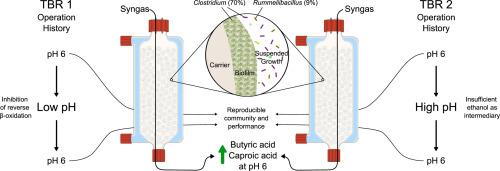
Syngas fermentation allows for the conversion of wastes into useful commodity chemicals. To target higher value products, the conditions can be tuned to be favourable for both acetogenic and reverse beta-oxidation pathways and produce, in one stage, butyric and caproic acid. Studies in CSTR have shown the crucial role of pH, which must be low enough to allow for ethanol generation in the acetogenic step while avoiding the inhibition of reverse β-oxidation in acidic conditions. However, no studies have investigated the effect of pH in reactor configurations suitable for syngas fermentation (i.e., allowing for cell retention and exhibiting high mass transfer rates at low operating costs), such as Trickle Bed Reactors, TBR. In this study, two TBR were used to study the pH effect on the fermentation of syngas to produce C4 and C6 acids, using undefined mixed cultures. Five pH values were tested in the range 4.5–7.5, and pH 6 was found to be the most favourable for simultaneous production of C4 & C6 acids from syngas, which agrees with what was found in suspended growth systems. In addition, the highest titers in literature so far were achieved in the TRB. 16S rRNA analysis was performed showing Clostridium and Rummenliibacillus to be the key genus for the efficient process at pH 6. Finally, the experimental methodology followed, and data collected proved the robustness of mixed culture biofilm reactors in respect to pH changes, as the same reactor performance and bacterial community were achieved regardless of the operation history.
期刊介绍:
Biomass & Bioenergy is an international journal publishing original research papers and short communications, review articles and case studies on biological resources, chemical and biological processes, and biomass products for new renewable sources of energy and materials.
The scope of the journal extends to the environmental, management and economic aspects of biomass and bioenergy.
Key areas covered by the journal:
• Biomass: sources, energy crop production processes, genetic improvements, composition. Please note that research on these biomass subjects must be linked directly to bioenergy generation.
• Biological Residues: residues/rests from agricultural production, forestry and plantations (palm, sugar etc), processing industries, and municipal sources (MSW). Papers on the use of biomass residues through innovative processes/technological novelty and/or consideration of feedstock/system sustainability (or unsustainability) are welcomed. However waste treatment processes and pollution control or mitigation which are only tangentially related to bioenergy are not in the scope of the journal, as they are more suited to publications in the environmental arena. Papers that describe conventional waste streams (ie well described in existing literature) that do not empirically address ''new'' added value from the process are not suitable for submission to the journal.
• Bioenergy Processes: fermentations, thermochemical conversions, liquid and gaseous fuels, and petrochemical substitutes
• Bioenergy Utilization: direct combustion, gasification, electricity production, chemical processes, and by-product remediation
• Biomass and the Environment: carbon cycle, the net energy efficiency of bioenergy systems, assessment of sustainability, and biodiversity issues.




 京公网安备 11010802042870号
京ICP备2023020795号-1
京公网安备 11010802042870号
京ICP备2023020795号-1

 分享
分享
 求助内容:
求助内容: 应助结果提醒方式:
 扫码关注我们
