{"title":"Sea Urchin-Like NiO-CoO Heterostructure as High-Energy Supercapattery Electrode: Laboratory Prototype to Field Application of Pouch-type Device","authors":"Kalidoss Kannadasan, Suresh Archana, Umamaheswari Rajaji, Ting-Yu Liu, Perumal Elumalai","doi":"10.1021/acsaelm.4c00795","DOIUrl":null,"url":null,"abstract":"Transition metal-oxides are being explored in the energy storage applications nowadays, serving as electrodes because of their desirable redox features. In this study, sea urchin-like nickel oxide-cobalt oxide (NiO-CoO) heterostructure was generated using a hydrothermal method and examined as supercapattery electrode. The crystallinity and morphological features of the synthesized heterostructure were analyzed using various techniques like powder X-ray Diffraction (XRD), scanning electron microscope (SEM), high-resolution-transmission electron microscopy (HR-TEM), and X-ray photoelectron spectroscopy (XPS), etc. The electrochemical activity of the sea urchin-like NiO-CoO heterostructure electrode toward supercapattery was tested in three diverse electrolytes consisting of KOH, NaOH, and LiOH. As a result, the heterostructure electrode exhibited excellent charge-storage features in three electrode configurations in the alkali electrolytes. Hence, the supercapattery practical devices were fabricated both in coin-type and pouch-type devices. The aqueous coin-type supercapattery device demonstrated an exceptionally high specific energy of 340 W h kg<sup>–1</sup> with a specific power of 295 W kg<sup>–1</sup>, showing an excellent cycling stability over 10,000 cycles, whereas the pouch-type device attained a specific energy of 140 W h kg<sup>–1</sup> coupled with a specific power of 320 W kg<sup>–1</sup>. Power Law and Dunn’s analyses confirmed the simultaneous contribution of the diffusive and the capacitive charge storage kinetics in the NiO-CoO heterostructure electrode. In the non-aqueous system, there seems to be Li<sup>+</sup> ion intercalation leading to high specific energy at passable specific power. The fabricated coin-type and the pouch-type supercapattery devices were demonstrated in the field applications such as glowing LED and functional stopwatch independently and together.","PeriodicalId":3,"journal":{"name":"ACS Applied Electronic Materials","volume":"13 1","pages":""},"PeriodicalIF":4.7000,"publicationDate":"2024-07-03","publicationTypes":"Journal Article","fieldsOfStudy":null,"isOpenAccess":false,"openAccessPdf":"","citationCount":"0","resultStr":null,"platform":"Semanticscholar","paperid":null,"PeriodicalName":"ACS Applied Electronic Materials","FirstCategoryId":"88","ListUrlMain":"https://doi.org/10.1021/acsaelm.4c00795","RegionNum":3,"RegionCategory":"材料科学","ArticlePicture":[],"TitleCN":null,"AbstractTextCN":null,"PMCID":null,"EPubDate":"","PubModel":"","JCR":"Q1","JCRName":"ENGINEERING, ELECTRICAL & ELECTRONIC","Score":null,"Total":0}
引用次数: 0
Abstract
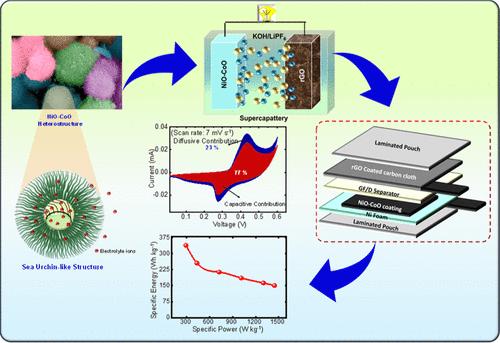
Transition metal-oxides are being explored in the energy storage applications nowadays, serving as electrodes because of their desirable redox features. In this study, sea urchin-like nickel oxide-cobalt oxide (NiO-CoO) heterostructure was generated using a hydrothermal method and examined as supercapattery electrode. The crystallinity and morphological features of the synthesized heterostructure were analyzed using various techniques like powder X-ray Diffraction (XRD), scanning electron microscope (SEM), high-resolution-transmission electron microscopy (HR-TEM), and X-ray photoelectron spectroscopy (XPS), etc. The electrochemical activity of the sea urchin-like NiO-CoO heterostructure electrode toward supercapattery was tested in three diverse electrolytes consisting of KOH, NaOH, and LiOH. As a result, the heterostructure electrode exhibited excellent charge-storage features in three electrode configurations in the alkali electrolytes. Hence, the supercapattery practical devices were fabricated both in coin-type and pouch-type devices. The aqueous coin-type supercapattery device demonstrated an exceptionally high specific energy of 340 W h kg–1 with a specific power of 295 W kg–1, showing an excellent cycling stability over 10,000 cycles, whereas the pouch-type device attained a specific energy of 140 W h kg–1 coupled with a specific power of 320 W kg–1. Power Law and Dunn’s analyses confirmed the simultaneous contribution of the diffusive and the capacitive charge storage kinetics in the NiO-CoO heterostructure electrode. In the non-aqueous system, there seems to be Li+ ion intercalation leading to high specific energy at passable specific power. The fabricated coin-type and the pouch-type supercapattery devices were demonstrated in the field applications such as glowing LED and functional stopwatch independently and together.
过渡金属氧化物因其理想的氧化还原特性而被用作电极,目前正在储能应用领域进行探索。本研究采用水热法生成了海胆状氧化镍-氧化钴(NiO-CoO)异质结构,并将其作为超级电池电极进行了研究。利用粉末 X 射线衍射 (XRD)、扫描电子显微镜 (SEM)、高分辨率透射电子显微镜 (HR-TEM) 和 X 射线光电子能谱 (XPS) 等多种技术分析了合成异质结构的结晶度和形态特征。在 KOH、NaOH 和 LiOH 三种不同的电解质中测试了海胆状 NiO-CoO 异质结构电极的超级电容器电化学活性。结果表明,异质结构电极在碱电解质中的三种电极构型中均表现出优异的电荷存储特性。因此,超级电池的实用装置被制成了硬币型和袋装型装置。水基硬币型超级电池装置的比能量高达 340 W h kg-1,比功率为 295 W kg-1,在 10,000 次循环中表现出卓越的稳定性;而袋式装置的比能量为 140 W h kg-1,比功率为 320 W kg-1。幂律分析和邓恩分析证实,NiO-CoO 异质结构电极同时具有扩散和电容电荷存储动力学。在非水体系中,似乎存在着 Li+ 离子插层,从而在可通过的比功率下产生了高比能量。所制备的硬币型和小袋型超级电池器件已在发光二极管和功能秒表等现场应用中进行了独立和组合演示。
期刊介绍:
ACS Applied Electronic Materials is an interdisciplinary journal publishing original research covering all aspects of electronic materials. The journal is devoted to reports of new and original experimental and theoretical research of an applied nature that integrate knowledge in the areas of materials science, engineering, optics, physics, and chemistry into important applications of electronic materials. Sample research topics that span the journal's scope are inorganic, organic, ionic and polymeric materials with properties that include conducting, semiconducting, superconducting, insulating, dielectric, magnetic, optoelectronic, piezoelectric, ferroelectric and thermoelectric.
Indexed/Abstracted:
Web of Science SCIE
Scopus
CAS
INSPEC
Portico




 京公网安备 11010802042870号
京ICP备2023020795号-1
京公网安备 11010802042870号
京ICP备2023020795号-1

 分享
分享
 求助内容:
求助内容: 应助结果提醒方式:
 扫码关注我们
