Multifunctional Nanodrug-Mediated Immunotherapy in Microsatellite Stable Colorectal Cancer via Promoting m6A Modification and M1-Like Tumor-Associated Macrophages Polarization
Caiying Li, Gengjia Chen, Tan Li, Peiyi Xie, Decai Ma, Long Yang, Zecong Xiao, Xintao Shuai, Xiaochun Meng
{"title":"Multifunctional Nanodrug-Mediated Immunotherapy in Microsatellite Stable Colorectal Cancer via Promoting m6A Modification and M1-Like Tumor-Associated Macrophages Polarization","authors":"Caiying Li, Gengjia Chen, Tan Li, Peiyi Xie, Decai Ma, Long Yang, Zecong Xiao, Xintao Shuai, Xiaochun Meng","doi":"10.1002/sstr.202400100","DOIUrl":null,"url":null,"abstract":"Immunotherapy has made great progress in various solid tumors. However, the “cold” tumor immune microenvironment of microsatellite stable subtype colorectal cancer (MSS-CRC) hinders the effectiveness of immunotherapy. Therefore, reshaping the immunosuppressive microenvironment and initiating efficient antitumor immune responses are critical for immunotherapy of MSS-CRC. According to the analysis of clinical samples, it is found that the levels of fat mass and obesity-associated protein (FTO) and M2-like tumor-associated macrophages (TAMs) infiltration are significantly elevated in CRC tissue, which has driven one to construct a targeted cationic liposome to simultaneously enhance the RNA methylation and inhibit the CD47 immune checkpoint expression of tumor cells in the hope of promoting the M1-like TAMs polarization and phagocytosis. By upregulating the m6A modification of tumor cells, the lactate secretion is decreased to promote the TAMs repolarized into M1-like. Meanwhile, CD47 siRNA codelivered by the cationic liposomes downregulates the expression of immune checkpoint CD47 on the cancer cell surface, which enhances the phagocytic ability of the M1-like TAMs. The combination treatment scheme is expected to provide a new option for treating MSS-CRC, which may also be extended for treating other immunologically “cold” tumors.","PeriodicalId":21841,"journal":{"name":"Small Structures","volume":"54 1","pages":""},"PeriodicalIF":0.0000,"publicationDate":"2024-06-19","publicationTypes":"Journal Article","fieldsOfStudy":null,"isOpenAccess":false,"openAccessPdf":"","citationCount":"0","resultStr":null,"platform":"Semanticscholar","paperid":null,"PeriodicalName":"Small Structures","FirstCategoryId":"1085","ListUrlMain":"https://doi.org/10.1002/sstr.202400100","RegionNum":0,"RegionCategory":null,"ArticlePicture":[],"TitleCN":null,"AbstractTextCN":null,"PMCID":null,"EPubDate":"","PubModel":"","JCR":"","JCRName":"","Score":null,"Total":0}
引用次数: 0
Abstract
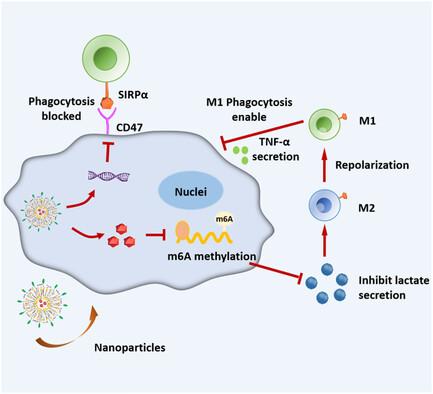
Immunotherapy has made great progress in various solid tumors. However, the “cold” tumor immune microenvironment of microsatellite stable subtype colorectal cancer (MSS-CRC) hinders the effectiveness of immunotherapy. Therefore, reshaping the immunosuppressive microenvironment and initiating efficient antitumor immune responses are critical for immunotherapy of MSS-CRC. According to the analysis of clinical samples, it is found that the levels of fat mass and obesity-associated protein (FTO) and M2-like tumor-associated macrophages (TAMs) infiltration are significantly elevated in CRC tissue, which has driven one to construct a targeted cationic liposome to simultaneously enhance the RNA methylation and inhibit the CD47 immune checkpoint expression of tumor cells in the hope of promoting the M1-like TAMs polarization and phagocytosis. By upregulating the m6A modification of tumor cells, the lactate secretion is decreased to promote the TAMs repolarized into M1-like. Meanwhile, CD47 siRNA codelivered by the cationic liposomes downregulates the expression of immune checkpoint CD47 on the cancer cell surface, which enhances the phagocytic ability of the M1-like TAMs. The combination treatment scheme is expected to provide a new option for treating MSS-CRC, which may also be extended for treating other immunologically “cold” tumors.



 京公网安备 11010802042870号
京ICP备2023020795号-1
京公网安备 11010802042870号
京ICP备2023020795号-1

 分享
分享

 求助内容:
求助内容: 应助结果提醒方式:
 扫码关注我们
