{"title":"Correlation between pre-anesthesia anxiety and emergence agitation in non-small cell lung cancer surgery patients.","authors":"Fen Yan, Li-Hua Yuan, Xiao He, Kai-Feng Yu","doi":"10.5498/wjp.v14.i6.930","DOIUrl":null,"url":null,"abstract":"<p><strong>Background: </strong>Preoperative anxiety is a common emotional problem during the perioperative period and may adversely affect postoperative recovery. Emergence agitation (EA) is a common complication of general anesthesia that may increase patient discomfort and hospital stay and may be associated with the development of postoperative complications. Pre-anesthetic anxiety may be associated with the development of EA, but studies in this area are lacking.</p><p><strong>Aim: </strong>To determine the relationship between pre-anesthetic anxiety and EA after radical surgery in patients with non-small cell lung cancer (NSCLC).</p><p><strong>Methods: </strong>Eighty patients with NSCLC undergoing surgical treatment between June 2020 and June 2023 were conveniently sampled. We used the Hospital Anxiety and Depression Scale's (HADS) anxiety subscale (HADS-A) to determine patients' anxiety at four time points (T1-T4): Patients' preoperative visit, waiting period in the surgical waiting room, after entering the operating room, and before anesthesia induction, respectively. The Riker Sedation-Agitation Scale (RSAS) examined EA after surgery. Scatter plots of HADS-A and RSAS scores assessed the correlation between patients' pre-anesthesia anxiety status and EA. We performed a partial correlation analysis of HADS-A scores with RSAS scores.</p><p><strong>Results: </strong>NSCLC patients' HADS-A scores gradually increased at the four time points: 7.33 ± 2.03 at T1, 7.99 ± 2.22 at T2, 8.05 ± 2.81 at T3, and 8.36 ± 4.17 at T4. The patients' postoperative RSAS score was 4.49 ± 1.18, and 27 patients scored ≥ 5, indicating that 33.75% patients had EA. HADS-A scores at T3 and T4 were significantly higher in patients with EA (9.67 ± 3.02 <i>vs</i> 7.23 ± 2.31, 12.56 ± 4.10 <i>vs</i> 6.23 ± 2.05, <i>P</i> < 0.001). Scatter plots showed the highest correlation between HADS-A and RSAS scores at T3 and T4. Partial correlation analysis showed a strong positive correlation between HADS-A and RSAS scores at T3 and T4 (<i>r</i> = 0.296, 0.314, <i>P</i> < 0.01).</p><p><strong>Conclusion: </strong>Agitation during anesthesia recovery in patients undergoing radical resection for NSCLC correlated with anxiety at the time of entering the operating room and before anesthesia induction.</p>","PeriodicalId":23896,"journal":{"name":"World Journal of Psychiatry","volume":"14 6","pages":"930-937"},"PeriodicalIF":3.4000,"publicationDate":"2024-06-19","publicationTypes":"Journal Article","fieldsOfStudy":null,"isOpenAccess":false,"openAccessPdf":"https://www.ncbi.nlm.nih.gov/pmc/articles/PMC11230093/pdf/","citationCount":"0","resultStr":null,"platform":"Semanticscholar","paperid":null,"PeriodicalName":"World Journal of Psychiatry","FirstCategoryId":"3","ListUrlMain":"https://doi.org/10.5498/wjp.v14.i6.930","RegionNum":4,"RegionCategory":"医学","ArticlePicture":[],"TitleCN":null,"AbstractTextCN":null,"PMCID":null,"EPubDate":"","PubModel":"","JCR":"Q1","JCRName":"PSYCHIATRY","Score":null,"Total":0}
引用次数: 0
Abstract
Background: Preoperative anxiety is a common emotional problem during the perioperative period and may adversely affect postoperative recovery. Emergence agitation (EA) is a common complication of general anesthesia that may increase patient discomfort and hospital stay and may be associated with the development of postoperative complications. Pre-anesthetic anxiety may be associated with the development of EA, but studies in this area are lacking.
Aim: To determine the relationship between pre-anesthetic anxiety and EA after radical surgery in patients with non-small cell lung cancer (NSCLC).
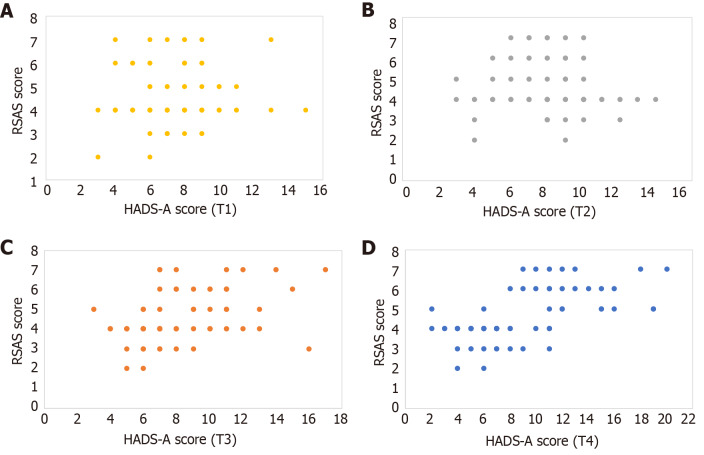
Methods: Eighty patients with NSCLC undergoing surgical treatment between June 2020 and June 2023 were conveniently sampled. We used the Hospital Anxiety and Depression Scale's (HADS) anxiety subscale (HADS-A) to determine patients' anxiety at four time points (T1-T4): Patients' preoperative visit, waiting period in the surgical waiting room, after entering the operating room, and before anesthesia induction, respectively. The Riker Sedation-Agitation Scale (RSAS) examined EA after surgery. Scatter plots of HADS-A and RSAS scores assessed the correlation between patients' pre-anesthesia anxiety status and EA. We performed a partial correlation analysis of HADS-A scores with RSAS scores.
Results: NSCLC patients' HADS-A scores gradually increased at the four time points: 7.33 ± 2.03 at T1, 7.99 ± 2.22 at T2, 8.05 ± 2.81 at T3, and 8.36 ± 4.17 at T4. The patients' postoperative RSAS score was 4.49 ± 1.18, and 27 patients scored ≥ 5, indicating that 33.75% patients had EA. HADS-A scores at T3 and T4 were significantly higher in patients with EA (9.67 ± 3.02 vs 7.23 ± 2.31, 12.56 ± 4.10 vs 6.23 ± 2.05, P < 0.001). Scatter plots showed the highest correlation between HADS-A and RSAS scores at T3 and T4. Partial correlation analysis showed a strong positive correlation between HADS-A and RSAS scores at T3 and T4 (r = 0.296, 0.314, P < 0.01).
Conclusion: Agitation during anesthesia recovery in patients undergoing radical resection for NSCLC correlated with anxiety at the time of entering the operating room and before anesthesia induction.
期刊介绍:
The World Journal of Psychiatry (WJP) is a high-quality, peer reviewed, open-access journal. The primary task of WJP is to rapidly publish high-quality original articles, reviews, editorials, and case reports in the field of psychiatry. In order to promote productive academic communication, the peer review process for the WJP is transparent; to this end, all published manuscripts are accompanied by the anonymized reviewers’ comments as well as the authors’ responses. The primary aims of the WJP are to improve diagnostic, therapeutic and preventive modalities and the skills of clinicians and to guide clinical practice in psychiatry.





 京公网安备 11010802042870号
京ICP备2023020795号-1
京公网安备 11010802042870号
京ICP备2023020795号-1

 分享
分享
 求助内容:
求助内容: 应助结果提醒方式:
 扫码关注我们
