{"title":"EXPAR for biosensing: recent developments and applications","authors":"Xinyi Ou, Kunxiang Li, Miao Liu, Jiajun Song, Zhihua Zuo and Yongcan Guo","doi":"10.1039/D4AN00609G","DOIUrl":null,"url":null,"abstract":"<p >Emerging as a promising novel amplification technique, the exponential amplification reaction (EXPAR) offers significant advantages due to its potent exponential amplification capability, straightforward reaction design, rapid reaction kinetics, and isothermal operation. The past few years have witnessed swift advancements and refinements in EXPAR-based technologies, with numerous high-performance biosensing systems documented. A deeper understanding of the EXPAR mechanism has facilitated the proposal of novel strategies to overcome limitations inherent to traditional EXPAR. Furthermore, the synergistic integration of EXPAR with diverse amplification methodologies, including the use of a CRISPR/Cas system, metal nanoparticles, aptamers, alternative isothermal amplification techniques, and enzymes, has significantly bolstered analytical efficacy, aiming to enhance specificity, sensitivity, and amplification efficiency. This comprehensive review presents a detailed exposition of the EXPAR mechanism and analyzes its primary challenges. Additionally, we summarize the latest research advancements in the biomedical field concerning the integration of EXPAR with diverse amplification technologies for sensing strategies. Finally, we discuss the challenges and future prospects of EXPAR technology in the realms of biosensing and clinical applications.</p>","PeriodicalId":63,"journal":{"name":"Analyst","volume":" 16","pages":" 4135-4157"},"PeriodicalIF":3.3000,"publicationDate":"2024-07-10","publicationTypes":"Journal Article","fieldsOfStudy":null,"isOpenAccess":false,"openAccessPdf":"https://pubs.rsc.org/en/content/articlepdf/2024/an/d4an00609g?page=search","citationCount":"0","resultStr":null,"platform":"Semanticscholar","paperid":null,"PeriodicalName":"Analyst","FirstCategoryId":"92","ListUrlMain":"https://pubs.rsc.org/en/content/articlelanding/2024/an/d4an00609g","RegionNum":3,"RegionCategory":"化学","ArticlePicture":[],"TitleCN":null,"AbstractTextCN":null,"PMCID":null,"EPubDate":"","PubModel":"","JCR":"Q2","JCRName":"CHEMISTRY, ANALYTICAL","Score":null,"Total":0}
引用次数: 0
Abstract
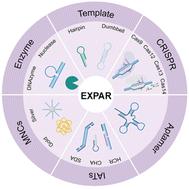
Emerging as a promising novel amplification technique, the exponential amplification reaction (EXPAR) offers significant advantages due to its potent exponential amplification capability, straightforward reaction design, rapid reaction kinetics, and isothermal operation. The past few years have witnessed swift advancements and refinements in EXPAR-based technologies, with numerous high-performance biosensing systems documented. A deeper understanding of the EXPAR mechanism has facilitated the proposal of novel strategies to overcome limitations inherent to traditional EXPAR. Furthermore, the synergistic integration of EXPAR with diverse amplification methodologies, including the use of a CRISPR/Cas system, metal nanoparticles, aptamers, alternative isothermal amplification techniques, and enzymes, has significantly bolstered analytical efficacy, aiming to enhance specificity, sensitivity, and amplification efficiency. This comprehensive review presents a detailed exposition of the EXPAR mechanism and analyzes its primary challenges. Additionally, we summarize the latest research advancements in the biomedical field concerning the integration of EXPAR with diverse amplification technologies for sensing strategies. Finally, we discuss the challenges and future prospects of EXPAR technology in the realms of biosensing and clinical applications.



 京公网安备 11010802042870号
京ICP备2023020795号-1
京公网安备 11010802042870号
京ICP备2023020795号-1

 分享
分享
 求助内容:
求助内容: 应助结果提醒方式:
 扫码关注我们
