J. Küspert, I. Biało, R. Frison, A. Morawietz, L. Martinelli, J. Choi, D. Bucher, O. Ivashko, M. v Zimmermann, N. B. Christensen, D. G. Mazzone, G. Simutis, A. A. Turrini, L. Thomarat, D. W. Tam, M. Janoschek, T. Kurosawa, N. Momono, M. Oda, Qisi Wang, J. Chang
{"title":"Engineering phase competition between stripe order and superconductivity in La1.88Sr0.12CuO4","authors":"J. Küspert, I. Biało, R. Frison, A. Morawietz, L. Martinelli, J. Choi, D. Bucher, O. Ivashko, M. v Zimmermann, N. B. Christensen, D. G. Mazzone, G. Simutis, A. A. Turrini, L. Thomarat, D. W. Tam, M. Janoschek, T. Kurosawa, N. Momono, M. Oda, Qisi Wang, J. Chang","doi":"10.1038/s42005-024-01699-2","DOIUrl":null,"url":null,"abstract":"Unconventional superconductivity often couples to other electronic orders in a cooperative or competing fashion. Identifying external stimuli that tune between these two limits is of fundamental interest. Here, we show that strain perpendicular to the copper-oxide planes couples directly to the competing interaction between charge stripe order and superconductivity in La1.88Sr0.12CuO4 (LSCO). Compressive c-axis pressure amplifies stripe order within the superconducting state, while having no impact on the normal state. By contrast, strain dramatically diminishes the magnetic field enhancement of stripe order in the superconducting state. These results suggest that c-axis strain acts as tuning parameter of the competing interaction between charge stripe order and superconductivity. This interpretation implies a uniaxial pressure-induced ground state in which the competition between charge order and superconductivity is reduced. Tuning superconductivity and its interplay with other phases in cuprates yields insights into the underlying physics of this material class. Here, the authors performed a hard x-ray diffraction experiment on La1.88Sr0.12CuO4 showing that uniaxial pressure along the c-axis acts as a direct tuning parameter of the competition between superconductivity and charge order.","PeriodicalId":10540,"journal":{"name":"Communications Physics","volume":" ","pages":"1-6"},"PeriodicalIF":5.8000,"publicationDate":"2024-07-10","publicationTypes":"Journal Article","fieldsOfStudy":null,"isOpenAccess":false,"openAccessPdf":"https://www.nature.com/articles/s42005-024-01699-2.pdf","citationCount":"0","resultStr":null,"platform":"Semanticscholar","paperid":null,"PeriodicalName":"Communications Physics","FirstCategoryId":"101","ListUrlMain":"https://www.nature.com/articles/s42005-024-01699-2","RegionNum":1,"RegionCategory":"物理与天体物理","ArticlePicture":[],"TitleCN":null,"AbstractTextCN":null,"PMCID":null,"EPubDate":"","PubModel":"","JCR":"Q1","JCRName":"PHYSICS, MULTIDISCIPLINARY","Score":null,"Total":0}
引用次数: 0
Abstract
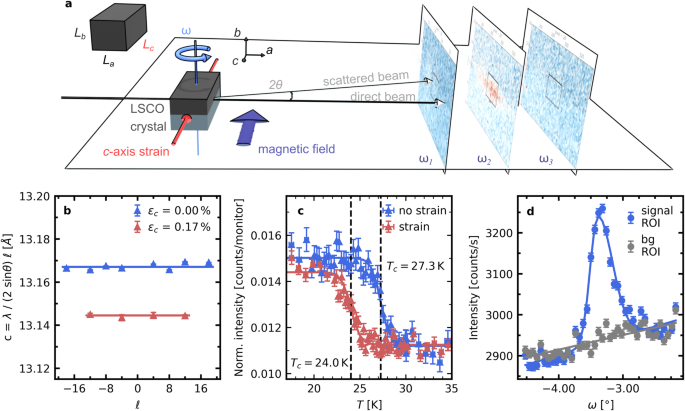
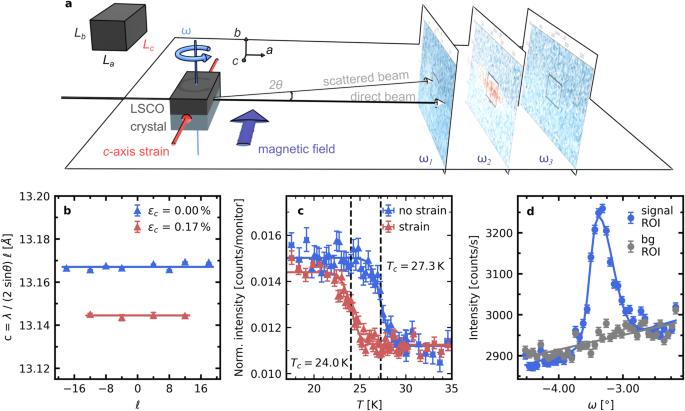
Unconventional superconductivity often couples to other electronic orders in a cooperative or competing fashion. Identifying external stimuli that tune between these two limits is of fundamental interest. Here, we show that strain perpendicular to the copper-oxide planes couples directly to the competing interaction between charge stripe order and superconductivity in La1.88Sr0.12CuO4 (LSCO). Compressive c-axis pressure amplifies stripe order within the superconducting state, while having no impact on the normal state. By contrast, strain dramatically diminishes the magnetic field enhancement of stripe order in the superconducting state. These results suggest that c-axis strain acts as tuning parameter of the competing interaction between charge stripe order and superconductivity. This interpretation implies a uniaxial pressure-induced ground state in which the competition between charge order and superconductivity is reduced. Tuning superconductivity and its interplay with other phases in cuprates yields insights into the underlying physics of this material class. Here, the authors performed a hard x-ray diffraction experiment on La1.88Sr0.12CuO4 showing that uniaxial pressure along the c-axis acts as a direct tuning parameter of the competition between superconductivity and charge order.
期刊介绍:
Communications Physics is an open access journal from Nature Research publishing high-quality research, reviews and commentary in all areas of the physical sciences. Research papers published by the journal represent significant advances bringing new insight to a specialized area of research in physics. We also aim to provide a community forum for issues of importance to all physicists, regardless of sub-discipline.
The scope of the journal covers all areas of experimental, applied, fundamental, and interdisciplinary physical sciences. Primary research published in Communications Physics includes novel experimental results, new techniques or computational methods that may influence the work of others in the sub-discipline. We also consider submissions from adjacent research fields where the central advance of the study is of interest to physicists, for example material sciences, physical chemistry and technologies.



 京公网安备 11010802042870号
京ICP备2023020795号-1
京公网安备 11010802042870号
京ICP备2023020795号-1

 分享
分享
 求助内容:
求助内容: 应助结果提醒方式:
 扫码关注我们
