Milad Khoubrooy Eslamloo;Kazem Varesi;Hadi Tarzamni;Sze Sing Lee
{"title":"Comprehensive Reliability Review and Assessment of Switched-Capacitor Step-Up DC–DC Converters","authors":"Milad Khoubrooy Eslamloo;Kazem Varesi;Hadi Tarzamni;Sze Sing Lee","doi":"10.1109/TR.2024.3421329","DOIUrl":null,"url":null,"abstract":"Due to the deficiencies of the traditional pulsewidth modulation dc–dc boost converter to achieve high voltage gain values, many capacitive and magnetic approaches have been suggested. As a promising solution, the switched-capacitor (SC) cells are employed to increase the voltage boosting capability, even at low/medium duty cycles, which accordingly removes the concerns originated from components' parasitic elements. In the literature, comprehensive investigations have been performed on the traditional SC boost converters from different viewpoints of step-up capability, efficiency, number of components, design considerations, and cost. Meanwhile, several papers investigate the reliability of boost converters only at a fixed operating point, but the extensive reliability analysis of these converters is still missed. This article provides comprehensive investigations on the effects of different operational or design parameters, such as input voltage, duty cycle, gain, switching frequency, output power, load resistance, and lifetime on the reliability of the traditional SC boost converters as well as their failure rate sensitivity. Based on the provided results, the maximum reliability can be accomplished by choosing optimal values for the converters' operational or design parameters. The provided theoretical analysis has been confirmed by the simulation and experimental results.","PeriodicalId":56305,"journal":{"name":"IEEE Transactions on Reliability","volume":"74 2","pages":"2766-2778"},"PeriodicalIF":5.7000,"publicationDate":"2024-07-09","publicationTypes":"Journal Article","fieldsOfStudy":null,"isOpenAccess":false,"openAccessPdf":"","citationCount":"0","resultStr":null,"platform":"Semanticscholar","paperid":null,"PeriodicalName":"IEEE Transactions on Reliability","FirstCategoryId":"94","ListUrlMain":"https://ieeexplore.ieee.org/document/10591479/","RegionNum":2,"RegionCategory":"计算机科学","ArticlePicture":[],"TitleCN":null,"AbstractTextCN":null,"PMCID":null,"EPubDate":"","PubModel":"","JCR":"Q1","JCRName":"COMPUTER SCIENCE, HARDWARE & ARCHITECTURE","Score":null,"Total":0}
引用次数: 0
Abstract
Due to the deficiencies of the traditional pulsewidth modulation dc–dc boost converter to achieve high voltage gain values, many capacitive and magnetic approaches have been suggested. As a promising solution, the switched-capacitor (SC) cells are employed to increase the voltage boosting capability, even at low/medium duty cycles, which accordingly removes the concerns originated from components' parasitic elements. In the literature, comprehensive investigations have been performed on the traditional SC boost converters from different viewpoints of step-up capability, efficiency, number of components, design considerations, and cost. Meanwhile, several papers investigate the reliability of boost converters only at a fixed operating point, but the extensive reliability analysis of these converters is still missed. This article provides comprehensive investigations on the effects of different operational or design parameters, such as input voltage, duty cycle, gain, switching frequency, output power, load resistance, and lifetime on the reliability of the traditional SC boost converters as well as their failure rate sensitivity. Based on the provided results, the maximum reliability can be accomplished by choosing optimal values for the converters' operational or design parameters. The provided theoretical analysis has been confirmed by the simulation and experimental results.
期刊介绍:
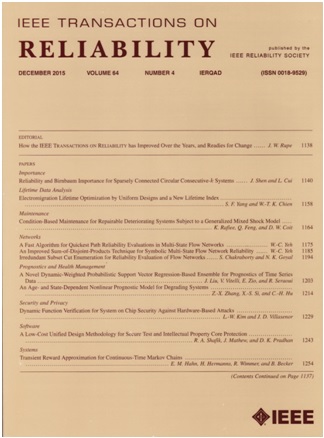
IEEE Transactions on Reliability is a refereed journal for the reliability and allied disciplines including, but not limited to, maintainability, physics of failure, life testing, prognostics, design and manufacture for reliability, reliability for systems of systems, network availability, mission success, warranty, safety, and various measures of effectiveness. Topics eligible for publication range from hardware to software, from materials to systems, from consumer and industrial devices to manufacturing plants, from individual items to networks, from techniques for making things better to ways of predicting and measuring behavior in the field. As an engineering subject that supports new and existing technologies, we constantly expand into new areas of the assurance sciences.




 京公网安备 11010802042870号
京ICP备2023020795号-1
京公网安备 11010802042870号
京ICP备2023020795号-1

 分享
分享
 求助内容:
求助内容: 应助结果提醒方式:
 扫码关注我们
