A Nanostructured Phenazine-Based Conjugated Microporous Polymer Hybrid Anode Boosts Power and Practicability of Organic-Manganese Hydronium-Ion Batteries
Rebecca Grieco, Alba Fombona-Pascual, Nagaraj Patil, Diego Alvan, Marta Liras, Rebeca Marcilla
{"title":"A Nanostructured Phenazine-Based Conjugated Microporous Polymer Hybrid Anode Boosts Power and Practicability of Organic-Manganese Hydronium-Ion Batteries","authors":"Rebecca Grieco, Alba Fombona-Pascual, Nagaraj Patil, Diego Alvan, Marta Liras, Rebeca Marcilla","doi":"10.1002/batt.202400346","DOIUrl":null,"url":null,"abstract":"<p>Organic-manganese hydronium-ion batteries are gaining attention for their safety, sustainability, and high rate capabilities. However, their electrochemical performance faces challenges due to organic active-materials’ inferior properties, including low conductivity and solubility, and limited content (<60 wt %) and loading (<2 mg cm<sup>−2</sup>) in the anode. To address this, we developed a high-performance battery using a phenazine-based conjugated microporous polymer hybrid anode (IEP-27-SR), utilizing hydronium-ion coordination/un-coordination chemistry. The IEP-27-SR anode features enhanced structural characteristics, such as a high BET specific surface area, mixed micro-/mesoporosity, nanostructurization, and hybridization, enabling rapid hydronium-ion mobility. The resulting IEP-27-SR//MnO<sub>2</sub>@GF full-cell demonstrates high capacity (101 mAh g<sup>−1</sup> at 2 C), excellent rate performance (41 mAh g<sup>−1</sup> at 100 C), ultrafast-charging capability (80 % charged in 18 seconds), and impressive cycling stability with 83 % capacity retention over 20400 cycles at 30 C with a regular polymer mass loading of 2 mg cm<sup>−2</sup>, despite its high content (80 wt %) in the anode. Moreover, it shows operability at low temperatures (63 mAh g<sup>−1</sup> at −40 °C). Most importantly, the full-cell with a high-mass-loading polymer anode (30 mg cm<sup>−2</sup>) achieves practically relevant areal capacity (3.4 mAh cm<sup>−2</sup> at 4 mA cm<sup>−2</sup>) and sustains 2 mAh cm<sup>−2</sup> under an extremely high areal current (50 mA cm<sup>−2</sup>). This breakthrough highlights the progress of organic hydronium-ion batteries, representing progress toward practical, sustainable energy storage solutions.</p>","PeriodicalId":132,"journal":{"name":"Batteries & Supercaps","volume":"8 2","pages":""},"PeriodicalIF":4.7000,"publicationDate":"2024-07-08","publicationTypes":"Journal Article","fieldsOfStudy":null,"isOpenAccess":false,"openAccessPdf":"https://onlinelibrary.wiley.com/doi/epdf/10.1002/batt.202400346","citationCount":"0","resultStr":null,"platform":"Semanticscholar","paperid":null,"PeriodicalName":"Batteries & Supercaps","FirstCategoryId":"88","ListUrlMain":"https://chemistry-europe.onlinelibrary.wiley.com/doi/10.1002/batt.202400346","RegionNum":4,"RegionCategory":"材料科学","ArticlePicture":[],"TitleCN":null,"AbstractTextCN":null,"PMCID":null,"EPubDate":"","PubModel":"","JCR":"Q2","JCRName":"ELECTROCHEMISTRY","Score":null,"Total":0}
引用次数: 0
Abstract
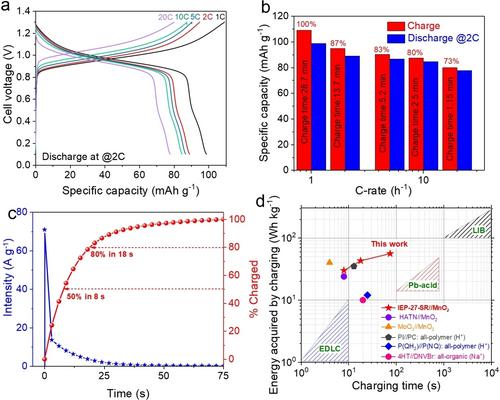
Organic-manganese hydronium-ion batteries are gaining attention for their safety, sustainability, and high rate capabilities. However, their electrochemical performance faces challenges due to organic active-materials’ inferior properties, including low conductivity and solubility, and limited content (<60 wt %) and loading (<2 mg cm−2) in the anode. To address this, we developed a high-performance battery using a phenazine-based conjugated microporous polymer hybrid anode (IEP-27-SR), utilizing hydronium-ion coordination/un-coordination chemistry. The IEP-27-SR anode features enhanced structural characteristics, such as a high BET specific surface area, mixed micro-/mesoporosity, nanostructurization, and hybridization, enabling rapid hydronium-ion mobility. The resulting IEP-27-SR//MnO2@GF full-cell demonstrates high capacity (101 mAh g−1 at 2 C), excellent rate performance (41 mAh g−1 at 100 C), ultrafast-charging capability (80 % charged in 18 seconds), and impressive cycling stability with 83 % capacity retention over 20400 cycles at 30 C with a regular polymer mass loading of 2 mg cm−2, despite its high content (80 wt %) in the anode. Moreover, it shows operability at low temperatures (63 mAh g−1 at −40 °C). Most importantly, the full-cell with a high-mass-loading polymer anode (30 mg cm−2) achieves practically relevant areal capacity (3.4 mAh cm−2 at 4 mA cm−2) and sustains 2 mAh cm−2 under an extremely high areal current (50 mA cm−2). This breakthrough highlights the progress of organic hydronium-ion batteries, representing progress toward practical, sustainable energy storage solutions.
期刊介绍:
Electrochemical energy storage devices play a transformative role in our societies. They have allowed the emergence of portable electronics devices, have triggered the resurgence of electric transportation and constitute key components in smart power grids. Batteries & Supercaps publishes international high-impact experimental and theoretical research on the fundamentals and applications of electrochemical energy storage. We support the scientific community to advance energy efficiency and sustainability.






 京公网安备 11010802042870号
京ICP备2023020795号-1
京公网安备 11010802042870号
京ICP备2023020795号-1

 分享
分享
 求助内容:
求助内容: 应助结果提醒方式:
 扫码关注我们
