Yongxia Wang, Jingjing Liu, Jiaxi Liu, Zhaodi Wang, Biyan Zhuang, Nengneng Xu, Xiangzhi Cui and Jinli Qiao
{"title":"Dual-carbon coupling modulated bimetallic sulfides as high-efficiency bifunctional oxygen electrocatalysts in a rechargeable Zn–air battery†","authors":"Yongxia Wang, Jingjing Liu, Jiaxi Liu, Zhaodi Wang, Biyan Zhuang, Nengneng Xu, Xiangzhi Cui and Jinli Qiao","doi":"10.1039/D4SE00793J","DOIUrl":null,"url":null,"abstract":"<p >The design and construction of high-efficiency carbon based non-precious metal electrocatalysts for oxygen reduction and oxygen evolution reactions (ORR and OER) with sluggish kinetics are of great importance but remain a big challenge. In this work, a 3D hybrid of bimetallic (Co/Fe) sulfide nanoparticles anchored on nitrogen-doped graphene and CNTs (Co<small><sub>0.2</sub></small>Fe<small><sub>0.6</sub></small>S<small><sub><em>x</em></sub></small>-Gra/CNT) is fabricated <em>via</em> a ball-milling assisted <em>in situ</em> pyrolysis process. Benefitting from the synergetic effects between the carbon matrix and metallic sulfides, the optimized Co<small><sub>0.2</sub></small>Fe<small><sub>0.6</sub></small>S<small><sub><em>x</em></sub></small>-Gra/CNT hybrid exhibits a high half-wave voltage up to 0.822 V for the ORR and a low overpotential of 540 mV at 10 mA cm<small><sup>−2</sup></small> for the OER, outperforming Co<small><sub>0.2</sub></small>Fe<small><sub>0.6</sub></small>S<small><sub><em>x</em></sub></small>-Gra and even a commercial Pt/C catalyst. Meanwhile, a home-made Zn–air battery with the hybrid as a cathode catalyst delivers a maximum power density up to 366 mW cm<small><sup>−2</sup></small>, along with a long-term charge and discharge stability at 10 mA cm<small><sup>−2</sup></small>. The excellent performances of the hybrid toward the ORR and OER are mainly attributed to the plentiful electron transfer channels provided by the 3D intertwined carbon matrix and enriched active sites derived from a dual-carbon coupling enhancement effect, which induce a change in the electronic structure and increase in the electron cloud density of the bimetallic sulfides and nitrogen dopant configuration. This work proves the importance of a carbon support to enhance the catalytic performance of non-precious metal-based catalysts and provides possibility of metal sulfides as bifunctional catalysts for the ORR/OER in a rechargeable Zn–air battery.</p>","PeriodicalId":104,"journal":{"name":"Sustainable Energy & Fuels","volume":" 16","pages":" 3610-3616"},"PeriodicalIF":4.6000,"publicationDate":"2024-07-09","publicationTypes":"Journal Article","fieldsOfStudy":null,"isOpenAccess":false,"openAccessPdf":"","citationCount":"0","resultStr":null,"platform":"Semanticscholar","paperid":null,"PeriodicalName":"Sustainable Energy & Fuels","FirstCategoryId":"88","ListUrlMain":"https://pubs.rsc.org/en/content/articlelanding/2024/se/d4se00793j","RegionNum":3,"RegionCategory":"材料科学","ArticlePicture":[],"TitleCN":null,"AbstractTextCN":null,"PMCID":null,"EPubDate":"","PubModel":"","JCR":"Q2","JCRName":"CHEMISTRY, PHYSICAL","Score":null,"Total":0}
引用次数: 0
Abstract
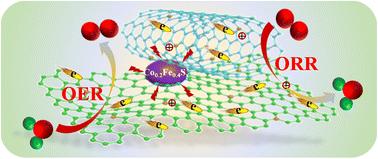
The design and construction of high-efficiency carbon based non-precious metal electrocatalysts for oxygen reduction and oxygen evolution reactions (ORR and OER) with sluggish kinetics are of great importance but remain a big challenge. In this work, a 3D hybrid of bimetallic (Co/Fe) sulfide nanoparticles anchored on nitrogen-doped graphene and CNTs (Co0.2Fe0.6Sx-Gra/CNT) is fabricated via a ball-milling assisted in situ pyrolysis process. Benefitting from the synergetic effects between the carbon matrix and metallic sulfides, the optimized Co0.2Fe0.6Sx-Gra/CNT hybrid exhibits a high half-wave voltage up to 0.822 V for the ORR and a low overpotential of 540 mV at 10 mA cm−2 for the OER, outperforming Co0.2Fe0.6Sx-Gra and even a commercial Pt/C catalyst. Meanwhile, a home-made Zn–air battery with the hybrid as a cathode catalyst delivers a maximum power density up to 366 mW cm−2, along with a long-term charge and discharge stability at 10 mA cm−2. The excellent performances of the hybrid toward the ORR and OER are mainly attributed to the plentiful electron transfer channels provided by the 3D intertwined carbon matrix and enriched active sites derived from a dual-carbon coupling enhancement effect, which induce a change in the electronic structure and increase in the electron cloud density of the bimetallic sulfides and nitrogen dopant configuration. This work proves the importance of a carbon support to enhance the catalytic performance of non-precious metal-based catalysts and provides possibility of metal sulfides as bifunctional catalysts for the ORR/OER in a rechargeable Zn–air battery.
期刊介绍:
Sustainable Energy & Fuels will publish research that contributes to the development of sustainable energy technologies with a particular emphasis on new and next-generation technologies.




 京公网安备 11010802042870号
京ICP备2023020795号-1
京公网安备 11010802042870号
京ICP备2023020795号-1

 分享
分享
 求助内容:
求助内容: 应助结果提醒方式:
 扫码关注我们
