{"title":"Electrosynthesis of urea by using Fe2O3 nanoparticles encapsulated in a conductive metal–organic framework","authors":"Da-Shuai Huang, Xiao-Feng Qiu, Jia-Run Huang, Min Mao, Lingmei Liu, Yu Han, Zhen-Hua Zhao, Pei-Qin Liao, Xiao-Ming Chen","doi":"10.1038/s44160-024-00603-8","DOIUrl":null,"url":null,"abstract":"The synthesis of urea by the electrochemical co-reduction of CO2 and nitrate is a crucial and challenging task. Catalysts typically suffer from either low Faradaic efficiency (FE) or inadequate current density, leading to a restricted yield rate of urea. Here we report ultrasmall γ-Fe2O3 nanoparticles (<2 nm) encapsulated in the pores of a conductive (40 S cm−1) metal–organic framework Ni-HITP (HITP = 2,3,6,7,10,11-hexaaminotriphenylene), resulting in a composite material, γ-Fe2O3@Ni-HITP. Under neutral conditions, γ-Fe2O3@Ni-HITP exhibited a state-of-art electrocatalytic performance for urea synthesis through the co-reduction of CO2 and nitrate in CO2-saturated 1 M KHCO3 and 0.1 M KNO3 aqueous solutions, achieving a FEurea of 67.2(6)%, a current density of −90 mA cm−2 and an high yield rate of $$20.4(2)\\,{\\mathrm{g}}\\,{\\mathrm{h}}^{-1}\\,{\\mathrm{g}}_{\\mathrm{cat}}^{-1}$$ (7.7(1) mg h−1 cm−2), which is about five times higher than the rates of previously reported catalysts. No degradation was observed over 150 h of continuous operation at such a high yield rate. Enlarging the electrode area by 125 times yielded about 1.05(4) g of high-purity urea over 8 h. A mechanistic study revealed that Fe(III) ions in the γ-Fe2O3 nanoparticles exhibit high activity, generating the key intermediates *NH2 and *COOH. Furthermore, pairs of adjacent Fe(III) ions in the γ-Fe2O3 nanoparticles can act as highly active catalytic sites for catalysing the C–N coupling between *NH2 and *COOH, resulting in the formation of the subsequent key intermediate *CONH2, thereby contributing to the exceptionally high performance of γ-Fe2O3@Ni-HITP for urea production. Small γ-Fe2O3 nanoparticles (<2 nm) encapsulated in the pores of a conductive metal–organic framework enable the efficient electrosynthesis of urea through the co-reduction of CO2 and nitrate under neutral conditions.","PeriodicalId":74251,"journal":{"name":"Nature synthesis","volume":"3 11","pages":"1404-1413"},"PeriodicalIF":20.0000,"publicationDate":"2024-07-10","publicationTypes":"Journal Article","fieldsOfStudy":null,"isOpenAccess":false,"openAccessPdf":"","citationCount":"0","resultStr":null,"platform":"Semanticscholar","paperid":null,"PeriodicalName":"Nature synthesis","FirstCategoryId":"1085","ListUrlMain":"https://www.nature.com/articles/s44160-024-00603-8","RegionNum":0,"RegionCategory":null,"ArticlePicture":[],"TitleCN":null,"AbstractTextCN":null,"PMCID":null,"EPubDate":"","PubModel":"","JCR":"0","JCRName":"CHEMISTRY, MULTIDISCIPLINARY","Score":null,"Total":0}
引用次数: 0
Abstract
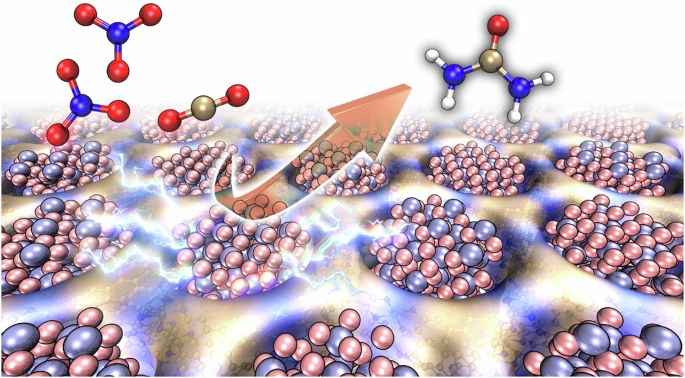
The synthesis of urea by the electrochemical co-reduction of CO2 and nitrate is a crucial and challenging task. Catalysts typically suffer from either low Faradaic efficiency (FE) or inadequate current density, leading to a restricted yield rate of urea. Here we report ultrasmall γ-Fe2O3 nanoparticles (<2 nm) encapsulated in the pores of a conductive (40 S cm−1) metal–organic framework Ni-HITP (HITP = 2,3,6,7,10,11-hexaaminotriphenylene), resulting in a composite material, γ-Fe2O3@Ni-HITP. Under neutral conditions, γ-Fe2O3@Ni-HITP exhibited a state-of-art electrocatalytic performance for urea synthesis through the co-reduction of CO2 and nitrate in CO2-saturated 1 M KHCO3 and 0.1 M KNO3 aqueous solutions, achieving a FEurea of 67.2(6)%, a current density of −90 mA cm−2 and an high yield rate of $$20.4(2)\,{\mathrm{g}}\,{\mathrm{h}}^{-1}\,{\mathrm{g}}_{\mathrm{cat}}^{-1}$$ (7.7(1) mg h−1 cm−2), which is about five times higher than the rates of previously reported catalysts. No degradation was observed over 150 h of continuous operation at such a high yield rate. Enlarging the electrode area by 125 times yielded about 1.05(4) g of high-purity urea over 8 h. A mechanistic study revealed that Fe(III) ions in the γ-Fe2O3 nanoparticles exhibit high activity, generating the key intermediates *NH2 and *COOH. Furthermore, pairs of adjacent Fe(III) ions in the γ-Fe2O3 nanoparticles can act as highly active catalytic sites for catalysing the C–N coupling between *NH2 and *COOH, resulting in the formation of the subsequent key intermediate *CONH2, thereby contributing to the exceptionally high performance of γ-Fe2O3@Ni-HITP for urea production. Small γ-Fe2O3 nanoparticles (<2 nm) encapsulated in the pores of a conductive metal–organic framework enable the efficient electrosynthesis of urea through the co-reduction of CO2 and nitrate under neutral conditions.



 京公网安备 11010802042870号
京ICP备2023020795号-1
京公网安备 11010802042870号
京ICP备2023020795号-1

 分享
分享

 求助内容:
求助内容: 应助结果提醒方式:
 扫码关注我们
