Emília Marques Brovini , Mariana de Oliveira , Andressa Rezende Pereira , Maria Elvira Poleti Martucci , Sérgio Francisco de Aquino
{"title":"Removal of acephate and methamidophos from water: Coagulation and adsorptive treatment approaches","authors":"Emília Marques Brovini , Mariana de Oliveira , Andressa Rezende Pereira , Maria Elvira Poleti Martucci , Sérgio Francisco de Aquino","doi":"10.1016/j.envpol.2024.124514","DOIUrl":null,"url":null,"abstract":"<div><p>Pesticides has transformed the agricultural industry, primarily by enhancing productivity. However, the indiscriminate use of such compounds can adversely affect human health and disrupt ecosystem balance. Limited knowledge exists regarding the removal of these compounds from water, particularly for organophosphate pesticides when employing conventional treatment technologies. Therefore, this study aimed to assess the removal of acephate (ACE) and methamidophos (MET) - considered priority pesticides in Brazil - from waters with high and low turbidity during the clarification process carried out with aluminum sulfate (AS) and ferric chloride (FC), either alone or combined with powdered activated carbon (PAC) adsorption. All water samples were submitted to solid phase extraction (SPE C18 cartridges) prior to acephate and methamidophos analysis by HPLC MS/MS. The clarification process with either AS or FC coagulant did not efficiently remove acephate or methamidophos and maximum average removal (27 %) was observed with waters of high turbidity when using ferric chloride as coagulant. Addition of mineral PAC was also ineffective for removing both pesticides. However, the use of vegetable PAC (10 mg/L) resulted in better removal percentages, up to 80%, but only for methamidophos. The limited removal rates were attributed to the high hydrophilicity of acephate and methamidophos, along with their neutral charge at coagulation pH. These factors hinder the interaction of such organophosphorus pesticides with the flocs formed during coagulation as well as with PAC surface.</p></div>","PeriodicalId":311,"journal":{"name":"Environmental Pollution","volume":"358 ","pages":"Article 124514"},"PeriodicalIF":7.3000,"publicationDate":"2024-10-01","publicationTypes":"Journal Article","fieldsOfStudy":null,"isOpenAccess":false,"openAccessPdf":"","citationCount":"0","resultStr":null,"platform":"Semanticscholar","paperid":null,"PeriodicalName":"Environmental Pollution","FirstCategoryId":"93","ListUrlMain":"https://www.sciencedirect.com/science/article/pii/S0269749124012284","RegionNum":2,"RegionCategory":"环境科学与生态学","ArticlePicture":[],"TitleCN":null,"AbstractTextCN":null,"PMCID":null,"EPubDate":"2024/7/8 0:00:00","PubModel":"Epub","JCR":"Q1","JCRName":"ENVIRONMENTAL SCIENCES","Score":null,"Total":0}
引用次数: 0
Abstract
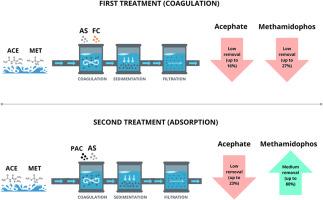
Pesticides has transformed the agricultural industry, primarily by enhancing productivity. However, the indiscriminate use of such compounds can adversely affect human health and disrupt ecosystem balance. Limited knowledge exists regarding the removal of these compounds from water, particularly for organophosphate pesticides when employing conventional treatment technologies. Therefore, this study aimed to assess the removal of acephate (ACE) and methamidophos (MET) - considered priority pesticides in Brazil - from waters with high and low turbidity during the clarification process carried out with aluminum sulfate (AS) and ferric chloride (FC), either alone or combined with powdered activated carbon (PAC) adsorption. All water samples were submitted to solid phase extraction (SPE C18 cartridges) prior to acephate and methamidophos analysis by HPLC MS/MS. The clarification process with either AS or FC coagulant did not efficiently remove acephate or methamidophos and maximum average removal (27 %) was observed with waters of high turbidity when using ferric chloride as coagulant. Addition of mineral PAC was also ineffective for removing both pesticides. However, the use of vegetable PAC (10 mg/L) resulted in better removal percentages, up to 80%, but only for methamidophos. The limited removal rates were attributed to the high hydrophilicity of acephate and methamidophos, along with their neutral charge at coagulation pH. These factors hinder the interaction of such organophosphorus pesticides with the flocs formed during coagulation as well as with PAC surface.
期刊介绍:
Environmental Pollution is an international peer-reviewed journal that publishes high-quality research papers and review articles covering all aspects of environmental pollution and its impacts on ecosystems and human health.
Subject areas include, but are not limited to:
• Sources and occurrences of pollutants that are clearly defined and measured in environmental compartments, food and food-related items, and human bodies;
• Interlinks between contaminant exposure and biological, ecological, and human health effects, including those of climate change;
• Contaminants of emerging concerns (including but not limited to antibiotic resistant microorganisms or genes, microplastics/nanoplastics, electronic wastes, light, and noise) and/or their biological, ecological, or human health effects;
• Laboratory and field studies on the remediation/mitigation of environmental pollution via new techniques and with clear links to biological, ecological, or human health effects;
• Modeling of pollution processes, patterns, or trends that is of clear environmental and/or human health interest;
• New techniques that measure and examine environmental occurrences, transport, behavior, and effects of pollutants within the environment or the laboratory, provided that they can be clearly used to address problems within regional or global environmental compartments.




 京公网安备 11010802042870号
京ICP备2023020795号-1
京公网安备 11010802042870号
京ICP备2023020795号-1

 分享
分享
 求助内容:
求助内容: 应助结果提醒方式:
 扫码关注我们
