{"title":"Micropropagation of <i>Dipcadi montanum</i> (Dalz.) Baker (<i>Asparagaceae</i>): a rare scapigerous herb.","authors":"Sautrik Basu, Emadul Islam, Debraj Chakraborty","doi":"10.5114/bta.2024.139755","DOIUrl":null,"url":null,"abstract":"<p><p><i>Dipcadi montanum</i> (Dalz.) Baker (<i>Asparagaceae</i>) is a rare scapigerous herb endemic to the Western Ghats, a global biodiversity hotspot running parallel to the western coast of India. This study reports the development of a reproducible protocol for mass propagation of this underutilized geophyte using bulb scale and immature leaf base explants. Miniature bulblets were successfully induced from both types of explants after 4 and 8 weeks of culture on full-strength semisolid MS basal medium fortified with 3% sucrose and varying levels of BAP (4.4-17.7 μM) and TDZ (4.5-18.1 μM). The addition of 2.7 μM NAA further enhanced the rate of microbulb induction. Rooting of the 8-week-old bulblets, obtained from both explants, was achieved with more than 90% efficiency on liquid as well as agar-gelled half-strength MS basal medium fortified with varying levels of IBA (2.46-9.84 μM) and NAA (2.68-10.74 μM), with or without 2.32 μM Kinetin. More than 95% of the rooted plants survived the initial acclimatization process under controlled ex-vitro conditions, and a survival rate of over 80% was recorded after 4 weeks of transfer to greenhouse conditions. After a brief dormancy, the regenerants resumed growth in the postmonsoon season and exhibited morphological resemblance to the donor plant. Comparative cytological analysis between the donor and 15 randomly selected regenerants revealed a stable somatic count of 2<i>n</i> = 20.</p>","PeriodicalId":94371,"journal":{"name":"Biotechnologia","volume":"105 2","pages":"159-167"},"PeriodicalIF":0.0000,"publicationDate":"2024-06-25","publicationTypes":"Journal Article","fieldsOfStudy":null,"isOpenAccess":false,"openAccessPdf":"https://www.ncbi.nlm.nih.gov/pmc/articles/PMC11231995/pdf/","citationCount":"0","resultStr":null,"platform":"Semanticscholar","paperid":null,"PeriodicalName":"Biotechnologia","FirstCategoryId":"1085","ListUrlMain":"https://doi.org/10.5114/bta.2024.139755","RegionNum":0,"RegionCategory":null,"ArticlePicture":[],"TitleCN":null,"AbstractTextCN":null,"PMCID":null,"EPubDate":"2024/1/1 0:00:00","PubModel":"eCollection","JCR":"","JCRName":"","Score":null,"Total":0}
引用次数: 0
Abstract
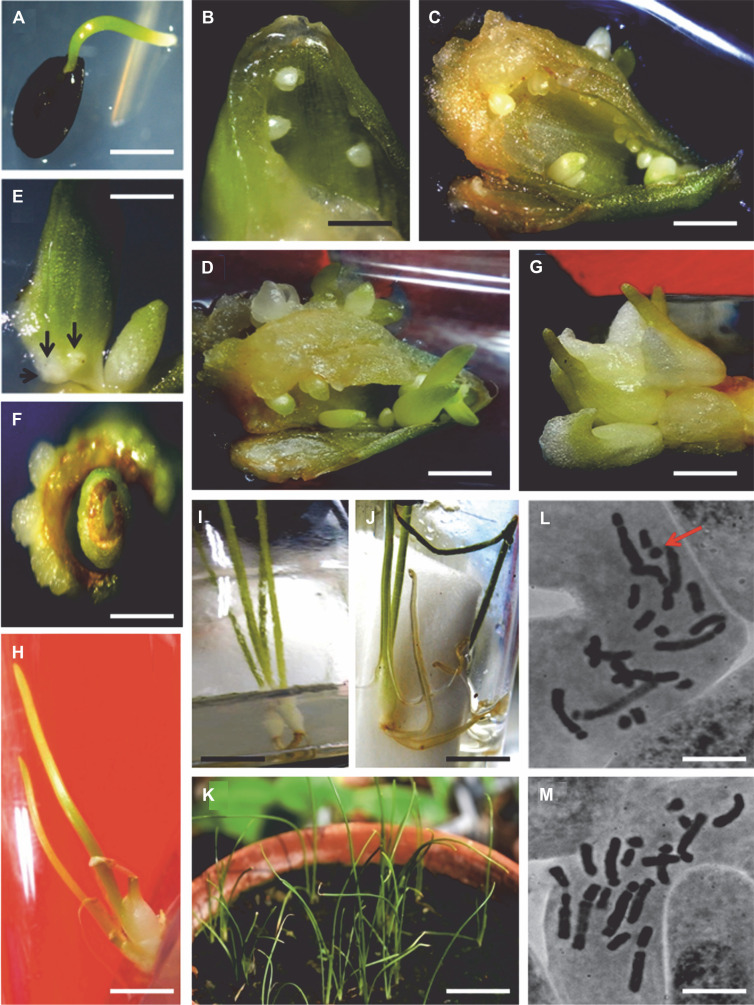
Dipcadi montanum (Dalz.) Baker (Asparagaceae) is a rare scapigerous herb endemic to the Western Ghats, a global biodiversity hotspot running parallel to the western coast of India. This study reports the development of a reproducible protocol for mass propagation of this underutilized geophyte using bulb scale and immature leaf base explants. Miniature bulblets were successfully induced from both types of explants after 4 and 8 weeks of culture on full-strength semisolid MS basal medium fortified with 3% sucrose and varying levels of BAP (4.4-17.7 μM) and TDZ (4.5-18.1 μM). The addition of 2.7 μM NAA further enhanced the rate of microbulb induction. Rooting of the 8-week-old bulblets, obtained from both explants, was achieved with more than 90% efficiency on liquid as well as agar-gelled half-strength MS basal medium fortified with varying levels of IBA (2.46-9.84 μM) and NAA (2.68-10.74 μM), with or without 2.32 μM Kinetin. More than 95% of the rooted plants survived the initial acclimatization process under controlled ex-vitro conditions, and a survival rate of over 80% was recorded after 4 weeks of transfer to greenhouse conditions. After a brief dormancy, the regenerants resumed growth in the postmonsoon season and exhibited morphological resemblance to the donor plant. Comparative cytological analysis between the donor and 15 randomly selected regenerants revealed a stable somatic count of 2n = 20.



 京公网安备 11010802042870号
京ICP备2023020795号-1
京公网安备 11010802042870号
京ICP备2023020795号-1

 分享
分享

 求助内容:
求助内容: 应助结果提醒方式:
 扫码关注我们
