Peng-Fei Yang, Han-Tong Zhao, Xiao-Yi Chen, Wei Shu
{"title":"Enantioselective alkyl–alkyl coupling by Ni-catalysed asymmetric cross-hydrodimerization of alkenes","authors":"Peng-Fei Yang, Han-Tong Zhao, Xiao-Yi Chen, Wei Shu","doi":"10.1038/s44160-024-00609-2","DOIUrl":null,"url":null,"abstract":"Saturated tertiary stereogenic carbon centres are common in small molecules and organic materials. Transition-metal-catalysed asymmetric alkyl–alkyl bond formation processes represent contemporary techniques for the straightforward and efficient construction of saturated tertiary stereogenic carbon centres. However, reaction modes for asymmetric alkyl–alkyl bond formation between sp3-hybridized carbon atoms, C(sp3)–C(sp3), are limited yet highly desirable. Here a mode for asymmetric alkyl–alkyl bond formation enabled by Ni-catalysed asymmetric alkyl–alkyl cross-coupling between alkenes has been developed to construct tertiary stereogenic carbon centres. Ni-catalysed asymmetric cross-hydrodimerization of N-acyl enamines and unactivated alkenes enables head-to-tail regioselectivity and excellent levels of chemo- and enantioselectivity. Notably, the reaction proceeds in the presence of both reducing and oxidizing reagents, rendering alkenes as the sole precursors to forge enantioselective alkyl–alkyl bonds. The exclusive head-to-tail cross-hydrodimerization of distinct alkenes opens the way to access saturated tertiary stereogenic carbon centres from alkenes. Methods for asymmetric alkyl–alkyl bond formation between sp3-hybridized carbon atoms, C(sp3)–C(sp3), are limited yet highly desirable. Now an approach for asymmetric alkyl–alkyl bond formation by Ni-catalysed cross-coupling between alkenes has been developed to construct tertiary stereogenic carbon centres with head-to-tail regioselectivity and excellent chemo- and enantioselectivity.","PeriodicalId":74251,"journal":{"name":"Nature synthesis","volume":"3 11","pages":"1360-1368"},"PeriodicalIF":20.0000,"publicationDate":"2024-07-11","publicationTypes":"Journal Article","fieldsOfStudy":null,"isOpenAccess":false,"openAccessPdf":"","citationCount":"0","resultStr":null,"platform":"Semanticscholar","paperid":null,"PeriodicalName":"Nature synthesis","FirstCategoryId":"1085","ListUrlMain":"https://www.nature.com/articles/s44160-024-00609-2","RegionNum":0,"RegionCategory":null,"ArticlePicture":[],"TitleCN":null,"AbstractTextCN":null,"PMCID":null,"EPubDate":"","PubModel":"","JCR":"0","JCRName":"CHEMISTRY, MULTIDISCIPLINARY","Score":null,"Total":0}
引用次数: 0
Abstract
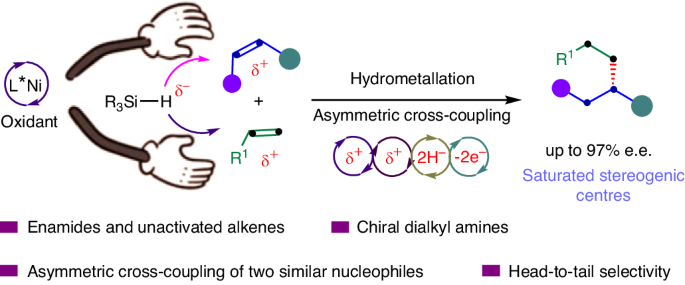
Saturated tertiary stereogenic carbon centres are common in small molecules and organic materials. Transition-metal-catalysed asymmetric alkyl–alkyl bond formation processes represent contemporary techniques for the straightforward and efficient construction of saturated tertiary stereogenic carbon centres. However, reaction modes for asymmetric alkyl–alkyl bond formation between sp3-hybridized carbon atoms, C(sp3)–C(sp3), are limited yet highly desirable. Here a mode for asymmetric alkyl–alkyl bond formation enabled by Ni-catalysed asymmetric alkyl–alkyl cross-coupling between alkenes has been developed to construct tertiary stereogenic carbon centres. Ni-catalysed asymmetric cross-hydrodimerization of N-acyl enamines and unactivated alkenes enables head-to-tail regioselectivity and excellent levels of chemo- and enantioselectivity. Notably, the reaction proceeds in the presence of both reducing and oxidizing reagents, rendering alkenes as the sole precursors to forge enantioselective alkyl–alkyl bonds. The exclusive head-to-tail cross-hydrodimerization of distinct alkenes opens the way to access saturated tertiary stereogenic carbon centres from alkenes. Methods for asymmetric alkyl–alkyl bond formation between sp3-hybridized carbon atoms, C(sp3)–C(sp3), are limited yet highly desirable. Now an approach for asymmetric alkyl–alkyl bond formation by Ni-catalysed cross-coupling between alkenes has been developed to construct tertiary stereogenic carbon centres with head-to-tail regioselectivity and excellent chemo- and enantioselectivity.



 京公网安备 11010802042870号
京ICP备2023020795号-1
京公网安备 11010802042870号
京ICP备2023020795号-1

 分享
分享

 求助内容:
求助内容: 应助结果提醒方式:
 扫码关注我们
