Karin B. Fieten, Marieke T. Drijver-Messelink, Rolf Wolters, Bart Hilvering, Susanne J.H. Vijverberg, Els J. Weersink
{"title":"Alpine altitude climate treatment improves asthma control, irrespective of biologics use","authors":"Karin B. Fieten, Marieke T. Drijver-Messelink, Rolf Wolters, Bart Hilvering, Susanne J.H. Vijverberg, Els J. Weersink","doi":"10.1111/all.16233","DOIUrl":null,"url":null,"abstract":"<p>Severe asthma management remains challenging, despite comprehensive asthma treatment guidelines, the availability of specialized severe asthma clinics and several biologics blocking Type 2 inflammation.<span><sup>1, 2</sup></span> Recently our specialized clinic has seen an increase in patients with a limited response to biologics. For these patients, OCS or non-pharmacological add-on interventions, such as alpine altitude climate treatment (AACT), are currently the only remaining treatment options.<span><sup>3</sup></span></p><p>Therefore, this prospective cohort study aims to evaluate whether the effectiveness of AACT on asthma control and systemic corticosteroid use is different between patients with severe asthma who currently, previously, or never used biologics.</p><p>Adult patients diagnosed with severe uncontrolled asthma, according to GINA guidelines, referred to the Dutch Asthma Centre Davos in Switzerland for AACT between January 2018 and December 2022, were included. Data were collected as part of usual care and exempt from approval by a medical ethics committee, according to Dutch law (WMO). The multidisciplinary pulmonary rehabilitation program contains an extensive patient assessment to determine the pulmonary, extrapulmonary and behavioral treatable traits. Patients received medical and behavioral interventions, personalized exercise programs, extensive patient education, and a personalized asthma action plan. Primary outcome was asthma control (ACQ6 score) after AACT. Collected data included age, sex, treatment duration, use of biologics or OCS, asthma control, asthma related quality of life, sino-nasal related outcomes, exercise capacity, FEV1, FeNO, and blood eosinophils. Differences between the groups were compared using Kruskal–Wallis tests or chi-squared tests, changes in clinical outcomes were assessed with Wilcoxon signed-rank tests.</p><p>Between 2018 and 2022, 375 severe asthma patients completed AACT in our clinic (Figure S1). Prior biologic use is no prerequisite for referral to AACT; however, 26% of our study population were current biologic users, while 27% previously used biologics. Patients who never used biologics were significantly different on baseline, with better asthma control, less OCS use, and more prevalent non T2 inflammation (Table S1). AACT resulted in similar improved asthma outcomes in all groups, reaching more than double the MCID for ACQ and AQLQ, as well as significant improvements in other outcomes (Figure 1, Table S2). Significant differences between the groups after AACT concerned inflammatory parameters FeNO and blood eosinophils. Blood eosinophils decreased only in the group that never used biologics, unlike FeNO which decreased in all three groups. Reduction of T2 inflammation is a hallmark of AACT and has been demonstrated repeatedly.<span><sup>3</sup></span> Several mechanisms have been hypothesized to contribute to the observed changes during AACT.<span><sup>3</sup></span></p><p>Corticosteroid sparing treatment strategies are important for patients and address a major unmet need.<span><sup>4</sup></span> Stopping OCS maintenance after AACT was possible in 52% of patients, significantly reducing OCS dose (≥2.5 mg per day) in another 32% of patients, irrespective of current or previous biologic use (Table 1). Adrenal insufficiency was present in 13% of our study population and may partly explain the need to continue maintenance OCS. Compared to a regular pulmonary rehabilitation program, AACT results in more successful stopping and tapering of OCS for most patients.<span><sup>5</sup></span> However, further studies are needed to explore the underlying mechanisms and to assess long-term OCS reduction.</p><p>This unique study used standardized real-world data collection over a 5-year period, contributing to effective treatment evaluation, but has inherent limitations.<span><sup>6</sup></span> Our study population is a relevant group of patients with severe uncontrolled asthma, despite using biologics or ineligible for biologics, who need effective interventions to improve asthma control.</p><p>To summarize, this study demonstrates that multidisciplinary pulmonary rehabilitation in the alpine climate at altitude (AACT) is an effective non-pharmacological add-on corticosteroid sparing treatment option that results in improved asthma control for patients with severe uncontrolled asthma, irrespective of biologics use.</p><p>KF designed the study, analyzed the data and drafted the manuscript. MD and RW contributed to data collection. EW provided supervision. All authors contributed to and approved the final version of the manuscript.</p><p>None.</p><p>The authors report no conflict of interest.</p>","PeriodicalId":122,"journal":{"name":"Allergy","volume":"79 10","pages":"2864-2867"},"PeriodicalIF":12.0000,"publicationDate":"2024-07-12","publicationTypes":"Journal Article","fieldsOfStudy":null,"isOpenAccess":false,"openAccessPdf":"https://onlinelibrary.wiley.com/doi/epdf/10.1111/all.16233","citationCount":"0","resultStr":null,"platform":"Semanticscholar","paperid":null,"PeriodicalName":"Allergy","FirstCategoryId":"3","ListUrlMain":"https://onlinelibrary.wiley.com/doi/10.1111/all.16233","RegionNum":1,"RegionCategory":"医学","ArticlePicture":[],"TitleCN":null,"AbstractTextCN":null,"PMCID":null,"EPubDate":"","PubModel":"","JCR":"Q1","JCRName":"ALLERGY","Score":null,"Total":0}
引用次数: 0
Abstract
Severe asthma management remains challenging, despite comprehensive asthma treatment guidelines, the availability of specialized severe asthma clinics and several biologics blocking Type 2 inflammation.1, 2 Recently our specialized clinic has seen an increase in patients with a limited response to biologics. For these patients, OCS or non-pharmacological add-on interventions, such as alpine altitude climate treatment (AACT), are currently the only remaining treatment options.3
Therefore, this prospective cohort study aims to evaluate whether the effectiveness of AACT on asthma control and systemic corticosteroid use is different between patients with severe asthma who currently, previously, or never used biologics.
Adult patients diagnosed with severe uncontrolled asthma, according to GINA guidelines, referred to the Dutch Asthma Centre Davos in Switzerland for AACT between January 2018 and December 2022, were included. Data were collected as part of usual care and exempt from approval by a medical ethics committee, according to Dutch law (WMO). The multidisciplinary pulmonary rehabilitation program contains an extensive patient assessment to determine the pulmonary, extrapulmonary and behavioral treatable traits. Patients received medical and behavioral interventions, personalized exercise programs, extensive patient education, and a personalized asthma action plan. Primary outcome was asthma control (ACQ6 score) after AACT. Collected data included age, sex, treatment duration, use of biologics or OCS, asthma control, asthma related quality of life, sino-nasal related outcomes, exercise capacity, FEV1, FeNO, and blood eosinophils. Differences between the groups were compared using Kruskal–Wallis tests or chi-squared tests, changes in clinical outcomes were assessed with Wilcoxon signed-rank tests.
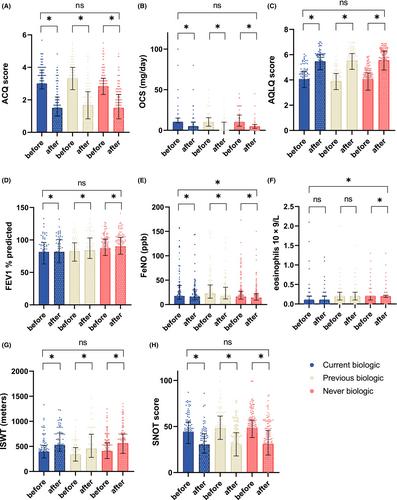
Between 2018 and 2022, 375 severe asthma patients completed AACT in our clinic (Figure S1). Prior biologic use is no prerequisite for referral to AACT; however, 26% of our study population were current biologic users, while 27% previously used biologics. Patients who never used biologics were significantly different on baseline, with better asthma control, less OCS use, and more prevalent non T2 inflammation (Table S1). AACT resulted in similar improved asthma outcomes in all groups, reaching more than double the MCID for ACQ and AQLQ, as well as significant improvements in other outcomes (Figure 1, Table S2). Significant differences between the groups after AACT concerned inflammatory parameters FeNO and blood eosinophils. Blood eosinophils decreased only in the group that never used biologics, unlike FeNO which decreased in all three groups. Reduction of T2 inflammation is a hallmark of AACT and has been demonstrated repeatedly.3 Several mechanisms have been hypothesized to contribute to the observed changes during AACT.3
Corticosteroid sparing treatment strategies are important for patients and address a major unmet need.4 Stopping OCS maintenance after AACT was possible in 52% of patients, significantly reducing OCS dose (≥2.5 mg per day) in another 32% of patients, irrespective of current or previous biologic use (Table 1). Adrenal insufficiency was present in 13% of our study population and may partly explain the need to continue maintenance OCS. Compared to a regular pulmonary rehabilitation program, AACT results in more successful stopping and tapering of OCS for most patients.5 However, further studies are needed to explore the underlying mechanisms and to assess long-term OCS reduction.
This unique study used standardized real-world data collection over a 5-year period, contributing to effective treatment evaluation, but has inherent limitations.6 Our study population is a relevant group of patients with severe uncontrolled asthma, despite using biologics or ineligible for biologics, who need effective interventions to improve asthma control.
To summarize, this study demonstrates that multidisciplinary pulmonary rehabilitation in the alpine climate at altitude (AACT) is an effective non-pharmacological add-on corticosteroid sparing treatment option that results in improved asthma control for patients with severe uncontrolled asthma, irrespective of biologics use.
KF designed the study, analyzed the data and drafted the manuscript. MD and RW contributed to data collection. EW provided supervision. All authors contributed to and approved the final version of the manuscript.
期刊介绍:
Allergy is an international and multidisciplinary journal that aims to advance, impact, and communicate all aspects of the discipline of Allergy/Immunology. It publishes original articles, reviews, position papers, guidelines, editorials, news and commentaries, letters to the editors, and correspondences. The journal accepts articles based on their scientific merit and quality.
Allergy seeks to maintain contact between basic and clinical Allergy/Immunology and encourages contributions from contributors and readers from all countries. In addition to its publication, Allergy also provides abstracting and indexing information. Some of the databases that include Allergy abstracts are Abstracts on Hygiene & Communicable Disease, Academic Search Alumni Edition, AgBiotech News & Information, AGRICOLA Database, Biological Abstracts, PubMed Dietary Supplement Subset, and Global Health, among others.



 京公网安备 11010802042870号
京ICP备2023020795号-1
京公网安备 11010802042870号
京ICP备2023020795号-1

 分享
分享
 求助内容:
求助内容: 应助结果提醒方式:
 扫码关注我们
